Organizations across all industries are undertaking "Digital Transformation" projects. But, what exactly is it? And, are they doing it right?
At its core, Digital Transformation is driven by the tangible shift in the role of technology within an organization. No longer as purely a support function that enables business processes, technology is now capable of much more. Technology now allows for new, innovative business models (e.g. XaaS), drives sales growth, and can even be a source of Competitive Advantage.
There are numerous emerging technology trends that drive Digital Transformation. Notable ones include Robotic Process Automation (RPA), Artificial Intelligence (namely Machine Learning), Mobile, Internet of Things (IoT), Cybersecurity, Big Data & Analytics, Cloud, Social Media, Blockchain, and so forth. The applicability of technology is largely dependent on the industry and organization.
With these technology trends, businesses are armed with the capability to fully digitize, transform, and grow their organizations. These technologies, in fact, mobilize 8 levers to Digital Transformation—spanning both Growth (business drivers) and Operational Improvement (business enablers). These 8 levers are listed and depicted below; and are at the core of LearnPPT Consulting's approach to Digital Transformation Strategy.
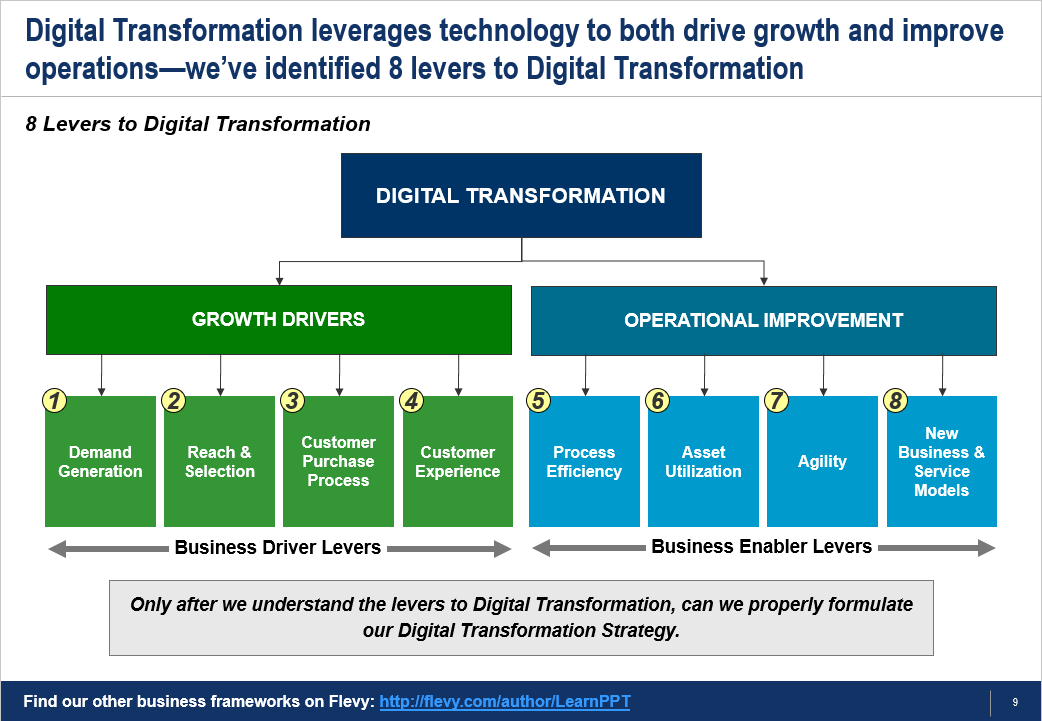
Let's take a deeper look into the 4 levers that drive growth for the organization.
145-slide PowerPoint
$89.00
$89.00 | 145-slides | Best for: Transformation leads and CIOs building phased digital roadmaps, maturity assessments, and execution templates.
EDITOR'S REVIEW
This deck stands out for its 100+ slide PowerPoint and an eight-lever Growth and Operational Improvement framework, paired with an integrated Digital Maturity Assessment, making it unusually actionable for a digital strategy project. The package includes the Digital Maturity Assessment across Customer Experience, Operations, and Information & Technology, plus templates and an appendix featuring frameworks like McKinsey’s Customer Decision Journey and Accenture’s Nonstop Customer Experience Model. It's particularly valuable for transformation leads and CIOs building phased roadmaps who need a quantified maturity view and ready-to-use materials to drive execution. [Learn more]
206-slide PowerPoint
$60.00
$60.00 | 206-slides | Best for: CIOs and transformation leads planning enterprise change with emphasis on people, readiness, and change management
EDITOR'S REVIEW
This deck stands out by expanding to 206 slides and explicitly centering people and change management as critical drivers of digital transformation. Among the new content are dedicated slides on Why People are the Critical Factor and The Value of Change Management, supported by research from multiple leading voices in the space. This framework is best used by CIOs and transformation leads who need a reference to align digital initiatives with readiness, culture, and talent considerations rather than treating technology as the sole driver. [Learn more]
153-slide PowerPoint
$89.00
$89.00 | 153-slides | Best for: Executives and transformation leads planning company-wide digital strategy with phased roadmap and capability assessment
EDITOR'S REVIEW
This deck stands out by mapping a four-phase digital transformation journey to twelve concrete steps and pairing it with a Digital Mastery Self-Assessment, keeping emphasis on leadership and governance rather than technology alone. It centers on Digital Darwinism as a driver of customer behavior change and offers practical guidance on framing the challenge, focusing investment, and mobilizing the organization to sustain the transition. It’s particularly helpful for executives and transformation leads planning a company-wide digital program that benefits from a structured roadmap to guide governance, funding, and behavior change. [Learn more]
35-slide PowerPoint
$29.00
$29.00 | 35-slides | Best for: Digital transformation leaders and CIOs orchestrating enterprise programs across strategy, customer journey, RPA, and analytics
EDITOR'S REVIEW
This deck distinguishes itself by pairing a holistic six-building-block framework with ready-to-use slide templates, turning digital transformation theory into actionable program design. The 6 blocks are Strategy and Innovation, Customer Decision Journey, RPA, Organization, Technology, and Big Data and Analytics, providing a concrete framework that cuts across people, process, and technology. It’s particularly valuable for transformation program leaders and CIOs orchestrating enterprise initiatives from strategy through analytics, offering a structured blueprint for execution and stakeholder alignment. [Learn more]
108-slide PowerPoint
$79.00
$79.00 | 108-slides | Best for: HR leaders and change consultants planning people-focused digital transformations during readiness, workshops, and training phases
EDITOR'S REVIEW
This deck foregrounds the people side of digital transformation, moving beyond tech deployment to emphasize a company-wide cultural fit built on design-thinking principles and human-centered design. Among its concrete tools, it weaves in established change-management models such as the McKinsey 7-S Framework, Lencioni's Five Dysfunctions of a Team, and Tuckman's Team Development, plus practical elements like empathy mapping and customer journey analysis. This toolkit is best leveraged by HR leaders and change practitioners during readiness, workshops, and training phases to build the cultural foundations that underlie successful digital initiatives. [Learn more]
91-slide PowerPoint
$69.00
$69.00 | 91-slides | Best for: Digital transformation leaders and consultants preparing strategy roadmaps, maturity assessments, and stakeholder presentations
EDITOR'S REVIEW
This deck stands out by consolidating 20 digital transformation frameworks and templates into a single, presentation-ready collection, enabling quick side-by-side comparisons for strategy teams. A concrete inclusion is IDC's MaturityScape for assessing organizational digital maturity. It’s most valuable to digital transformation leads and consultants crafting strategy roadmaps and stakeholder decks, and it can also serve as visual support in classroom sessions, though it’s intended as a supplementary resource rather than a stand-alone curriculum. [Learn more]
27-slide PowerPoint
$29.00
$29.00 | 27-slides | Best for: Executives designing governance for a portfolio of digital initiatives needing decision rights and KPI alignment
EDITOR'S REVIEW
This deck rests on a study of more than 100 companies and 55 digital executives, crystallizing governance into 7 key principles that tie digital initiatives to outcomes. It complements the principles with practical templates and tools, including a fit-for-purpose mapping system and scenario analysis, plus slide templates you can adapt for your own presentations. The resource is especially helpful for senior leaders tasked with balancing flexibility and consistency across a diverse digital portfolio, clarifying decision rights and how success is measured. [Learn more]
81-slide PowerPoint
$59.00
$59.00 | 81-slides | Best for: CIOs and digital transformation leads building an integrated ecosystem roadmap and governance.
EDITOR'S REVIEW
This deck stands out by tying a six-phase implementation path to a four-ecosystem model—Customer Solutions, Operations, Technology, and People—and embedding governance into each stage. It couples this framework with a four-level Digital Maturity Model (Digital Beginner to Digital Leader) and notes that Asia Pacific leads in digital advancement, with 19% categorized as Digital Leaders. This deck is especially valuable for CIOs and transformation programs seeking to develop an integrated ecosystem concept and governance model, guiding how to orchestrate partnerships and internal capabilities across the 4 ecosystems. [Learn more]
21-slide PowerPoint
$29.00
$29.00 | 21-slides | Best for: Digital transformation leads and strategy teams quantifying value and prioritizing cross-functional digital investments
EDITOR'S REVIEW
This deck stands out by anchoring Digital Transformation value creation in a three-horizon framework—Digital Norm, Digital Storm, and Digital Form—integrated with a Digital Value Chain analysis to show where impact actually comes from. It includes practical presentation templates and illustrates how Big Data and mobile tech can be leveraged to drive efficiency and customer engagement across functions. It is most useful for strategy leads and cross-functional portfolio teams seeking to quantify value across the entire organization and align investments accordingly. [Learn more]
41-slide PowerPoint
$49.00
$49.00 | 41-slides | Best for: Operations and IT leaders prioritizing cross-functional automation and digital transformation roadmaps post process assessment
EDITOR'S REVIEW
This deck stands out by packaging a six-workstream Process Automation & Digitalization Assessment into a practical PowerPoint that translates findings into an actionable roadmap. It evaluates over 150 items across 6 workstreams—Process Mapping & Analysis; Technology Infrastructure; Automation Opportunities; Digital Transformation; Data Management, Governance, & Compliance; and People and Change Management—and includes a structured checklist with Task, Question, Verification, and Deliverable to guide tailoring. This deck is especially helpful for cross-functional teams seeking a prioritized automation roadmap and a pragmatic implementation plan aligned with business goals. [Learn more]
1. Demand Generation
Emerging technologies, particularly Social Media (and Social Media Marketing), are facilitating Demand Generation by building awareness and brand interest. With an increasing number of customer touch points and ability to collect and unify customer data across these various touch points, we are better able to understand our customers and their interests—leading towards customer "micro-segmentation."
Likewise, advertising platforms (as they, too, are collecting more and more customer data) also allow for more targeted ads. You can reach consumers by demographics, behavior, location, interests, and so forth.
Furthermore, ad platforms, such as Google and Meta, leverage Machine Learning algorithms to analyze large amounts of data about users and their behaviors. This allows the system to identify patterns and connections that can be used to target ads more effectively. For example, the system might use data on a user's previous searches, purchases, and other online activities to determine which ads are most likely to be relevant and engaging to that user. Typically, the more data the algorithm has been trained, the more accurate the results. By using Machine Learning to improve ad targeting, these advertising platforms help organizations reach the right audiences and maximize the effectiveness of their ad campaigns.
3. Customer Experience (CX)
Prior to the Internet era, customers had limited interactions with a company—e.g., retail salesman, telephone customer service. With emerging technologies—namely, Social Media, Mobility, Internet of Things—the number of customer touch points has increased dramatically. This is both an increase in number of ways for the customer to reach the company and an increase to the number of people within a company to reach the customer.
Companies now have the ability to constantly engage with the customer. In fact, this has become the customer's expectation—to be able to reach a business at all hours and receive a prompt response.
Thus, Customer Experience has grown in increasing importance. Immediate growth opportunities tends to come through Customer Experiences and relationships that adapt to their dynamics and demands.
In fact, of the growth drivers, Customer Experience (CX) is the most impactful and at the core of Digital Transformation-driven growth. Typically, Customer Experience Strategy is a focal point within any Digital Transformation Program.
Customer Experience has evolved from a traditional linear process (with few touch points) to a continuous, circular process (with constant touch points). This change in Customer Experience is so significant that many top management consulting firms have developed their own frameworks addressing this behavioral and operational change, such as McKinsey's Customer Decision Journey and Accenture's Nonstop Customer Experience Model.
Today's Customer Journey and Purchase Process is dynamic, accessible, and continuous, because the digital touch points consumers are exposed to are always on and customers can constantly re-evaluate their purchase options. Enabled by technology, customers expect to easily control and vary their routes within and across channels to suit their needs at any given moment. Customers now expect their experiences to be continuous, constant, customized, and cross-channel.
The key, then, is for us to deliver a continuous Customer Experience via an integrated Omnichannel Strategy. Otherwise, in today's "switching economy," a customer may quickly look for a different provider that does provide the continuous experience she desires.
4. Customer Purchase Process
As highlighted above, with the evolution of Customer Experience, so has the Customer Purchase Process evolved. Customers can now be reached via:
- New and optimized products and services
- New and optimized channels
- New pricing models
Likewise, existing channels, services, and products can also be improved and better leveraged.
As we can better target customers and tailor our offerings, customer profitability (or revenue per customer) is a metric that should see considerable improvement. Technology also shortens product development cycles and reduces the time to market for offerings.
For a more in-depth discussion on the 4 growth drivers to Digital Transformation, as well as the 4 levers to operational improvement, take a look at our Digital Transformation Strategy methodology document. In addition to discussing the levers to Digital Transformation Strategy, this document also provides a framework for Digital Transformation Execution. We lay out key phases and functional layers. Furthermore, we provide a framework for Digital Maturity—i.e. know where you stand and how to gradually improve/mature across the areas of Customer Experience, Operations, and Information/Technology.
If your organization already has a Digital Transformation Strategy underway, we also recommend you familiarize yourself with the 4 business ecosystems critical to a successful Digital Transformation Program. These ecosystems are:
4. People Ecosystem
As it's true with all business initiatives objectives, especially those that are transformational, without the right people and talent in place, then we won't be able to successfully and effectively execute on our plans. Thus, the People Ecosystem is an enabling layer.
It is the domain of organizational competence and culture. This layer supports Digital Transformation initiatives.
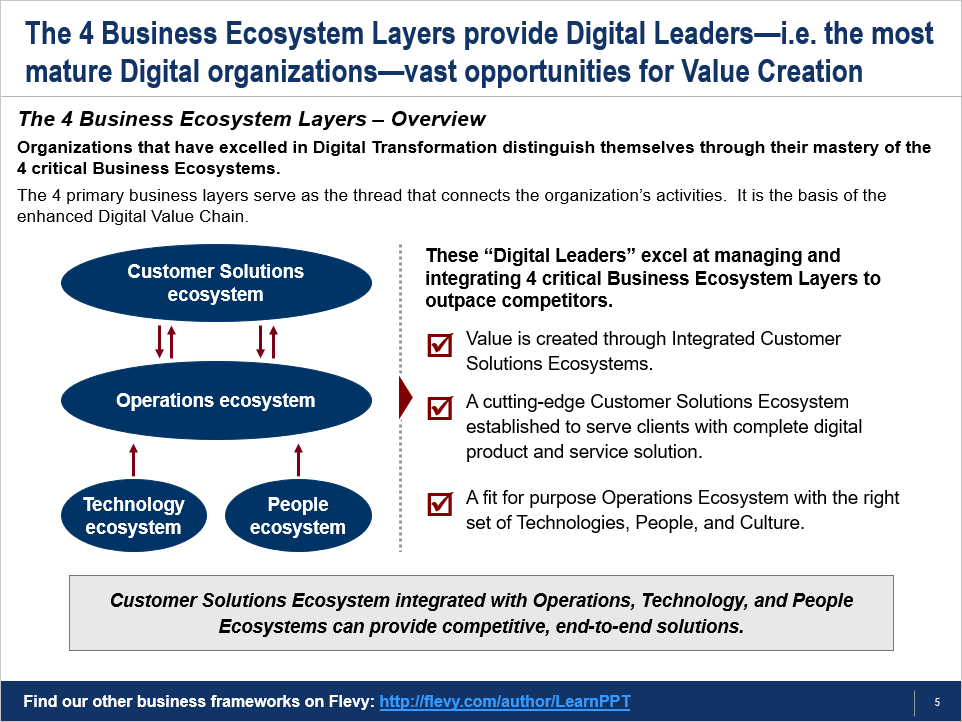
Studies have shown organizations that have excelled in Digital Transformation (i.e. "Digital Leaders") distinguish themselves through their mastery of these 4 critical business ecosystems, characterized by:
- Value Creation through Integrated Customer Solutions Ecosystems.
- A cutting-edge Customer Solutions Ecosystem established to serve customers with a complete digital product and service solution.
- A fit for purpose Operations Ecosystem with the right set of technologies, people, and organizational culture.
Digital Leaders align their organizations around a clear and coherent overall strategy made up of a Value Proposition and Distinctive Capabilities. More information on the Digital Transformation: Integrated Business Ecosystems methodology can be found here.
Strategic Alignment and Leadership in Digital Transformation
Strategic Alignment and Leadership are paramount in steering an organization's Digital Transformation journey. As digital initiatives become central to an organization's strategy, the role of C-suite executives, especially Chief Information Officers (CIOs) and Chief Digital Officers (CDOs), has evolved. These leaders are not just technology implementers but strategic visionaries who align digital initiatives with business goals. According to a report by McKinsey, companies with strong digital leaders are twice as likely to achieve success in their Digital Transformation efforts compared to those without.
However, achieving Strategic Alignment and fostering Leadership in Digital Transformation presents several challenges. One significant challenge is bridging the gap between IT and business units. Often, there is a disconnect in understanding and objectives between these groups, which can hinder the progress of digital initiatives. To overcome this, organizations must foster a culture of collaboration and ensure that digital strategies are clearly linked to business outcomes. This involves regular communication, shared KPIs, and cross-functional teams.
Moreover, leadership in Digital Transformation requires a commitment to continuous learning and adaptability. The digital landscape is constantly evolving, with new technologies and trends emerging at a rapid pace. Leaders must stay informed and be willing to pivot strategies as needed. They should also prioritize the upskilling of their teams, investing in training programs to build digital capabilities across the organization. By doing so, companies can ensure that their workforce is equipped to support their digital goals, driving success in the Digital Age.
Data Privacy and Security in Digital Transformation
In the era of Digital Transformation, Data Privacy and Security have emerged as critical concerns for executives. As organizations collect, store, and analyze vast amounts of data, they become targets for cyber threats and must navigate complex regulatory landscapes. A study by Accenture revealed that security breaches have increased by 67% over the past five years, highlighting the growing risk in the digital domain.
The challenge of ensuring Data Privacy and Security is multifaceted. On one hand, organizations must protect sensitive customer and business information from cyber threats, such as data breaches, ransomware attacks, and phishing schemes. This requires robust cybersecurity measures, including encryption, access controls, and continuous monitoring of IT systems. On the other hand, companies must comply with a growing array of data protection regulations, such as the General Data Protection Regulation (GDPR) in Europe and the California Consumer Privacy Act (CCPA) in the United States. Non-compliance can result in hefty fines and damage to an organization's reputation.
To address these challenges, executives should adopt a comprehensive approach to Data Privacy and Security. This includes implementing a strong cybersecurity framework, investing in advanced security technologies, and fostering a culture of security awareness among employees. Additionally, organizations should engage with legal and compliance experts to ensure they understand and adhere to relevant data protection laws. By prioritizing Data Privacy and Security, companies can build trust with customers and stakeholders, safeguarding their digital initiatives and long-term success.
Innovation and Customer Experience in Digital Transformation
Innovation and Customer Experience are at the heart of Digital Transformation, driving organizations to rethink how they engage with customers and deliver value. In today's digital economy, customers expect personalized, seamless, and omnichannel experiences. A report by Salesforce indicates that 80% of customers now consider the experience a company provides to be as important as its products or services. This shift has made Customer Experience a key differentiator in competitive markets.
However, delivering exceptional Customer Experience in the digital age is not without its challenges. Organizations must navigate the complexities of integrating digital technologies across multiple touchpoints while ensuring a cohesive and engaging customer journey. This requires a deep understanding of customer needs, behaviors, and preferences, which can be achieved through data analytics and customer insights. Additionally, companies must continuously innovate, leveraging technologies such as AI, machine learning, and IoT to create personalized and anticipatory experiences.
To excel in Innovation and Customer Experience, organizations should adopt a customer-centric approach to Digital Transformation. This involves aligning digital initiatives with customer needs and involving customers in the development process through feedback loops and co-creation opportunities. Furthermore, companies should foster a culture of innovation, encouraging experimentation and risk-taking. By focusing on Innovation and Customer Experience, organizations can not only meet but exceed customer expectations, driving loyalty and growth in the digital era.
David Tang, New York
Strategy & Operations, Digital Transformation, Management Consulting

The editorial content of this page was overseen by David Tang. David is the CEO and Founder of Flevy. Prior to Flevy, David worked as a management consultant for 8 years, where he served clients in North America, EMEA, and APAC. He graduated from Cornell with a BS in Electrical Engineering and MEng in Management.
Last updated: May 20, 2026
 PowerPoint (79)
 Excel (21)
 MS Word (5)
 PDF (3)