
Measuring and Managing Customer Profitability   69-slide PPT PowerPoint presentation slide deck (PPT)
$49.00

Measuring and Managing Customer Profitability (69-slide PPT PowerPoint presentation slide deck (PPT)) Preview Image
Log in to unlock full preview.
Measuring and Managing Customer Profitability (69-slide PPT PowerPoint presentation slide deck (PPT)) Preview Image
Arrow   Click main image to view in full screen.

Measuring and Managing Customer Profitability (PowerPoint PPT Slide Deck)

PowerPoint (PPT) + supplemental PDF 69 Slides

$49.00
This presentation is developed a former consultant at Deloitte, KPMG, HP, and SAS, who is an internationally recognized EPM/CPM expert, speaker, and Wiley & Sons published author with almost 50 years of experience.
Add to Cart


Immediate download
Fully editable PowerPoint
Free lifetime updates

BENEFITS OF THIS POWERPOINT DOCUMENT

  1. Learn why customers are the source of shareholder wealth creation.
  2. Understand how to shift the mindset from growing sales to growing profitable sales and to view customers as investments like in a stock portfolio to seek higher ROIs ? return on customers (ROC).
  3. Learn why the marketing and sales functions need accounting data to better formulate customer account strategies including compensation incentives.

CUSTOMER PROFITABILITY PPT DESCRIPTION

Customer Profitability PPT: Learn how to measure and manage customer lifetime value (CLV) and optimize profitable customer segments. Download now. Measuring Customer Profitability is a 69-slide PPT PowerPoint presentation slide deck (PPT) with a supplemental PDF document available for immediate download upon purchase.

The only value a company will ever create for its shareholders and owners is the value that comes from its customers ? current ones and new ones acquired in the future. To remain competitive, companies must determine how to retain customers longer, grow them into bigger customers, make them more profitable, serve them more efficiently, and target acquiring more profitable customers.

Customers increasingly view suppliers' products and standard service lines as commodities. This means that suppliers must shift their actions toward differentiating their services, offers, discounts, and deals to different types of existing customers to retain and grow them. Further, they should concentrate their marketing and sales efforts on acquiring new customers who have traits comparable to those of their relatively more profitable customers.

As a result of this shift from being product-centric to customer centric there needs to be an increased emphasis on measuring current and future potential profitability of products, standard service-lines, channels, and customers. (For business to consumer (B2C) industries, there is need to also consider applying of "customer lifetime value (CLV)" metrics.)

A mind-shift is needed from pursuing increased sales volume at any cost ? to profitable sales volume. Cost accounting leveraging business analytics is essential to achieve this result. Organizations realize it is substantially more expensive to acquire new customers than to retain existing ones. This focus on customer retention combined with the recognition that spray-and-pray mass marketing of products and service-lines is being eclipsed by direct one-to-one to marketing with customers and prospects is causing the need for the marketing function to require financial data on customer profits and future value. Why? Because given any company's scarce resources, it should attract its relatively more profitable customers rather than high maintenance ones whose substantial cost-to-serve erodes profit margins.

Which types of customers are worth more to retain, grow, acquire, or win-back? And types are not worth pursuing? And how much should you optimally spend on each type of customer micro-segment?

The Internet is irreversibly shifting power from sellers to buyers. Suppliers must react. Earning, not just buying, customer loyalty is now mandatory. A popular term in CRM circles is customer lifetime value (CLV) ? measuring each customer as if they are an investment with an ROI. Is this another fad or a real need?

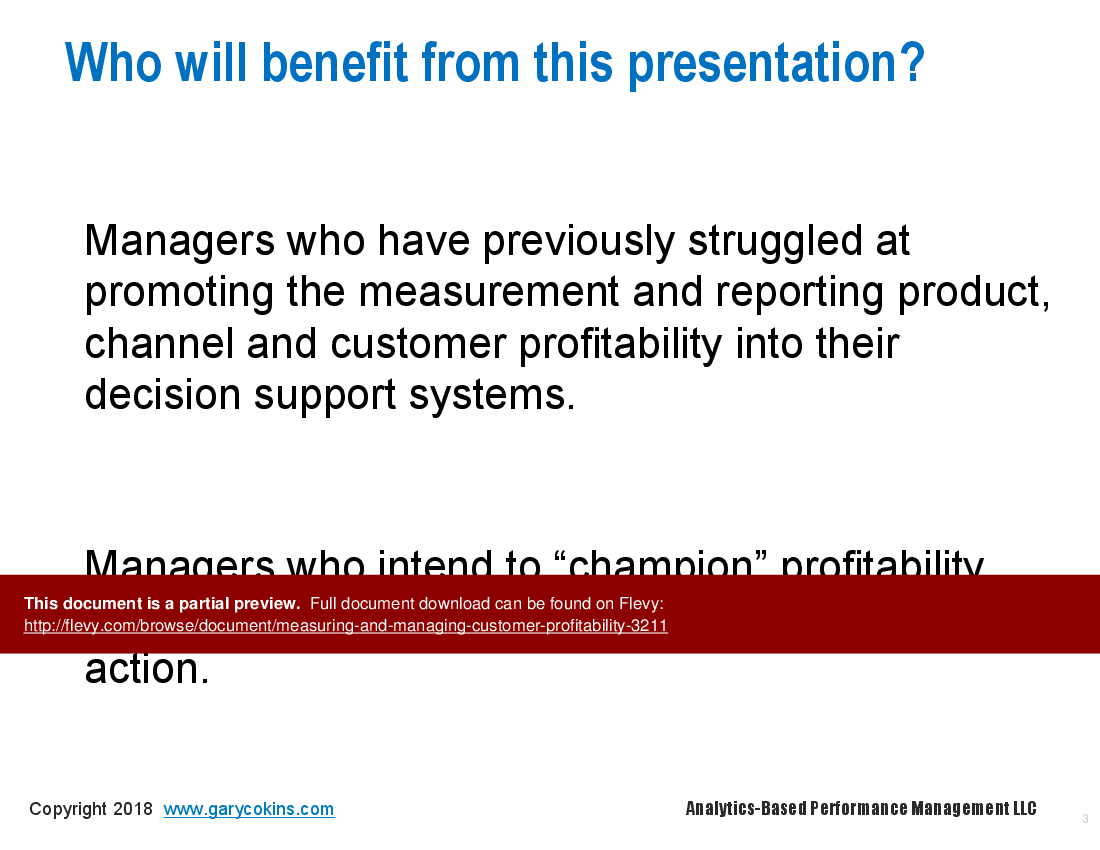
This presentation is ideal for managers aiming to integrate profitability metrics into decision support systems. It addresses the challenges of traditional accounting methods and emphasizes the need for a shift towards predictive analytics.

Got a question about the product? Email us at support@flevy.com or ask the author directly by using the "Ask the Author a Question" form. If you cannot view the preview above this document description, go here to view the large preview instead.

MARCUS OVERVIEW

This synopsis was written by Marcus [?] based on the analysis of the full 69-slide presentation.


Executive Summary
This presentation titled "Measuring and Managing Customer Profitability" is crafted by Gary Cokins, a recognized expert in analytics-based performance management. It provides a comprehensive framework for measuring and managing customer profitability through advanced techniques such as activity-based costing (ABC) and predictive analytics. Executives and managers will gain insights into optimizing customer lifetime value (CLV), identifying profitable customer segments, and overcoming barriers to effective profitability analysis. This deck serves as a vital resource for organizations aiming to enhance their decision-making processes and drive sustainable growth.

Who This Is For and When to Use
•  Financial executives focused on profitability analysis and decision support
•  Managers responsible for customer relationship management and profitability
•  Analysts engaged in performance measurement and reporting
•  Consultants advising organizations on cost management and profitability strategies

Best-fit moments to use this deck:
•  During strategic planning sessions to align profitability goals
•  In workshops aimed at implementing activity-based costing methodologies
•  When addressing challenges in customer profitability reporting and analysis

Learning Objectives
•  Define customer profitability and its significance in strategic decision-making
•  Build a framework for measuring customer lifetime value (CLV)
•  Establish methods for calculating channel and customer profitability
•  Identify barriers to the adoption of profitability analysis techniques
•  Apply predictive analytics to enhance profitability insights
•  Develop strategies to manage costs-to-serve for improved customer profitability

Table of Contents
•  Introduction to Customer Profitability (page 3)
•  Activity-Based Costing Fundamentals (page 6)
•  Implementing ABC Rapid Prototyping (page 23)
•  Calculating Customer Profitability (page 26)
•  Applying Predictive Analytics (page 46)
•  Barriers to Adoption of Profitability Analysis (page 63)

Primary Topics Covered
•  Customer Profitability Definition - Understanding the importance of measuring customer profitability for informed decision-making.
•  Activity-Based Costing (ABC) - A detailed explanation of ABC and its role in accurately attributing costs to customer activities.
•  Rapid Prototyping for ABC - Techniques for implementing ABC through iterative modeling to enhance accuracy and relevance.
•  Calculating Customer Profitability - Methods for assessing profitability at the customer level, including cost-to-serve analysis.
•  Predictive Analytics Application - Utilizing predictive analytics to forecast customer behavior and profitability trends.
•  Overcoming Adoption Barriers - Identifying and addressing technical, perception, and organizational barriers to effective profitability analysis.

Deliverables, Templates, and Tools
•  Activity-Based Costing models for profitability analysis
•  Customer profitability calculation templates
•  Predictive analytics frameworks for customer behavior forecasting
•  Rapid prototyping guides for implementing ABC systems
•  Barriers assessment tools for evaluating organizational readiness

Slide Highlights
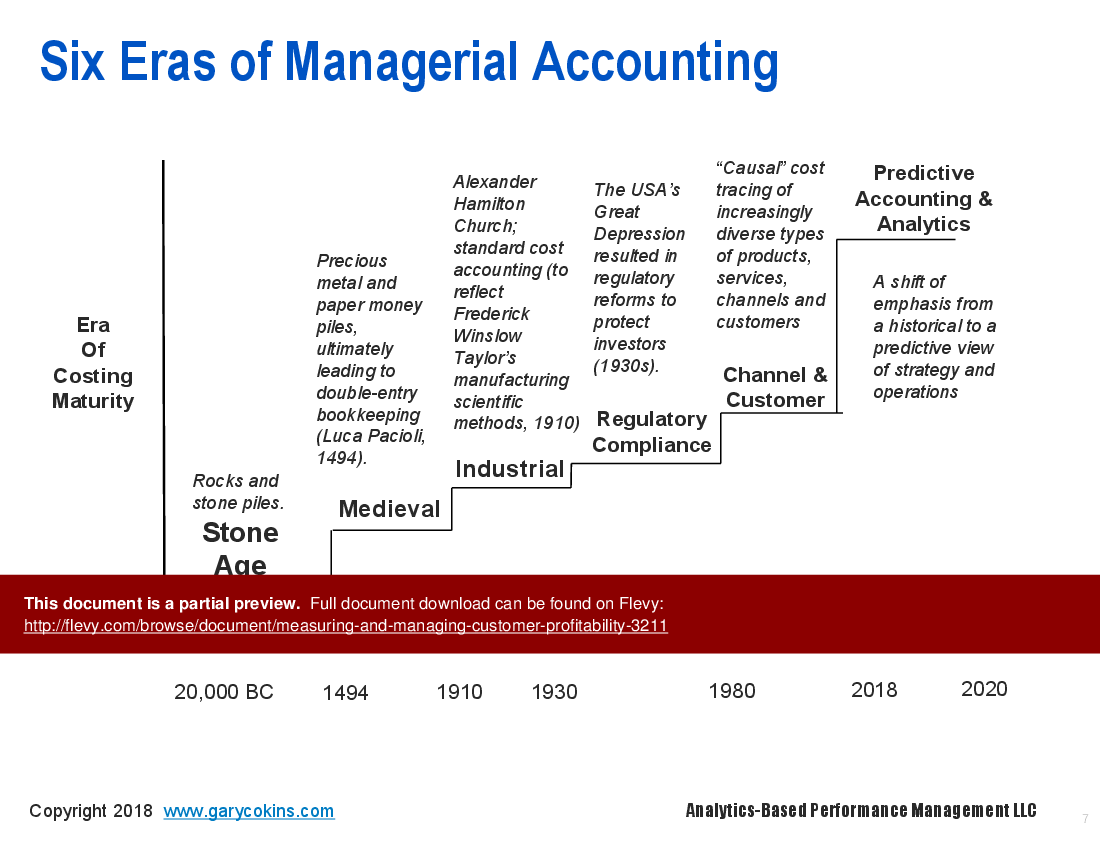
•  Overview of the 6 eras of managerial accounting, illustrating the evolution towards predictive analytics.
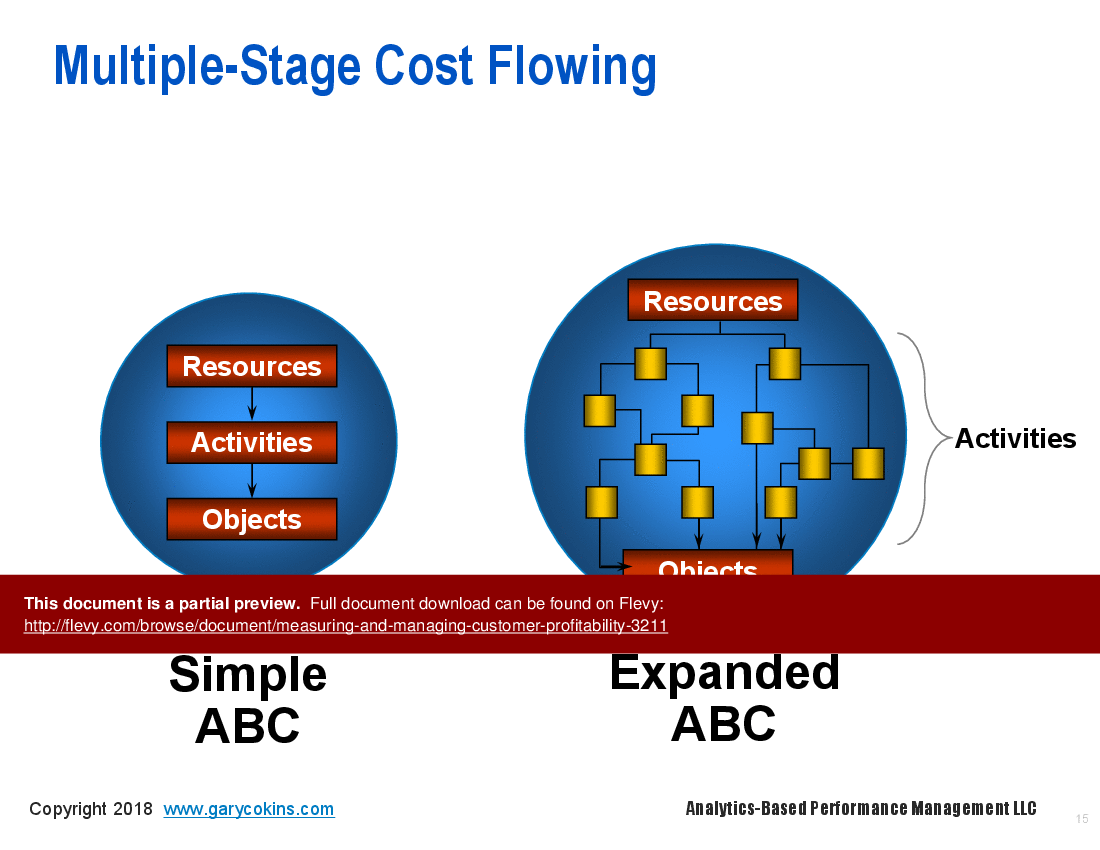
•  Visual representation of the ABC cost assignment network, detailing resource allocation to customer activities.
•  Case studies demonstrating the impact of accurate customer profitability measurement on strategic decisions.
•  Charts illustrating the relationship between customer sales volume and profitability, highlighting key insights.
•  Frameworks for managing costs-to-serve and enhancing customer profitability through targeted strategies.

Potential Workshop Agenda
Introduction to Customer Profitability (30 minutes)
•  Define customer profitability and its relevance
•  Discuss the importance of measuring CLV

Activity-Based Costing Overview (60 minutes)
•  Explain ABC fundamentals and its application
•  Engage in group exercises to calculate customer profitability

Implementing Predictive Analytics (45 minutes)
•  Introduce predictive analytics concepts
•  Discuss case studies and practical applications

Overcoming Barriers to Adoption (30 minutes)
•  Identify common barriers organizations face
•  Develop action plans for addressing these challenges

Customization Guidance
•  Tailor the ABC models to reflect specific organizational structures and cost drivers.
•  Adjust the customer profitability calculation templates to align with industry-specific metrics.
•  Incorporate company-specific terminology and metrics into the presentation for clarity.

Secondary Topics Covered
•  Historical versus predictive costing methodologies
•  The role of customer segmentation in profitability analysis
•  Strategies for improving customer retention and loyalty
•  The impact of external factors on customer profitability

FAQ
What is customer profitability?
Customer profitability refers to the measurement of the profit generated from a customer after accounting for all associated costs.

How does activity-based costing improve profitability analysis?
ABC provides a more accurate method for allocating costs to specific customer activities, leading to better insights into profitability.

What are the key barriers to adopting profitability analysis?
Common barriers include technical challenges, organizational resistance to change, and perceptions of complexity.

How can predictive analytics enhance customer profitability insights?
Predictive analytics allows organizations to forecast customer behavior and profitability trends, enabling proactive decision-making.

What is the significance of customer lifetime value (CLV)?
CLV is a crucial metric that helps organizations understand the long-term value of a customer, guiding investment in customer acquisition and retention strategies.

How can organizations manage costs-to-serve effectively?
By analyzing customer interactions and identifying high-cost activities, organizations can streamline processes and improve profitability.

What role does customer segmentation play in profitability analysis?
Customer segmentation helps identify profitable customer groups, allowing for targeted marketing and service strategies.

How can organizations get started with activity-based costing?
Organizations should begin with rapid prototyping of ABC models, gradually refining them based on insights and feedback.

Glossary
•  Customer Profitability - The profit generated from a customer after accounting for all associated costs.
•  Activity-Based Costing (ABC) - A costing method that assigns costs to activities based on their use of resources.
•  Customer Lifetime Value (CLV) - The total revenue a business can expect from a single customer account throughout the business relationship.
•  Predictive Analytics - Techniques that analyze current and historical data to make predictions about future events.
•  Cost-to-Serve - The total cost incurred by a company to serve a customer, including production, distribution, and service costs.
•  Segmentation - The process of dividing customers into groups based on shared characteristics for targeted marketing.
•  Rapid Prototyping - An iterative approach to developing models that allows for quick adjustments based on feedback.
•  Barriers to Adoption - Challenges that organizations face when implementing new methodologies or technologies.
•  Decision Support Systems - Information systems that support business or organizational decision-making activities.
•  Managerial Accounting - The practice of analyzing and reporting financial and non-financial information to help managers make decisions.
•  Performance Management - The process of ensuring that a set of activities and outputs meets an organization's goals in an effective and efficient manner.
•  Cost Drivers - Factors that cause changes in the cost of an activity.
•  Profitability Analysis - The process of determining the profitability of various segments of a business.
•  Customer Relationship Management (CRM) - Strategies and technologies used by companies to manage and analyze customer interactions and data.
•  Operational Efficiency - The ability to deliver products or services in the most cost-effective manner without compromising quality.
•  Financial Reporting - The process of producing statements that disclose an organization's financial status to management, investors, and the government.
•  Strategic Planning - The process of defining a business's direction and making decisions on allocating resources to pursue this direction.
•  Value Proposition - The promise of value to be delivered to the customer, explaining how a product or service meets their needs.
•  Return on Investment (ROI) - A measure used to evaluate the efficiency of an investment or compare the efficiency of several investments.
•  Stakeholder - Any individual or group that has an interest in the success of an organization.

Source: Best Practices in Customer Profitability PowerPoint Slides: Measuring and Managing Customer Profitability PowerPoint (PPT) Presentation Slide Deck, Gary Cokins


$49.00
This presentation is developed a former consultant at Deloitte, KPMG, HP, and SAS, who is an internationally recognized EPM/CPM expert, speaker, and Wiley & Sons published author with almost 50 years of experience.
Add to Cart
  

ABOUT THE AUTHOR

Author image
Author: Gary Cokins
Additional documents from author: 6

Gary Cokins is an internationally recognized expert, speaker, and author in business analytics enterprise and corporate performance management (EPM/CPM) improvement methods (e.g., strategy map and its balanced scorecard; product, channel, customer profitability reporting usinf activity-based costing; driver-based rolling financial forecasts).

He is the founder of Analytics-Based ... [read more]

Ask the Author a Question

You must be logged in to contact the author.

Click here to log in Click here register

Did you know?
The average daily rate of a McKinsey consultant is $6,625 (not including expenses). The average price of a Flevy document is $65.
Bundle and save! You can save up to % with bundles!

View bundle(s)


Trusted by over 10,000+ Client Organizations
Since 2012, we have provided business templates to over 10,000 businesses and organizations of all sizes, from startups and small businesses to the Fortune 100, in over 130 countries.
AT&T GE Cisco Intel IBM Coke Dell Toyota HP Nike Samsung Microsoft Astrazeneca JP Morgan KPMG Walgreens Walmart 3M Kaiser Oracle SAP Google E&Y Volvo Bosch Merck Fedex Shell Amgen Eli Lilly Roche AIG Abbott Amazon PwC T-Mobile Broadcom Bayer Pearson Titleist ConEd Pfizer NTT Data Schwab


Read Customer Testimonials

 
"As a small business owner, the resource material available from FlevyPro has proven to be invaluable. The ability to search for material on demand based our project events and client requirements was great for me and proved very beneficial to my clients. Importantly, being able to easily edit and tailor "

– Michael Duff, Managing Director at Change Strategy (UK)
 
"As an Independent Management Consultant, I find Flevy to add great value as a source of best practices, templates and information on new trends. Flevy has matured and the quality and quantity of the library is excellent. Lastly the price charged is reasonable, creating a win-win value for "

– Jim Schoen, Principal at FRC Group
 
"I have used FlevyPro for several business applications. It is a great complement to working with expensive consultants. The quality and effectiveness of the tools are of the highest standards."

– Moritz Bernhoerster, Global Sourcing Director at Fortune 500
 
"[Flevy] produces some great work that has been/continues to be of immense help not only to myself, but as I seek to provide professional services to my clients, it gives me a large "tool box" of resources that are critical to provide them with the quality of service and outcomes they are expecting."

– Royston Knowles, Executive with 50+ Years of Board Level Experience
 
"The wide selection of frameworks is very useful to me as an independent consultant. In fact, it rivals what I had at my disposal at Big 4 Consulting firms in terms of efficacy and organization."

– Julia T., Consulting Firm Owner (Former Manager at Deloitte and Capgemini)
 
"As a niche strategic consulting firm, Flevy and FlevyPro frameworks and documents are an on-going reference to help us structure our findings and recommendations to our clients as well as improve their clarity, strength, and visual power. For us, it is an invaluable resource to increase our impact and value."

– David Coloma, Consulting Area Manager at Cynertia Consulting
 
"Last Sunday morning, I was diligently working on an important presentation for a client and found myself in need of additional content and suitable templates for various types of graphics. Flevy.com proved to be a treasure trove for both content and design at a reasonable price, considering the time I "

– M. E., Chief Commercial Officer, International Logistics Service Provider
 
"Flevy is our 'go to' resource for management material, at an affordable cost. The Flevy library is comprehensive and the content deep, and typically provides a great foundation for us to further develop and tailor our own service offer."

– Chris McCann, Founder at Resilient.World


Save with Bundles

This document is available as part of the following discounted bundle(s):

Save %!
Analytics-Based Enterprise and Corporate Performance Management

This bundle contains 5 total documents. See all the documents to the right.

$179.00


Add Bundle & Save


Customers Also Bought These Documents


Customers Also Like These Documents

Explore Related Management Topics


Your Recently Viewed Documents
Download our FREE Strategy & Transformation Framework Templates

Download our free compilation of 50+ Strategy & Transformation slides and templates. Frameworks include McKinsey 7-S, Balanced Scorecard, Disruptive Innovation, BCG Curve, and many more.