
This framework is developed by a team of former McKinsey and Big 4 consultants. The presentation follows the headline-body-bumper slide format used by global consulting firms.
Editor Summary
Digital Platform Strategy is a 33-slide PowerPoint (PPTX) by LearnPPT Consulting that outlines how companies can leverage sensors and IoT to participate in the Sharing Economy via Tethered Digital Platforms.
Read moreCovers 5 platform types (Supplier to Digital Platforms; Collaborative, Enabled, Fully, and Hybrid Tethered Platforms) and 3 strategic considerations (Sensor Strategy, User Acquisition Strategy, Digital Platform Strategy). Includes case studies and customizable slide templates. Targeted at business leaders and managers. Sold as a digital download on Flevy with immediate digital download.
Use this deck when an organization is evaluating sensor-enabled business models or deciding whether to adopt a tethered digital platform — for example when moving into the Sharing Economy, launching IoT-enabled products, or designing multi-sided digital ecosystems.
Business leaders and managers selecting a platform model and comparing the 5 platform types for strategic fit.
Product or engineering managers defining sensor integration and data-capture tradeoffs to inform a Sensor Strategy.
Marketing and growth managers planning user acquisition approaches for two-sided or multi-sided platforms.
The three-part focus on Sensor, User Acquisition, and Digital Platform Strategy reflects a structured, stage-based strategic analysis commonly used in consulting engagements.
Until recently, most traditional companies could not adapt their established business models to participate in the so-called Sharing Economy. However, sensors and related technologies are changing that reality.
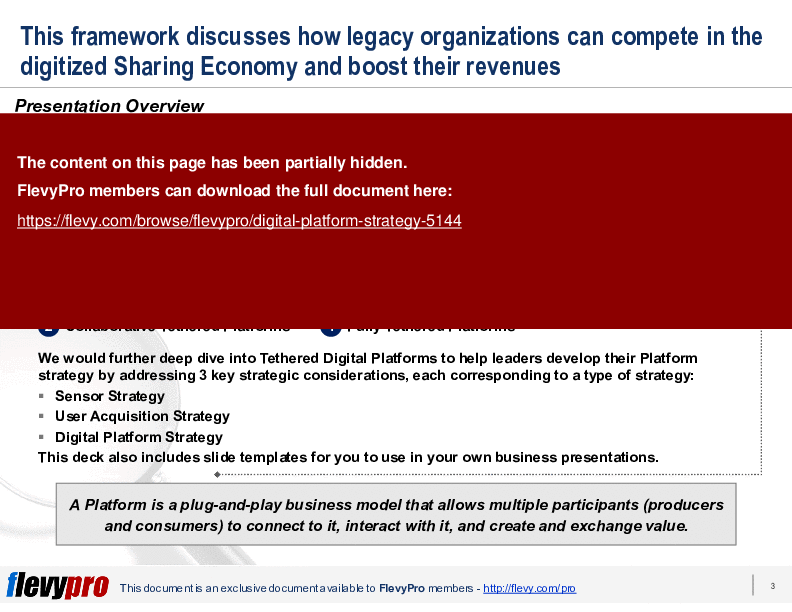
Sensors and the Internet of Things (IoT) are expected to connect 20 billion to 50 billion smart devices and products in the coming years, creating new consumption ecosystems and fresh avenues for competition through "Platforms" or more specifically "Tethered-Digital-Platforms." A Platform is a plug-and-play business model that allows multiple participants (producers and consumers) to connect to it, interact with it, and create and exchange value.
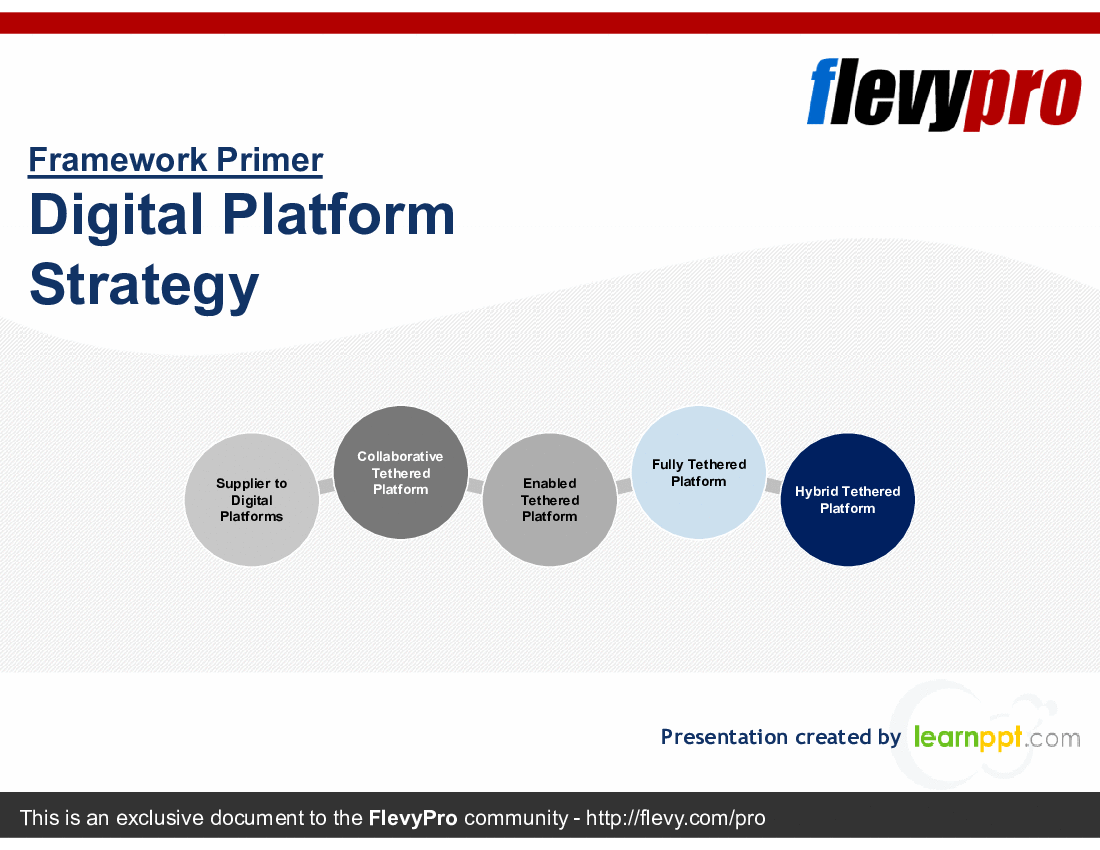
This presentation provides a framework for business leaders and managers to leverage the power of Sharing Economy through Platforms. It first discusses the 5 types of Digital Platforms:
We would further deep dive into Tethered Digital Platforms to help leaders develop their Platform strategy by addressing 3 key strategic considerations, each corresponding to a type of strategy:
1. Sensor Strategy
2. User Acquisition Strategy
3. Digital Platform Strategy
This deck also includes slide templates for you to use in your own business presentations.
The PPT delves into the core components of Tethered Digital Platforms, emphasizing the role of sensors and sensor data in creating value. It outlines how businesses can leverage sensor data to enhance product offerings and create new revenue streams. The framework includes practical examples and case studies to illustrate the application of various platform strategies.
This presentation also provides a comparative analysis of five types of digital platforms, helping leaders determine the best fit for their organization. The deck includes customizable templates to facilitate the development of your own platform strategy, ensuring that your business can effectively compete in the evolving digital landscape.
What are the common types of digital platforms companies consider when adopting IoT-enabled business models?
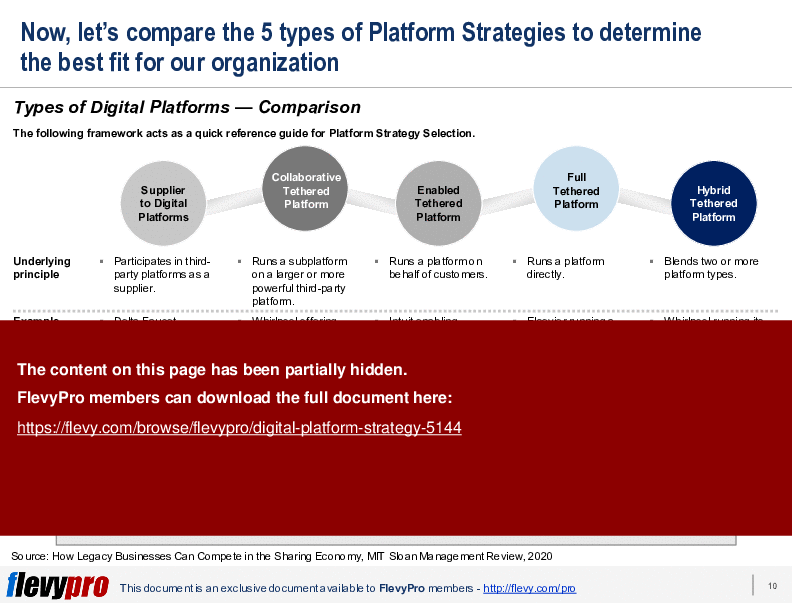
Five types of digital platforms are commonly discussed for IoT-enabled models: Supplier to Digital Platforms, Collaborative Tethered Platforms, Enabled Tethered Platforms, Fully Tethered Platforms, and Hybrid Tethered Platforms, as detailed in the deck’s comparative analysis of platform form and fit across 5 platform types.
How does a sensor strategy contribute to a tethered digital platform?
A sensor strategy defines how sensor hardware and collected data are used to create product differentiation, improve offerings, and enable new revenue streams; the presentation positions sensor data as a core value driver and treats Sensor Strategy as a primary strategic consideration.
What should business leaders evaluate when choosing between enabled, fully tethered, or hybrid tethered platforms?
Leaders should evaluate the role and integration level of sensors, the degree of control over the product-platform relationship, and the user acquisition implications; the deck frames these as interlinked considerations across Sensor, User Acquisition, and Digital Platform Strategy.
What are typical elements of a user acquisition strategy for multi-sided digital platforms?
A user acquisition strategy for platforms focuses on attracting and balancing producers and consumers, sequencing acquisition actions, and building network effects; the presentation identifies User Acquisition Strategy as one of 3 key strategic areas to design for platform growth.
How can companies monetize sensor data within a tethered platform?
The presentation explains that sensor data can be used to enhance product features and to create distinct service or data products that generate additional revenue, illustrating these approaches through practical examples and case studies and highlighting new revenue streams.
What should I look for in a vendor deck or template when buying a digital platform strategy presentation?
Look for comparative analysis of platform types, explicit treatment of sensor/data strategy, a user acquisition framework, practical examples or case studies, and ready-to-use slide templates to adapt; the Digital Platform Strategy deck includes case studies and customizable templates.
How much time and team resources are typically needed to adapt a platform strategy template for internal use?
The presentation does not prescribe specific timelines; it provides slide templates and examples intended to accelerate internal adaptation, and the file is delivered as a 33-slide PPTX that teams can edit for their own planning needs.
I need to decide between a supplier-to-digital platform and a collaborative tethered platform after an IoT prototype — what framework helps compare them?
Use a comparative framework that assesses sensor integration, participant roles, value-capture models, and user acquisition requirements; the deck offers a comparative analysis and case examples to help determine the best fit among the 5 platform types.
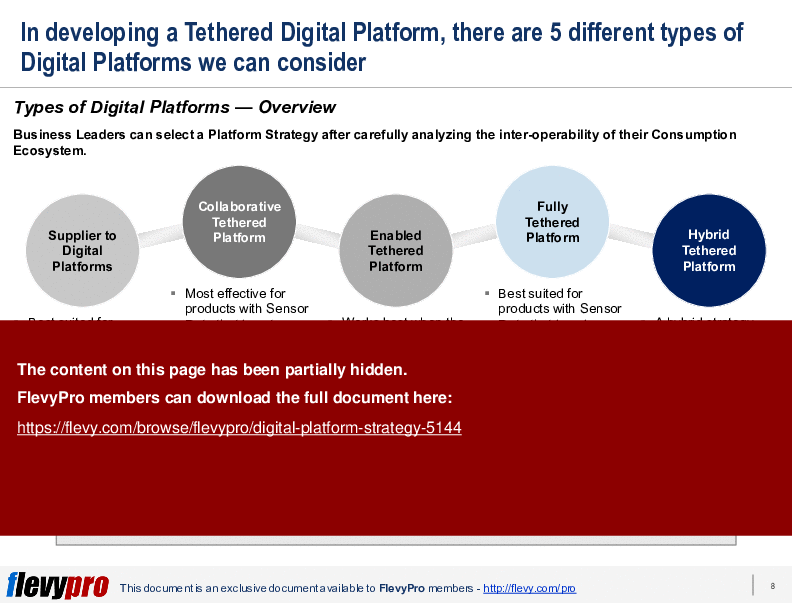
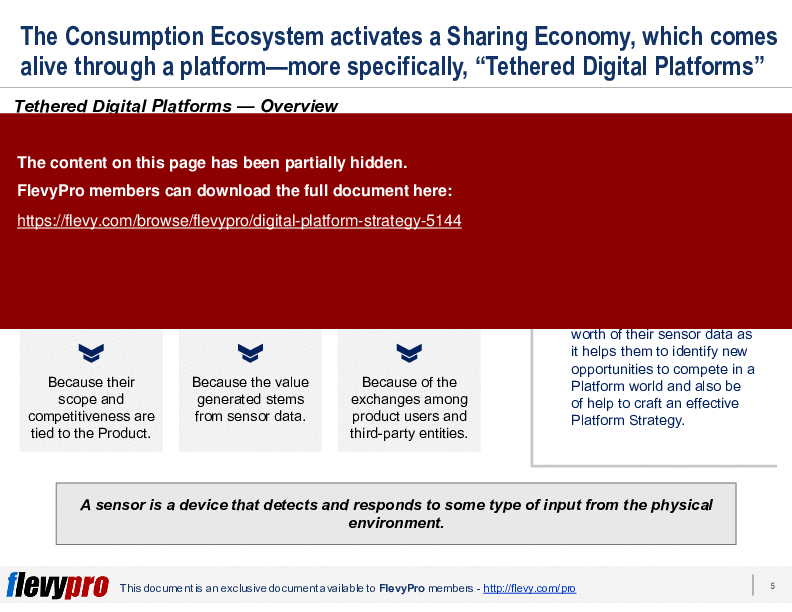
This PPT slide outlines 5 types of digital platforms for developing a tethered digital platform strategy based on sensor data. The "Supplier to Digital Platforms" category is suited for products with sensors that provide limited data exchanges, acting as data suppliers. The "Collaborative Tethered Platform" is effective for products with non-unique sensor data, enabling data sharing and user collaboration. The "Enabled Tethered Platform" supports products with unique sensor data, allowing companies to navigate user access complexities. The "Fully Tethered Platform" is optimal for products with unique sensor data and minimal sharing restrictions, maximizing interactivity. Lastly, the "Hybrid Tethered Platform" integrates elements from previous types, suitable for products with mixed sensor data characteristics. Analyzing the interoperability of the consumption ecosystem is crucial for selecting the right platform strategy.
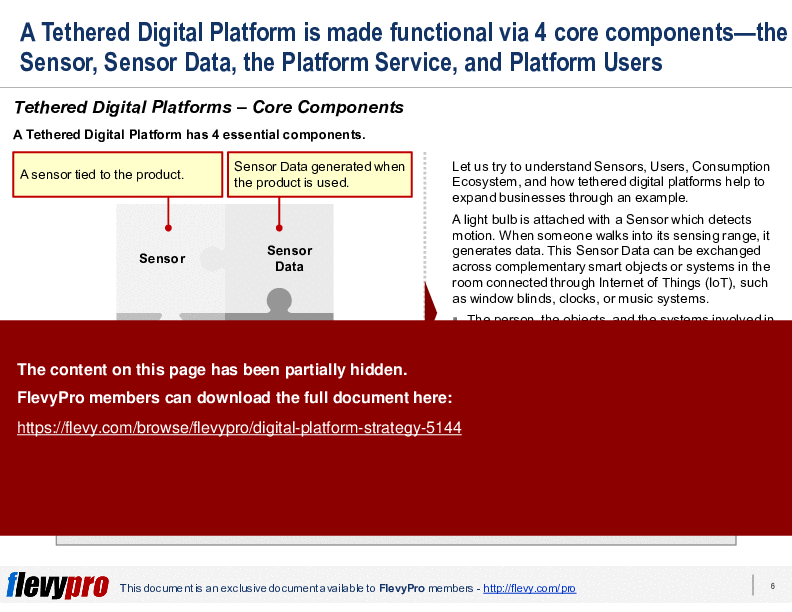
A Tethered Digital Platform consists of 4 components: Sensor, Sensor Data, Platform Service, and Platform Users. The Sensor captures real-time data during product use, generating Sensor Data through environmental interactions. The Platform Service facilitates seamless exchanges of Sensor Data among Platform Users, who interact with the platform. This forms a "Consumption Ecosystem" involving users, objects, and systems. For example, a smart light bulb with a motion-detecting sensor generates data when a person enters its range, sharing it with other smart devices like window blinds or music systems. As user engagement and complementary device integration increase, the ecosystem expands, enabling developers to create new applications and enhance service offerings. The evolution of IT in the next decade will focus on transforming business models rather than merely changing work processes.
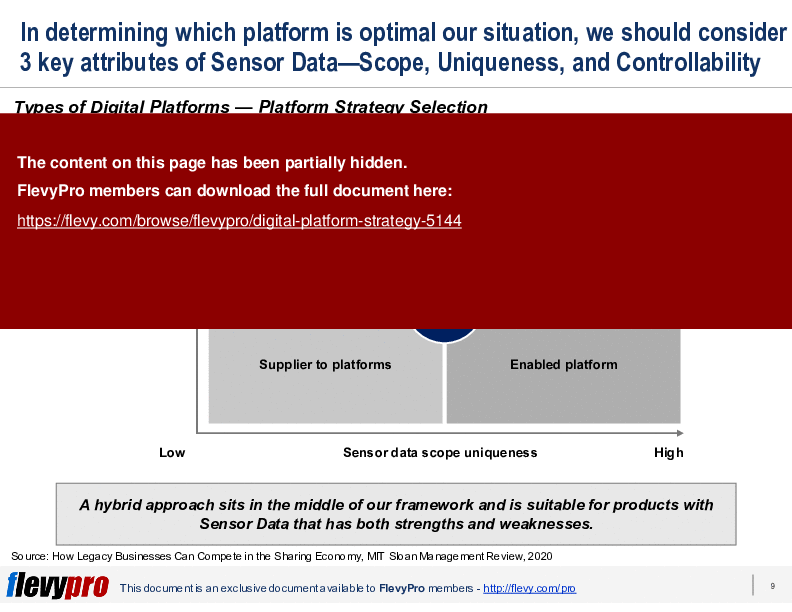
This PPT slide presents a framework for selecting digital platform strategies based on 3 critical attributes of sensor data: Scope, Uniqueness, and Controllability. It categorizes 5 distinct platform strategies within a two-dimensional matrix, where the vertical axis represents sensor data controllability and the horizontal axis indicates the uniqueness of sensor data scope. The "Full platform" strategy indicates high controllability and uniqueness, while the "Collaborative platform" emphasizes strong controllability, but lower uniqueness. The "Supplier to platforms" suggests limited controllability and uniqueness, and the "Enabled platform" shows high uniqueness with lower controllability. The "Hybrid approach" integrates elements from various strategies, suitable for products with both strengths and weaknesses. Organizations should evaluate their specific sensor data attributes to determine the most fitting platform strategy, considering trade-offs between controllability and uniqueness.
The Fully Tethered Platform is a strategic framework for managing sensor data and ensuring platform ownership. This model emphasizes direct control, autonomy, and self-sufficiency, making it ideal for products generating sensor data with limited sharing constraints. Companies with proprietary data can significantly benefit from this approach, enabling independent platform operation and autonomous data exchanges. Full ownership of the platform allows product companies to innovate without external dependencies, reinforcing the importance of retaining critical data assets. Practical applications, such as Elsevier's digitization of research publications, demonstrate how organizations can leverage data for collaboration and create value. Additionally, premium subscription services can serve as a monetization strategy, enhancing profitability through innovative data utilization.
This PPT slide outlines critical elements of developing a robust Sensor Strategy. Understanding how sensor data is generated through user interactions is essential for maximizing product-user interface effectiveness. Companies should explore innovative ways to leverage product-user interfaces beyond primary functions, utilizing sensors as transformative tools to enhance operational efficiency across supply chains. Sensors can significantly alter system operations, creating new opportunities from sensor data. Organizations are encouraged to ask strategic questions to refine their focus on these opportunities, promoting a proactive approach to sensor integration. The broader implications of IoT applications highlight that limitations stem from the creativity and engineering capabilities of system designers, emphasizing the need for innovative application and integration. This slide urges businesses to rethink their Sensor Strategy, expanding their consumer ecosystem through enhanced data generation and utilization.
A comprehensive Digital Platform Strategy is essential for leveraging sensor data and expanding platform user bases. Formulating a Tethered Platform Strategy drives revenue growth and enhances service offerings through a two-step process.
The first step assesses the product category and evaluates available sensor data, focusing on the scope, uniqueness, and controllability of the data. This assessment identifies the potential of data assets for effective utilization.
The second step examines the strength of traditional competencies, including scale of operations and brand strength, to determine whether to pursue a tethered digital platform or act as a supplier to a larger platform. These strategic decisions influence the company's direction in the digital landscape, guiding informed choices about market positioning and growth trajectory.
The Collaborative Tethered Platform operates as a sub-platform within a larger third-party platform, relevant in the Sharing Economy. Companies leverage non-unique sensor data with minimal sharing restrictions. The tiered partnership model enables effective participation when data integrates with a dominant platform. This strategy allows companies to enhance data capabilities without building a standalone platform. Key aspects include platform ownership and sensor data ownership, where the product company retains sensor data while sharing it with a more powerful platform for greater utility. An example is Whirlpool's sensor-equipped refrigerators, which collect stock level data to facilitate exchanges among grocery stores and delivery services. Competing with Amazon, Whirlpool collaborates with Alexa to enhance service offerings, strategically positioning itself to leverage its sub-platform effectively and attract consumers engaged with Alexa.
Source: Best Practices in Digital Transformation, Internet of Things, Platform Strategy PowerPoint Slides: Digital Platform Strategy PowerPoint (PPTX) Presentation Slide Deck, LearnPPT Consulting
This framework is developed by a team of former McKinsey and Big 4 consultants. The presentation follows the headline-body-bumper slide format used by global consulting firms.
For $10.00 more, you can download this document plus 2 more FlevyPro documents. That's just $13 each.
ABOUT FLEVYPRO
This document is part of the FlevyPro Library, a curated knowledge base of documents for our FlevyPro subscribers.
FlevyPro is a subscription service for on-demand business frameworks and analysis tools. FlevyPro subscribers receive access to an exclusive library of curated business documents—business framework primers, presentation templates, Lean Six Sigma tools, and more—among other exclusive benefits.
The average daily rate of a McKinsey consultant is $6,625 (not including expenses). The average price of a Flevy document is $65.
Trusted by over 10,000+ Client Organizations
Since 2012, we have provided business templates to over 10,000 businesses and organizations of all sizes, from startups and small businesses to the Fortune 100, in over 130 countries.
"As a niche strategic consulting firm, Flevy and FlevyPro frameworks and documents are an on-going reference to help us structure our findings and recommendations to our clients as well as improve their clarity, strength, and visual power. For us, it is an invaluable resource to increase our impact and value."
– David Coloma, Consulting Area Manager at Cynertia Consulting
"As a consultant requiring up to date and professional material that will be of value and use to my clients, I find Flevy a very reliable resource.
The variety and quality of material available through Flevy offers a very useful and commanding source for information. Using Flevy saves me time, enhances my expertise and ends up being a good decision."
– Dennis Gershowitz, Principal at DG Associates
"Flevy is our 'go to' resource for management material, at an affordable cost. The Flevy library is comprehensive and the content deep, and typically provides a great foundation for us to further develop and tailor our own service offer."
– Chris McCann, Founder at Resilient.World
"As an Independent Management Consultant, I find Flevy to add great value as a source of best practices, templates and information on new trends. Flevy has matured and the quality and quantity of the library is excellent. Lastly the price charged is reasonable, creating a win-win value for
the customer, Flevy and the various authors. This is truly a service that benefits the consulting industry and associated clients. Thanks for providing this service.
"
– Jim Schoen, Principal at FRC Group
"I have found Flevy to be an amazing resource and library of useful presentations for lean sigma, change management and so many other topics. This has reduced the time I need to spend on preparing for my performance consultation. The library is easily accessible and updates are regularly provided. A wealth of great information."
– Cynthia Howard RN, PhD, Executive Coach at Ei Leadership
"I have used FlevyPro for several business applications. It is a great complement to working with expensive consultants. The quality and effectiveness of the tools are of the highest standards."
– Moritz Bernhoerster, Global Sourcing Director at Fortune 500
"Flevy is now a part of my business routine. I visit Flevy at least 3 times each month.
Flevy has become my preferred learning source, because what it provides is practical, current, and useful in this era where the business world is being rewritten.

many challenges and there is the need to make the right decisions in a short time, with so much scattered information, we are fortunate to have Flevy. Flevy investigates, selects, and puts at our disposal the best of the best to help us be successful in our work.
"
– Omar Hernán Montes Parra, CEO at Quantum SFE
"I am extremely grateful for the proactiveness and eagerness to help and I would gladly recommend the Flevy team if you are looking for data and toolkits to help you work through business solutions."
Download our FREE Digital Transformation Templates
Download our free compilation of 50+ Digital Transformation slides and templates. DX concepts covered include Digital Leadership, Digital Maturity, Digital Value Chain, Customer Experience, Customer Journey, RPA, etc.
Download our FREE Digital Transformation Templates
Get Our FREE Product.
Download our free compilation of 50+ Digital Transformation slides and templates. DX concepts covered include Digital Leadership, Digital Maturity, Digital Value Chain, Customer Experience, Customer Journey, RPA, etc.