Editor's Note: Take a look at our featured best practice, Employee Engagement Measurement & Improvement (25-slide PowerPoint presentation). Employee Engagement has emerged as one of the significant pillars on which the Competitive Advantage, Productivity, and Growth of an organization rests. Measuring Employee Engagement is vital in shaping Employee Engagement Strategies that help propel the organization towards growth.
This [read more]
* * * *
Employer of Record (EOR) services reduce employment compliance risks by legally hiring international workers through pre-established local entities, absorbing statutory employer liabilities, administering localized payroll and taxes, and strictly adhering to local labor codes to eliminate misclassification and establishment penalties.
An established EOR partner like Multiplier eliminates these administrative and legal burdens entirely, allowing scaling enterprises to onboard top-tier global talent quickly, safely, and compliantly without establishing costly foreign legal entities.
Key Takeaways
Discover how global entity models mitigate statutory labor, tax, and reporting exposures during rapid international workforce scaling.
How partnering with an Employer of Record shifts legal liabilities away from your parent organization across foreign jurisdictions.
Learn how partnering with Multiplier protects growing businesses from severe worker misclassification fines and permanent establishment liabilities.
Uncover the exact framework for administering statutory local benefits, localized payroll, and multi-currency social security contributions.
Evaluate comprehensive risk mitigation strategies comparing direct entity incorporation against compliant global employer of record solutions.
Understanding Employer of Record: The Legal Buffer between Employee and Employer
An Employer of Record (EOR) is a specialized third-party organization that serves as the legal employer for your international personnel on paper while you retain day-to-day management of their deliverables, workflows, and performance.
When your organization identifies exceptional candidates in foreign markets where you lack an incorporated legal presence, an EOR steps in to bridge the gap. The EOR provider hires the employee through its own registered local legal entity, drafts compliant employment contracts tailored to local labor standards, registers the worker with local tax and social security authorities, and executes localized statutory benefits administration.
Through this dual-layer employment arrangement, the client company directs the team member’s day-to-day projects, performance reviews, core duties, and working hours.
Concurrently, the EOR assumes legal responsibility for all statutory employer obligations, mitigating the risk of corporate non-compliance under regional labor regulations.
What Are the Key Compliance Risks of Global Expansion?
Navigating foreign employment markets without localized legal infrastructure exposes expanding companies to several severe compliance risks:
1. Worker Misclassification
Treating full-time global team members as independent contractors to bypass local employment legislation is heavily penalized across jurisdictions. Regulatory authorities evaluate operational reality over contractual wording.
If an authority determines that a contractor is functioning as a de facto employee, your company faces retroactive payroll tax assessments, mandatory severance obligations, unpaid statutory leave reimbursements, and severe regulatory fines.
2. Permanent Establishment (PE)
Engaging personnel who execute commercial contracts, conduct revenue-generating activities, or habitually negotiate deals in a foreign territory can inadvertently trigger a Permanent Establishment status.
Once triggered, regional tax authorities may deem your business a locally taxable corporate entity, subjecting global corporate profits to double taxation, retrospective corporate filings, and back taxes.
3. Dynamic Local Labor Regulations
Employment codes vary substantially worldwide. Requirements concerning standard workweeks, overtime caps, statutory notice periods, minimum holiday entitlements, mandatory 13th-month bonuses, and strict severance calculation formulas differ drastically between countries.
Applying standardized domestic HR policies globally inevitably leads to statutory violations and costly wrongful termination claims.
How Do Employer of Record Services Mitigate Global Risks?
By placing international staff onto established, legally compliant corporate rails, an EOR neutralizes exposure across the entire employment lifecycle:
Shielding from Corporate Tax Liabilities
The EOR acts as the employing entity of record, containing personnel strictly within localized employment frameworks and insulating the client company from inadvertently establishing taxable corporate presence.
Standardizing Statutory Payroll & Tax Remittance
EORs calculate exact gross-to-net withholdings, mandatory social insurances, regional pensions, and employee income taxes in real time, remitting dues directly to local tax authorities.
Providing Compliant Employment Agreements
Every agreement incorporates mandatory local terms, statutory benefits, notice parameters, probation regulations, and enforceable intellectual property (IP) assignment clauses.
Executing Compliant Terminations
Navigating complex local termination laws requires deep jurisdiction-specific experience. EORs ensure all offboarding follows required statutory probation guidelines, progressive documentation, and severance mandates.
To streamline this process seamlessly, Multiplier acts as a native Global Teams Platform, enabling companies of any size to scale safely across borders with integrated EOR, Contractor of Record (COR), and Global Payroll solutions.
Comparing Global Expansion Approaches: Direct Entity vs. EOR
Deciding whether to incorporate local subsidiaries or leverage an established EOR partner represents a fundamental strategic decision for international expansion:
Strategic Parameter
Foreign Subsidiary Incorporation
Employer of Record (EOR) Service
Speed to Market
3 to 12 months per country
24 to 48 hours
Upfront Setup Costs
High ($20,000 to $80,000+ per entity)
Minimal / Zero entity incorporation fees
Legal & Tax Exposure
Borne 100% by your internal parent entity
Shifted to the EOR’s local corporate structure
Ongoing Maintenance
Requires local legal, tax, accounting, and audit retainers
Fully managed under a transparent platform fee
Misclassification Risk
Remains high if contracting is used as an interim fix
Eliminated through compliant local employment contracts
Flexibility
Difficult and expensive to dissolve if market tests fail
Instant scaling up or winding down without corporate dissolution
Final Thoughts
Not all EOR solutions are created equal. Many legacy aggregators rely heavily on fragmented third-party local agencies, adding layers of margin, communication delays, and shared operational liability.
Multiplier operates a vast network of 160+ owned legal entities, removing unnecessary intermediaries to guarantee uncompromising compliance, direct operational accountability, and complete IP protection across every jurisdiction. Backed by enterprise-grade ISO, SOC 2+3 certifications, and GDPR-compliant infrastructure, the platform handles end-to-end global payroll reconciliation powered by cutting-edge machine learning.
Multiplier provides 24/7 human-first support with a dedicated Customer Success Manager for every account, ensuring scaling businesses have localized employment experts on standby whenever compliance questions arise.
Frequently Asked Questions
What is the primary role of an Employer of Record?
An Employer of Record legally hires employees on behalf of your company in foreign jurisdictions. It handles localized payroll, tax filings, statutory benefits, and labor law compliance, while your internal management retains full day-to-day oversight of performance and daily responsibilities.
How does an EOR protect intellectual property abroad?
An EOR ensures employment contracts include localized, legally enforceable intellectual property assignment clauses and non-disclosure protections compliant with domestic court standards, ensuring that all patents, software code, and commercial creations remain exclusively owned by your parent organization.
How does Multiplier ensure compliance across 160+ countries?
Multiplier manages its own network of 160+ legally incorporated entities worldwide, pairing built-in compliance engines and automated payroll reconciliation with dedicated local legal experts. This eliminates intermediary reliance, mitigates misclassification, and safeguards businesses against evolving cross-border employment liabilities.
Can an EOR assist with offboarding and severance payments?
Yes, an EOR oversees termination workflows in full alignment with local labor jurisdictions. It calculates mandatory statutory notice periods, handles accrued leave payouts, drafts enforceable mutual separation agreements, and administers severance payments to prevent wrongful dismissal disputes.
Is an Employer of Record suitable for long-term hiring?
An EOR is ideal for both short-term market expansion and permanent long-term staffing. It allows companies to compliantly retain international specialists indefinitely without bearing the ongoing financial, accounting, and operational overhead of maintaining overseas corporate legal subsidiaries.
High Employee Engagement ties directly to financial benefits for a company and companies with high Employee Engagement typically have distinctive and compelling Employee Value Propositions (EVP). We can define an EVP as what we offer our employees in exchange for their effort and commitment.
This [read more]
Do You Want to Implement Business Best Practices?
You can download in-depth presentations on Employee Retention and 100s of management topics from the FlevyPro Library. FlevyPro is trusted and utilized by 1000s of management consultants and corporate executives.
For even more best practices available on Flevy, have a look at our top 100 lists:
These best practices are of the same as those leveraged by top-tier management consulting firms, like McKinsey, BCG, Bain, and Accenture. Improve the growth and efficiency of your organization by utilizing these best practice frameworks, templates, and tools. Most were developed by seasoned executives and consultants with over 20+ years of experience.
Readers of This Article Are Interested in These Resources
Businesses typically focus on customers. However, with rapid changes and intense competition they have come to realize that employees make or break an enterprise, create brand impression, and represent the organization's culture & values.
Exceptional service has been realized as a key source [read more]
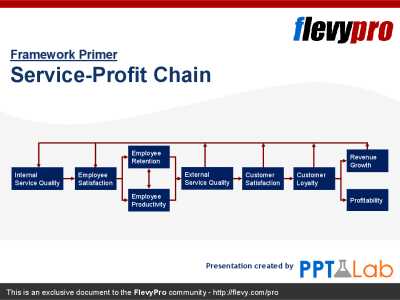
The Service-Profit Chain model, developed by James Heskett, Earl Sasser, and Leonard Schlesinger, theorizes that organizations need to focus on providing what their employees, customers, investors, suppliers, and others value most. Driving value for these stakeholders will lead to maximum [read more]
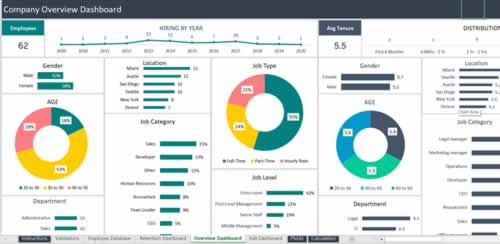
We are delighted to present the Employee Retention Dashboard Excel Template, a valuable resource designed to facilitate the tracking and analysis of employee retention rates within your organization. This intuitive template offers a seamless experience for data entry and provides instant access to [read more]
The most important aspect when looking to hire someone is to have the mindset to hire and retain the best and right person for the job. Try to recruit people who will thrive under your management approach. In most cases you will inherit your staff and department, which is obviously out of your [read more]
 Employer of Record