Editor's Note: Take a look at our featured best practice, GenAI Roadmap Design (30-slide PowerPoint presentation). Organizations worldwide are embracing GenAI for its ability to generate actionable insights, predict outcomes, personalize at scale, and process natural language with human-like fluency.
Leading organizations already deploy GenAI in AI-assisted software development, workflow automation, [read more]
* * * *
Generative AI (GenAI) represents the most significant shift in how work gets done since the industrial revolution. The strategic objective of adopting it is by now well established: the Trifecta of Opportunities, meaning the Economic, Business, and People upsides that responsible, people-centered deployment unlocks. Knowing the destination, however, is not the same as knowing the route. The pressing question for leadership teams is how the Trifecta is actually captured in practice.
The organizations answering that question best are a small group. Research identifies the top 9% as Reinventors: enterprises that fundamentally redesign how they operate, compete, and create value through AI, and that are twice as likely as peers to anticipate GenAI-related productivity gains of 20% or more over the next 3 years. What separates them is not superior technology. It is the way they activate 4 Workforce Accelerators in parallel.
Capturing GenAI’s full potential demands innovation on 2 fronts at once: reinventing business models, operations, and digital infrastructure, while preparing a creative workforce for continuous change. Pursue only the first front and the result is impressive technology paired with stalled pilots. The GenAI Workforce Accelerators framework keeps both fronts moving together, translating AI ambition into practical execution.
4 GenAI Workforce Accelerators
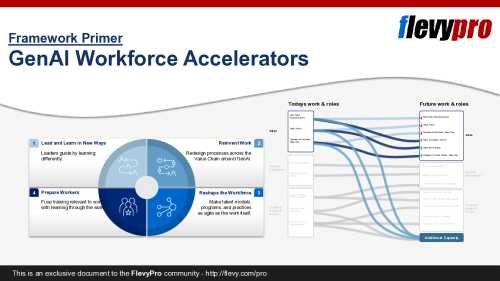
The framework comprises 4 Accelerators, activated in parallel rather than in sequence:
Lead and Learn in New Ways: Leaders guide the transformation by learning differently themselves.
Reinvent Work: Processes across the Value Chain are redesigned around GenAI rather than retrofitted with it.
Reshape the Workforce: Talent models, programs, and practices become as agile as the work itself.
Prepare Workers: Training relevant to the work is fused with learning through the work.
Each Accelerator addresses a different failure point in GenAI adoption, and none compensates for the absence of another. Let’s examine the first 2 Accelerators more closely, for now.
Lead and Learn in New Ways
The case for starting with leadership is uncomfortable but well supported: over 65% of executives lack the technical expertise required for GenAI-led Transformation. Leaders cannot delegate their way around that gap. To secure workforce buy-in, they must engage with AI tools more than anyone else in the organization, challenge long-held attitudes and operating habits, and lead with a combination of confidence and humility that acknowledges how much they themselves are still learning.
The framework structures this journey as a learning roadmap of 5 capability layers. The first establishes baseline literacy: digital fluency across cloud, data, and security, plus a working grasp of Large Language Models (LLMs), architectures, and responsible AI principles, so leaders can ask the right questions before committing resources. The second layer turns inward, assessing the enterprise’s AI readiness.
The third layer connects leadership learning to the other Accelerators, identifying where GenAI can reinvent processes and how the workforce should be reallocated for cross-functional collaboration. The fourth requires leaders to understand how people actually learn and what drives the talent lifecycle. The fifth wraps governance around everything else: enterprise AI governance structures, regulatory and ethical considerations, and risk mitigation that make scale safe.
Reinvent Work
The second Accelerator confronts the most common mistake in enterprise AI: bolting GenAI onto existing processes and expecting transformation. Nearly half of Reinventors recognize that extensive process transformation across the Value Chain is required to capture the Business, Economic, and People upsides, and more than half are actively restructuring workflows to embed GenAI capabilities where the work actually happens.
Reinventing work follows a recognizable logic. GenAI is embedded within core business goals rather than run as side experiments. Departmental silos give way to tighter integration, because GenAI-enabled workflows rarely respect old organizational boundaries. Effort is redirected toward the initiatives with the greatest customer impact and enterprise performance benefit. Most importantly, people shift from executing assigned tasks to co-creating their roles and shaping how work moves through the enterprise.
The payoff of process-level clarity is capacity. Once an organization can see exactly where GenAI absorbs routine work, it can reallocate that freed capacity toward higher-value activity, which is precisely where the third and fourth Accelerators take over.
Case Study
Moderna illustrates what reinvented work looks like in practice. The biotech firm targeted its operating model, processes, and workflows for Transformation and built mChat, an internal GenAI solution that lets non-coders self-start processes by generating code, expanding what employees can accomplish and giving their ideas a route to incubation. The capability directly supports Moderna’s ambition to launch 15 new products in 5 years, with an AI academy sustaining the upskilling behind it.
Radisson Hotel Group applied the same Accelerator to a very different workflow. The group receives more than 1,000 customer reviews daily, each previously read and answered manually. GenAI now drafts responses at scale while employees oversee every reply, freeing staff to concentrate on service quality and giving them richer insight into customer needs. In both cases the reinvented workflow did more than save time. It expanded employee capability, deepened customer intelligence, and strengthened Customer Experience and Loyalty.
FAQs
What distinguishes Reinventors from other organizations adopting GenAI?
Reinventors, roughly the top 9% of organizations, redesign how they operate, compete, and create value through AI rather than adding tools to existing processes, activating all 4 Accelerators in parallel. That is why they are twice as likely to expect productivity gains of 20% or more.
Why do the Accelerators need to run in parallel rather than in sequence?
Each Accelerator resolves a different failure point: unprepared leaders, retrofitted processes, rigid talent models, or untrained workers. Progress on one cannot offset neglect of another, and sequencing them creates exactly the lag between technology and people that stalls most programs.
Where should a leadership team begin if its GenAI expertise is limited?
Begin with the learning roadmap’s foundation: digital fluency and GenAI fundamentals. Executives do not need to become engineers, but they need enough literacy to ask sharp questions, evaluate readiness honestly, and sequence investments before deployment begins.
Is reinventing work realistic for organizations that cannot pause operations?
Yes, because reinvention proceeds workflow by workflow. The practical route is to identify process-level opportunities, embed GenAI where the work happens, and redeploy the freed capacity, as Radisson did with customer reviews while operations continued.
How does workforce reshaping differ from workforce reduction?
Reshaping treats the capacity GenAI releases as an asset to redeploy, not a cost to eliminate. Organizations create new and extended roles aligned with customer needs, preserving institutional knowledge while opening career paths that did not previously exist.
Concluding Thoughts
The Trifecta of Opportunities will not be captured by the organizations with the largest AI budgets or the most pilots in flight, but by those that treat workforce acceleration as the core of the Transformation rather than its afterthought. The 4 Accelerators supply the operating discipline: leaders who model the learning they expect of others, work redesigned around the technology’s strengths, talent models that move as fast as the work, and workers prepared through the work itself.
There is a reinforcing cycle here that Reinventors understand well. Leaders who learn visibly earn the credibility to reinvent work. Reinvented work releases the capacity that makes reshaping the workforce possible. A reshaped, well-prepared workforce delivers the productivity and engagement that justify further investment. That is how AI ambition turns into sustained performance.
You can download in-depth presentations on this and hundreds of similar business frameworks from the FlevyPro Library. FlevyPro is trusted and utilized by 1000s of management consultants and corporate executives.
For even more best practices available on Flevy, have a look at our top 100 lists:
Generative AI (GenAI) is the most significant shift to work since the industrial revolution--and the Trifecta of Opportunities it unlocks (the economic, business, and people upsides) is the strategic objective. This presentation moves from the opportunity to the path: how leaders capture [read more]
Readers of This Article Are Interested in These Resources
Pharmaceutical companies recognize the immense potential of Generative AI (GenAI) to accelerate drug discovery, improve clinical trials, and optimize commercial operations. Yet, capturing real value requires moving beyond hype to structured implementation strategies.
The McKinsey Global [read more]
GenAI use is rising globally. Many organizations set GenAI strategies and launch pilots across functions. Yet most stall at the proof-of-concept stage and never show measurable financial or operational results.
This PPT presentation outlines the missing piece: an effective GenAI Operating [read more]
Generative AI (GenAI) marks a turning point in how organizations function and compete today. Similar to how the industrial revolution reshaped production, this wave of GenAI forces leaders to reimagine operating models, workforce design, and decision‑making at unprecedented speed.
This [read more]
A fast-growing share of buyers now open an AI answer engine--ChatGPT, Perplexity, Google's AI answers, Claude, or Copilot--instead of a search engine, asking for an answer rather than a page of links. The engine names a few options, recommends one, and passes judgment on price and trust. [read more]
 Generative AI (GenAI)