Editor's Note: Take a look at our featured best practice, Sustainability (137-slide PowerPoint presentation). Sustainability has become an increasingly critical topic as the world recognizes the need to protect our planet and its resources for future generations. Sustainability means meeting our current needs without compromising the ability of future generations to meet theirs. It involves long-term [read more]
* * * *
Global economic systems are entering a period of structural disruption. Geopolitical fragmentation, climate volatility, and resource scarcity are redefining the boundaries of growth. Traditional land-based models are increasingly constrained by finite resources, regulatory pressure, and diminishing marginal returns.
The Ocean Economy Opportunities framework introduces a fundamentally different growth paradigm. It is not a single sector. It is an integrated economic system that captures all activity linked to marine environments. This includes food production, energy generation, transportation, tourism, and digital infrastructure. The defining characteristic of this system is its ability to align Economic Growth with sustainability at scale.
From a Strategy Development standpoint, the Ocean Economy must be understood as a portfolio of interdependent value chains rather than isolated industries. This interconnected structure creates resilience. It also enables organizations to unlock compounding value across sectors.
Ocean-based industries have consistently outperformed traditional sectors. Between 2015 and 2020, they expanded at approximately 1.3 times the pace of the global economy. This outperformance reflects structural advantages that are unlikely to reverse. Resource abundance, demand alignment with global megatrends, and rapid Innovation are reinforcing long-term growth trajectories.
For C-level executives, the implication is direct. The Ocean Economy is no longer optional. It is a strategic platform for Business Transformation, Risk Management, and sustained value creation.
The 8 Core Growth Opportunities
The Ocean Economy framework is anchored on 8 Core Growth Opportunities. These represent the most scalable and investible segments within the ecosystem.
Ocean Economy
Non-Ocean Economy
Aquaculture
Desalination and Water Treatment
Offshore Wind
Shipping and Ports Decarbonization
Digital Infrastructure
Ocean Tourism
Each of these segments offers distinct value drivers. Together, they form a diversified and resilient growth portfolio. The first two elements provide the macro lens that frames the investment thesis. The remaining six represent sector-specific opportunities that can be activated through targeted Strategic Planning.
Key Benefits of the Framework
The Ocean Economy delivers three strategic benefits that are difficult to replicate in traditional sectors. First, resilience. Ocean-based industries are less exposed to land constraints and benefit from regulatory support tied to sustainability objectives. This reduces long-term risk exposure.
Second, scalability. The ocean remains one of the least exploited economic frontiers. It provides access to energy, food, and infrastructure opportunities at global scale. Third, alignment with capital flows. Institutional investors are increasingly prioritizing Environmental, Social, and Governance criteria. The Ocean Economy is structurally aligned with these priorities, improving access to capital. These benefits position the Ocean Economy as a cornerstone of modern Strategic Planning and Performance Management.
Ocean Economy
The first and most important opportunity is the Ocean Economy itself. It should be treated as an investible macro theme rather than a collection of disconnected sectors. Ocean-based economic activity exceeds three trillion dollars annually. If considered as a standalone economy, it would rank among the largest globally. Growth has been consistent and resilient, supported by demand across multiple sectors.
The strength of this platform lies in its diversity. Food production, energy, logistics, tourism, and digital infrastructure all contribute to value creation. This diversification reduces volatility and enhances Risk Management. Interconnectivity is a defining feature. Offshore wind supports hydrogen production. Smart ports enable efficient logistics. Digital infrastructure enhances operational visibility. These linkages create multiplier effects that amplify returns.
From a Capital Budgeting perspective, this integrated model allows organizations to deploy resources across complementary segments. This improves portfolio efficiency and reduces concentration risk. Leadership teams must approach this opportunity with a systems mindset. Siloed investment strategies will underperform. Value is created through integration.
Non-Ocean Economy
The second element is the Non-Ocean Economy. While it may appear counterintuitive to include it as a growth category, it serves a critical analytical function. Non-ocean economic activity grew at approximately 2.1 percent annually between 2015 and 2020. This is significantly lower than ocean-based growth. The gap highlights a structural divergence that is likely to widen.
The limitations of the Non-Ocean Economy are clear. Land scarcity, resource depletion, and climate exposure are constraining growth. These factors increase operational risk and reduce long-term returns. From a Performance Management perspective, this baseline provides a benchmark for evaluating investment decisions. Organizations can quantify the opportunity cost of remaining overexposed to traditional sectors.
This comparison also strengthens the case for diversification. Organizations that continue to allocate capital primarily to land-based industries risk underperformance. The objective is not to abandon traditional sectors. The objective is to rebalance portfolios to capture higher-growth opportunities while managing risk.
Case Study
A leading global port operator initiated a Business Transformation program to reposition its assets within the Ocean Economy. The organization faced declining margins due to inefficiencies and increasing environmental regulations. Leadership recognized the need for a strategic shift. The transformation focused on three pillars.
First, Digital Transformation. The port implemented smart systems to optimize cargo handling, reduce turnaround times, and improve data visibility. This delivered immediate gains in Operational Excellence. Second, energy integration. The port invested in renewable energy infrastructure, including offshore wind connectivity and shore power electrification. This reduced emissions and created new revenue streams.
Third, ecosystem partnerships. The organization collaborated with technology providers, energy companies, and government agencies. This accelerated implementation and reduced risk. The results were significant. Operational costs declined, new revenue streams were established, and the port strengthened its competitive position. The transformation demonstrates how organizations can capture value by integrating multiple Ocean Economy segments.
FAQs
How should organizations prioritize among the eight opportunities?
Organizations should align investments with core capabilities and market access. Strategic Planning must identify where the organization can achieve differentiation and scale.
What are the primary risks in the Ocean Economy?
Key risks include regulatory complexity, capital intensity, and environmental impact. Robust Risk Management frameworks are required to mitigate these challenges.
Is the Ocean Economy relevant for organizations without maritime operations?
Yes. Many opportunities, particularly in Digital Infrastructure and energy, extend beyond traditional maritime sectors.
How does the Ocean Economy align with ESG priorities?
The Ocean Economy inherently supports sustainability objectives. It enables decarbonization, resource efficiency, and ecosystem preservation.
What is the recommended entry strategy?
Organizations should begin with targeted pilot projects. These initiatives build capabilities and validate investment theses before scaling.
Closing Thoughts
The Ocean Economy represents a structural shift in how value is created and sustained. It offers a rare combination of growth, resilience, and sustainability. Organizations that treat it as a peripheral opportunity will miss its full potential. Those that integrate it into core Strategy Development will gain a durable competitive advantage.
Execution will determine outcomes. Leadership must drive Change Management, align Capital Allocation, and embed sustainability into Performance Management systems. The strategic imperative is clear. The Ocean Economy is not an emerging trend. It is the next foundation of global economic growth. Organizations that act decisively will define the future competitive landscape.
You can download in-depth presentations on this and hundreds of similar business frameworks from the FlevyPro Library. FlevyPro is trusted and utilized by 1000s of management consultants and corporate executives.
For even more best practices available on Flevy, have a look at our top 100 lists:
Curated by McKinsey-trained Executives
Unlocking Sustainable Success: Your Comprehensive ESG Business Toolkit
Welcome to the future of responsible and sustainable business practices! In an era where environmental, social, and governance (ESG) considerations are no longer optional but [read more]
Readers of This Article Are Interested in These Resources
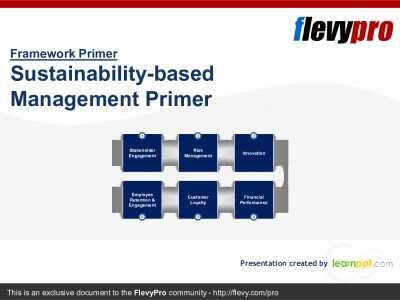
Today's executives are dealing with a complex and unprecedented brew of social, environmental, market, and technological trends which requires sophisticated Sustainability-Based Management.
A large group of executives have their own reluctance of various levels toward Sustainability due to the [read more]
"All what you need to know about ESG in this document - 148 Slides."
Introduction
In the evolving landscape of business and finance, Environmental, Social, and Governance (ESG) factors have surged to the forefront, playing a significant role in the decision-making process of investors, [read more]
ISO 20400:2017 is the world's first International Standard for sustainable procurement. The standard provides guidelines for integrating sustainability into an organization's procurement processes.
Aimed at top managers and directors of the purchasing function, it helps to align [read more]
 Global economic systems are entering a period of structural disruption. Geopolitical fragmentation, climate volatility, and resource scarcity are redefining the boundaries of growth. Traditional land-based models are increasingly constrained by finite resources, regulatory pressure, and diminishing marginal returns.