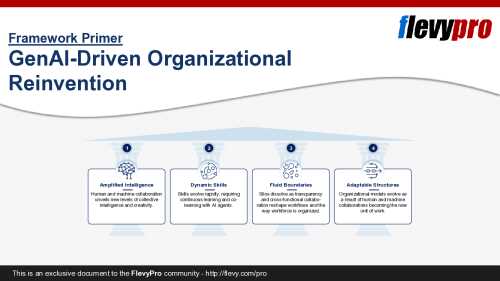
Editor's Note: Take a look at our featured best practice, GenAI Roadmap Design (30-slide PowerPoint presentation). Organizations worldwide are embracing GenAI for its ability to generate actionable insights, predict outcomes, personalize at scale, and process natural language with human-like fluency.
Leading organizations already deploy GenAI in AI-assisted software development, workflow automation, [read more]
* * * *
Artificial Intelligence (AI) has evolved through 3 distinct eras. The Diagnostic Era focused on understanding what happened through Machine Learning (ML) and data analysis. The Predictive Era enabled organizations to forecast future outcomes using advanced analytics, simulation, and optimization techniques. Today, the Generative Era fundamentally changes AI’s role. Rather than merely analyzing or predicting, Generative AI (GenAI) creates content, writes software, summarizes knowledge, assists decision-making, and increasingly collaborates with people in executing work.
This represents far more than another technology upgrade. It changes how work itself is performed. For the first time, advanced AI capabilities are accessible to virtually every knowledge worker through natural language. Employees no longer need specialized technical expertise to leverage sophisticated AI models.
However, widespread accessibility alone does not guarantee widespread adoption. The real challenge is not technology. It Is trust. Employees generally recognize the potential benefits of AI. Many already understand the technology and believe they can develop the necessary skills. Yet uncertainty persists regarding how organizations will deploy GenAI and what that means for careers, workloads, and future opportunities.
Research highlights several important perception gaps between executives and employees. Workers consistently express greater concern about stress, burnout, job security, and the quality of AI-generated outputs than executive teams often recognize. Ironically, employees also tend to be more confident in their ability to learn GenAI than many leaders assume.
This disconnect creates a significant trust gap. Without addressing these concerns, organizations risk slowing adoption, reducing engagement, and limiting the return on substantial AI investments. Technology implementation alone cannot close this gap. Leadership can. That’s where the GenAI-Driven Workforce Transformation framework creates value for organizations.
The framework emphasizes that organizations must communicate transparently, involve employees early, invest in continuous reskilling, and demonstrate that GenAI is designed to augment human capability rather than simply replace it. Only then can organizations unlock the full benefits of AI Transformation.
The Trifecta of Opportunities
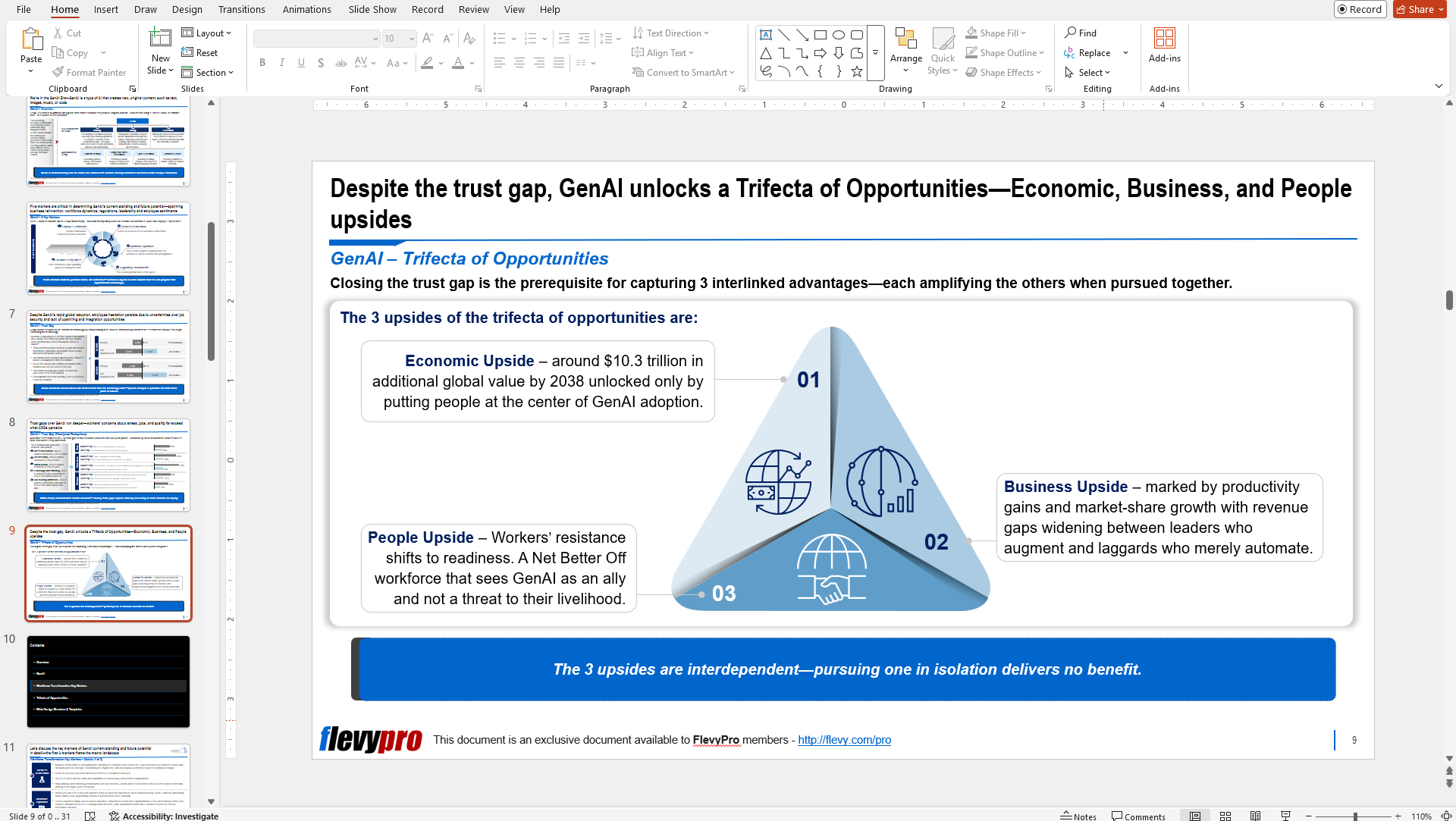
Closing the GenAI trust gap opens the door to 3 interconnected opportunities.
These opportunities should not be viewed independently. Each reinforces the others, creating a compounding effect that determines long-term organizational success.
Economic Upside
Business Upside
People Upside
Together, they form what can be called the Trifecta of Opportunities. Let’s discuss the first 2 upsides in more detail, for now.
Economic Upside
Perhaps the most compelling argument for people-centered AI comes from its economic impact. Different approaches to GenAI adoption produce dramatically different outcomes over time. Organizations that aggressively pursue AI primarily as a cost-cutting exercise often realize faster short-term efficiency gains. However, those gains eventually plateau.
In contrast, organizations that combine responsible AI adoption with workforce development, innovation, and human augmentation continue generating increasing value year after year. Research suggests that this people-centric path could unlock approximately $17.9 trillion in additional economic value globally by 2038, compared with $7.6 trillion under an aggressive cost-reduction strategy. The difference of roughly $10.3 trillion represents the economic value of choosing people over pure automation.
The implication is profound. Cost reduction creates immediate financial improvements, but investment in people creates compounding competitive advantage. Organizations that continuously develop talent alongside technology ultimately outperform those focused solely on efficiency.
Business Upside
The second opportunity extends beyond productivity. Business leaders increasingly recognize that GenAI is not simply another automation tool, it is becoming a catalyst for enterprise reinvention. Organizations leading in continuous reinvention consistently achieve stronger business outcomes than those treating AI as isolated technology projects.
When companies integrate GenAI into core business processes while simultaneously redesigning workflows and developing workforce capabilities, the benefits multiply. Technology investments alone typically generate modest productivity improvements. However, organizations that combine technology, data, leadership, and people-focused Business Transformation can nearly triple those gains.
Involving employees directly in Transformation efforts accelerates organizational change. Companies that actively engage their workforce move faster, scale innovation more effectively, and adapt more successfully to changing market conditions. This helps explain why leading organizations increasingly view GenAI as a revenue-growth strategy rather than merely a cost-saving initiative.
Case Study
A compelling example of the People Upside comes from Accenture’s own sales organization, where 53 sales professionals participated in a GenAI pilot. Rather than introducing AI as a top-down technology deployment, employees were first engaged in redesigning their workflows and then involved in shaping how GenAI tools would support their daily work. The outcome was significant: productivity improved by 34%, confidence in using AI increased by 34%, meaningful work improved by 31%, and employees reported 29% better stress management. Notably, the strongest improvements were observed among experienced employees, dispelling the myth that tenured workers are resistant to AI-driven change. The case reinforces a critical lesson: organizations realize the greatest return from GenAI when they transform work with people, not around them.
FAQs
Why is Generative AI considered a Business Transformation rather than just a technology initiative?
Generative AI affects far more than individual productivity. It reshapes business processes, decision-making, workforce capabilities, customer experiences, and operating models, making it an enterprise-wide transformation rather than a standalone technology deployment.
What is the “Trifecta of Opportunities” in Generative AI?
The Trifecta of Opportunities refers to the 3 interconnected benefits of GenAI adoption: Economic Upside (long-term value creation), Business Upside (higher productivity and competitive growth), and People Upside (greater employee readiness, engagement, and trust). Organizations maximize value only when all 3 are pursued together.
Why is trust such an important factor in successful GenAI adoption?
Employees are more likely to embrace GenAI when they trust that the technology will augment their work rather than replace them. Transparent communication, responsible governance, continuous learning, and employee involvement are essential to building that trust.
Can organizations achieve meaningful ROI from GenAI without investing in workforce development?
Short-term productivity gains are possible, but sustainable competitive advantage is unlikely. Research consistently shows that organizations combining technology investments with leadership development, reskilling, and human-centered change achieve significantly greater business and economic returns.
What should leaders prioritize to successfully scale GenAI across the enterprise?
Leaders should focus on modernizing the digital and data foundation, establishing responsible AI governance, redesigning business processes, investing in workforce capabilities, and fostering a culture of continuous learning. Successful GenAI transformation is driven as much by leadership and people as by technology.
Concluding Thoughts
Generative AI represents one of the most consequential shifts in the future of work, but its ultimate impact will be determined not by the sophistication of algorithms, but by the quality of leadership and the choices organizations make today. The organizations that achieve lasting competitive advantage will be those that look beyond automation and embrace the Trifecta of Opportunities—creating economic value, accelerating business reinvention, and empowering their people simultaneously. In the GenAI era, technology may be the catalyst, but people remain the multiplier. Organizations that recognize this distinction will be best positioned to lead the next wave of enterprise transformation.
Those that simultaneously pursue the Economic, Business, and People Upsides create a reinforcing cycle where stronger employees drive better business outcomes, better business outcomes generate greater economic value, and greater value enables further investment in people. That is the true power of the Trifecta of Opportunities.
You can download in-depth presentations on this and hundreds of similar business frameworks from the FlevyPro Library. FlevyPro is trusted and utilized by 1000s of management consultants and corporate executives.
For even more best practices available on Flevy, have a look at our top 100 lists:
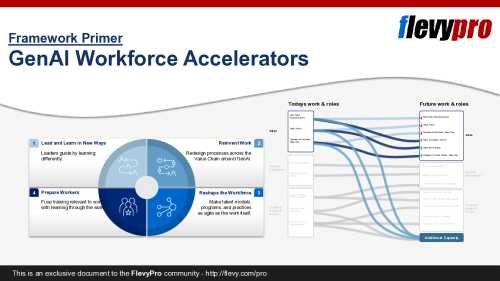
Generative AI (GenAI) is the most significant shift to work since the industrial revolution--and the Trifecta of Opportunities it unlocks (the economic, business, and people upsides) is the strategic objective. This presentation moves from the opportunity to the path: how leaders capture [read more]
Readers of This Article Are Interested in These Resources
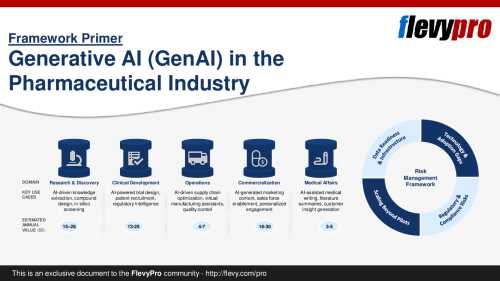
Pharmaceutical companies recognize the immense potential of Generative AI (GenAI) to accelerate drug discovery, improve clinical trials, and optimize commercial operations. Yet, capturing real value requires moving beyond hype to structured implementation strategies.
The McKinsey Global [read more]
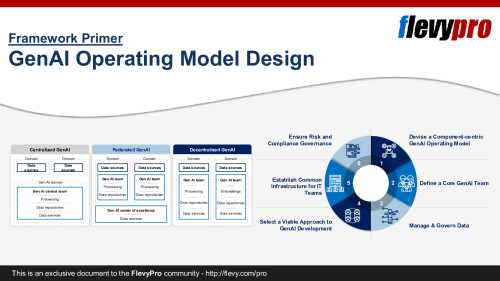
GenAI use is rising globally. Many organizations set GenAI strategies and launch pilots across functions. Yet most stall at the proof-of-concept stage and never show measurable financial or operational results.
This PPT presentation outlines the missing piece: an effective GenAI Operating [read more]
Generative AI (GenAI) marks a turning point in how organizations function and compete today. Similar to how the industrial revolution reshaped production, this wave of GenAI forces leaders to reimagine operating models, workforce design, and decision‑making at unprecedented speed.
This [read more]
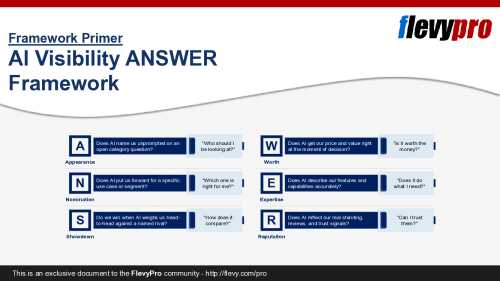
A fast-growing share of buyers now open an AI answer engine--ChatGPT, Perplexity, Google's AI answers, Claude, or Copilot--instead of a search engine, asking for an answer rather than a page of links. The engine names a few options, recommends one, and passes judgment on price and trust. [read more]