Editor's Note: Take a look at our featured best practice, Digital Transformation: Artificial Intelligence (AI) Strategy (27-slide PowerPoint presentation). The rise of the machines is becoming an impending reality. The Artificial Intelligence (AI) revolution is here. Most businesses are aware of this and see the tremendous potential of AI.
This presentation defines AI and explains the 3 basic forms of AI:
1. Assisted Intelligence
2. [read more]
* * * *
Artificial Intelligence has shifted from pilot experimentation to enterprise scale deployment. Organizations are investing heavily to improve Operational Excellence, strengthen decision making, and unlock new value streams. Despite this momentum, many initiatives fail to scale, with the primary constraint being governance rather than technology.
AI Risk and Controls Management framework introduces a fundamentally different risk profile compared to traditional systems. Models evolve continuously, depend on dynamic data inputs, and often operate with varying degrees of autonomy. This creates uncertainty that legacy Risk Management frameworks, designed for static processes and predictable outputs, are not equipped to handle.
As a result, organizations face a structural execution gap. AI initiatives move quickly through development but slow during validation and approval stages. Risk, Legal, and Compliance teams are often engaged too late, leading to conservative interpretations, delays, rework, or project stoppage. Leading organizations are responding by redesigning AI Risk and Controls Management as a strategic enabler of Business Transformation. This requires embedding structured governance across the full AI lifecycle rather than applying it as a late-stage compliance checkpoint.
The 4 Foundational Risk and Control Guardrails
Establish an AI council
Engage risk and control partners early
Clarify minimum risk requirements
Adopt a fit-for-purpose maturity model
These guardrails collectively shift governance from reactive oversight to proactive enablement, ensuring that Innovation and Risk Management operate in alignment rather than opposition.
Key Benefits of the Framework
Organizations that implement structured AI governance typically achieve three outcomes. First, faster time to value through reduced approval bottlenecks and earlier risk alignment. Second, improved control effectiveness, ensuring that regulatory, ethical, and data requirements are embedded into design rather than retrofitted. Third, stronger stakeholder confidence, particularly in environments where AI transparency and accountability are under increasing scrutiny.
The framework also improves Organizational Alignment. Development teams gain clarity on expectations, while control functions gain visibility into design decisions earlier in the process. This reduces friction and improves execution consistency.
Establish an AI council
The first foundational guardrail is the establishment of an AI Governance Council. This function acts as the central decision-making body for AI Risk Management, Strategy Development alignment, and Technology oversight. Its primary role is to eliminate fragmented governance structures that often exist across business units. Without central coordination, organizations typically develop inconsistent AI policies, duplicative controls, and conflicting approval standards. This creates execution inefficiency and increases compliance risk.
The AI Governance Council establishes a single source of truth for AI policies, standards, and escalation pathways. It also ensures alignment between Innovation priorities and Risk Management requirements. Importantly, it creates accountability at the enterprise level rather than leaving governance dispersed across functions. Effective councils include representation from Technology, Risk, Legal, Compliance, and key business units. Their mandate is not to slow down execution but to standardize decision rights and reduce ambiguity. In mature organizations, this structure becomes a core component of Operational Excellence in AI deployment.
Engage risk and control partners early
The second foundational guardrail is early engagement of Risk, Legal, and Compliance functions during the design phase of AI initiatives. This marks a shift from traditional end stage validation to embedded governance across the AI lifecycle. In many organizations, control functions are involved only after models are fully developed. At that point, key design decisions are already fixed, limiting flexibility. Risk and Compliance teams are then required to assess systems retrospectively, often resulting in conservative approvals, redesign cycles, or delays.
Early engagement changes this dynamic. Involving control functions at the ideation and design stage allows organizations to identify regulatory, ethical, and operational risks before they are embedded in system architecture. This reduces downstream rework, accelerates approval cycles, and improves solution quality by integrating governance requirements into data design, model development, and deployment strategy from the outset.
Over time, it strengthens collaboration between Innovation and Control functions, positioning Risk Management as a design input rather than a post hoc gatekeeper.
Case Study
A global financial institution launched an enterprise AI transformation focused on credit risk modeling and customer personalization. Early results showed strong technical performance, but the program failed to scale beyond pilot phases. The main constraint emerged during governance review. Risk and Compliance functions were engaged late and raised concerns around model transparency, data usage, and regulatory alignment. This resulted in paused initiatives, redesign requirements, and significant delivery delays.
To address this, the organization implemented a revised AI governance framework based on four guardrails. An AI Governance Council was established to centralize cross business decision making. Risk, Legal, and Compliance teams were embedded into early-stage design workshops. Minimum control standards were defined for data governance, explainability, and ethical use. A maturity-based governance model was introduced to separate low risk automation from high risk decisioning systems.
Within one year, approval cycle times declined, deployment velocity increased, and regulatory escalations reduced. The organization moved from fragmented experimentation to scalable AI deployment with controlled risk exposure.
FAQs
How does this framework differ from traditional Risk Management?
Traditional Risk Management is typically reactive and validation focused. This framework embeds governance into the design phase of AI systems, making it proactive and integrated.
Can this model slow down Innovation?
No. When implemented correctly, it reduces rework and accelerates approvals by addressing risk earlier in the lifecycle.
Is an AI Governance Council necessary for all organizations?
Yes, for any organization scaling AI across multiple business units. It ensures consistency, accountability, and strategic alignment.
How should organizations define minimum risk requirements?
Requirements should cover data governance, model transparency, ethical considerations, and regulatory compliance baselines.
What is the role of maturity-based governance?
It ensures that governance intensity is proportional to risk level, allowing low risk applications to scale quickly while maintaining strict oversight for high-risk use cases.
Closing Thoughts
AI scale does not fail due to lack of technical capability. It fails when governance structures are not aligned with the speed and complexity of AI systems. Organizations that treat AI Risk and Controls Management as a strategic enabler rather than a compliance gatekeeper will unlock faster deployment cycles and higher quality outcomes. Those that rely on legacy governance models will continue to experience delays, rework, and constrained Innovation.
The direction is clear. Governance must move upstream into the design phase. Control functions must become embedded partners in Strategy Development and execution. And governance structures must be designed for adaptability, not static enforcement.
In AI driven organizations, governance is no longer a constraint to manage. It is a capability to design.
You can download in-depth presentations on this and hundreds of similar business frameworks from the FlevyPro Library. FlevyPro is trusted and utilized by 1000s of management consultants and corporate executives.
For even more best practices available on Flevy, have a look at our top 100 lists:
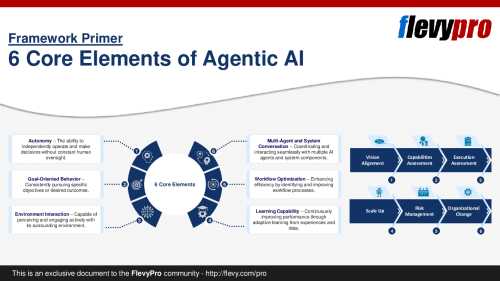
Agentic AI represents a shift toward autonomous, intelligent systems that can make decisions and take actions with minimal human intervention. Evolving from traditional machine learning, this technology enhances operations by automating complex workflows, optimizing decision-making, and enabling [read more]
Readers of This Article Are Interested in These Resources
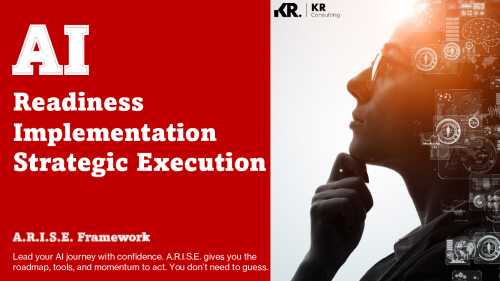
Artificial Intelligence (AI) is no longer a future concept - it's a present-day business imperative. AI is transforming how organizations operate, compete, and create value. Yet, with its rapid evolution, many enterprises struggle to keep pace. The A.R.I.S.E. Framework is a proven, [read more]
Curated by McKinsey-trained Executives
How to Use AI Skills for Consulting - The Complete AI-Powered Consulting Framework Guide
Stop leaving millions in consulting value on the table.
Most consultants destroy competitive advantage not because they lack brilliant analytical minds or [read more]
Curated by McKinsey-trained Executives
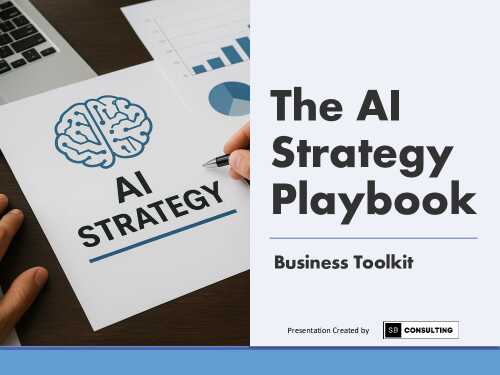
Unlock the Future of Your Business with the Ultimate AI Strategy Playbook: 1000+ Slides to Master AI and Dominate Your Industry
In today's fast-evolving digital landscape, Artificial Intelligence (AI) is no longer a luxury -- it's a [read more]
Organizations worldwide are embracing GenAI for its ability to generate actionable insights, predict outcomes, personalize at scale, and process natural language with human-like fluency.
Leading organizations already deploy GenAI in AI-assisted software development, workflow automation, [read more]
 Artificial Intelligence has shifted from pilot experimentation to enterprise scale deployment. Organizations are investing heavily to improve