Editor's Note: Take a look at our featured best practice, 6 Core Elements of Agentic AI (36-slide PowerPoint presentation). Agentic AI represents a shift toward autonomous, intelligent systems that can make decisions and take actions with minimal human intervention. Evolving from traditional machine learning, this technology enhances operations by automating complex workflows, optimizing decision-making, and enabling [read more]
* * * *
Artificial Intelligence is rapidly moving beyond conversational assistance and isolated Automation. Organizations are increasingly exploring AI agents that can reason, plan, interact with enterprise systems, and execute multi-step workflows with minimal human intervention. The promise is significant: simplified workflows, lower operating costs, faster execution, better decision-making, and greater organizational leverage. Yet many organizations remain stuck at the pilot stage because deploying an individual agent is considerably easier than creating an enterprise environment in which multiple agents can operate reliably, securely, and at scale.
The challenge is no longer simply which AI model to use. Organizations must determine how agents will access enterprise knowledge, interact with systems, coordinate with one another, operate within defined boundaries, and continuously improve. The real potential of Agentic AI emerges when organizations move beyond deploying individual AI agents and instead create hierarchies of specialized agents that can collaborate, delegate, and coordinate work. The Agentic Architecture is an enterprise framework that enables AI agents to move from experimentation to dependable production deployment.
Rather than asking one agent to perform every task, the Agentic Architecture distributes responsibilities across 3 levels of intelligence: specialized agents at the base, domain agents in the middle, and higher-level agents at the top layer. Each layer has a distinct role, while collectively they enable increasingly complex, end-to-end business processes to be executed with greater autonomy.
Super Agents (Middle Layer) – Domain-oriented agents that understand a broader objective and mobilize the appropriate Utility Agents to accomplish it.
Orchestrator Agents (Top Layer) – Higher-level agents that interpret overarching goals, coordinate multiple Super Agents, manage dependencies, and oversee the end-to-end workflow.
Let’s dive deeper into the first 2 layers of the framework, for now.
Utility Agents
Utility Agents form the base layer of the agentic architecture and provide the specialized capabilities on which higher-level agents depend. These agents are designed around relatively focused tasks or capabilities—for example, retrieving information, validating data, analyzing documents, checking compliance requirements, generating a report, processing a transaction, or interacting with a particular enterprise application. Their strength comes from specialization: rather than attempting to solve an entire business problem, each Utility Agent performs a defined function autonomously and returns its output to the agent coordinating the broader task. This separation of responsibilities allows organizations to build a library of reusable capabilities that can be invoked across multiple workflows.
The importance of this layer lies in granularity and reusability. A procurement process, for example, might employ separate Utility Agents for supplier discovery, contract analysis, pricing comparison, compliance verification, and purchase-order processing. These agents can operate against the relevant enterprise systems and data sources while remaining focused on their specific responsibilities. Higher-level agents can then combine these capabilities dynamically rather than requiring a single, monolithic agent to possess every skill. This modularity can make agentic systems easier to scale, maintain, test, and govern.
Super Agents
Super Agents sit above Utility Agents and transform individual capabilities into coordinated business outcomes. While a Utility Agent may be responsible for a single task, a Super Agent understands a broader goal within a particular business domain and determines which combination of Utility Agents is required to achieve it. It can interpret the user’s intent, break the objective into constituent activities, mobilize the relevant specialists, manage dependencies, and consolidate their outputs into a coherent result.
Consider a customer-service Super Agent tasked with resolving a complex customer complaint. Rather than attempting to solve the problem itself, it could invoke a customer-history Utility Agent, a policy-retrieval agent, a billing-analysis agent, and a resolution-recommendation agent. The Super Agent coordinates these activities, determines what information is still required, evaluates the outputs, and formulates an appropriate resolution. In this way, the Super Agent acts as a domain-level intelligence and coordination layer, translating a broader business objective into executable work while shielding users and higher-level agents from the complexity of individual tasks.
Case Study
An example highlighted in the presentation illustrates the emerging business value of multi-agent systems. BMW, in partnership with Accenture, deployed multi-agent systems in sales Decision-making, reportedly improving productivity by 30–40% and allowing employees to focus more heavily on higher-value strategic work.
The example illustrates an important shift: agentic AI is not simply about replacing individual manual tasks. Its greater potential lies in coordinating intelligence across workflows, allowing people to move away from repetitive execution toward activities requiring judgment, relationship management, and strategic thinking.
FAQs
Why is an enterprise architecture necessary for AI agents?
Individual agents can be developed relatively quickly, but enterprise deployment requires reliable infrastructure, integrated data, security, governance, system connectivity, monitoring, and continuous improvement. Architecture provides the foundation for scaling beyond isolated pilots.
Why use multiple layers of agents instead of one powerful AI agent?
A single agent can become difficult to manage as the number of tasks, tools, data sources, and business rules increases. A hierarchical architecture separates responsibilities, allowing specialized agents to focus on specific capabilities while higher-level agents manage coordination.
What is the primary role of a Utility Agent?
A Utility Agent performs a specific, well-defined task or capability. Examples include retrieving data, analyzing a document, validating a transaction, performing calculations, or interacting with an enterprise application.
How is a Super Agent different from a Utility Agent?
A Utility Agent executes an individual task, whereas a Super Agent understands a broader business objective and coordinates multiple Utility Agents to accomplish it. The Super Agent therefore operates at a higher level of abstraction.
Does every agentic system need all three layers?
Not necessarily. The appropriate architecture depends on the complexity of the problem. Simple, narrowly defined use cases may be better served by a single agent or a small group of specialized agents. Three-tier hierarchy becomes particularly valuable when workflows involve multiple domains, dependencies, and sequential or parallel tasks.
Is Agentic Architecture purely a technology initiative?
No. Technology is an important foundation, but enterprise-scale agentic AI also requires governance, security, data management, operational discipline, and clearly defined boundaries for autonomous decision-making.
Conclusion
Agentic AI’s transformation from experimental technology into an enterprise capability depends on more than increasingly powerful models. The three-tier Agentic Architecture provides a blueprint for moving from individual AI capabilities to coordinated, autonomous enterprise workflows. Utility Agents create the execution capacity; Super Agents transform those capabilities into domain-level solutions; and Orchestrator Agents provide the overarching coordination needed to manage complex, cross-functional objectives. The architecture therefore mirrors an effective organizational model—specialists execute, managers coordinate, and enterprise-level orchestration aligns the whole system toward a common outcome.
As organizations scale their use of Agentic AI, the differentiator will increasingly be not the number of agents deployed, but how effectively those agents are structured, coordinated, governed, and connected to business processes. A well-designed hierarchy provides the foundation for turning autonomous AI from isolated point solutions into an integrated digital workforce.
You can download in-depth presentations on this and hundreds of similar business frameworks from the FlevyPro Library. FlevyPro is trusted and utilized by 1000s of management consultants and corporate executives.
For even more best practices available on Flevy, have a look at our top 100 lists:
Curated by McKinsey-trained Executives
Unlock the Future of Business with the Ultimate Agentic AI Playbook: The Only Resource You'll Ever Need to Dominate the AI Revolution
In today's fast-paced, tech-driven world, the companies that stay ahead of the curve are the ones that fully [read more]
Readers of This Article Are Interested in These Resources
Most organizations have realized wins by developing AI and analytics capabilities. The challenge is scaling those wins so they are seen in operations, customer experience and financial results, however, tools alone rarely deliver that outcome.
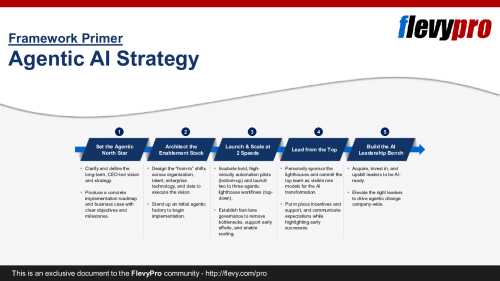
An Agentic AI Strategy focuses on building the [read more]
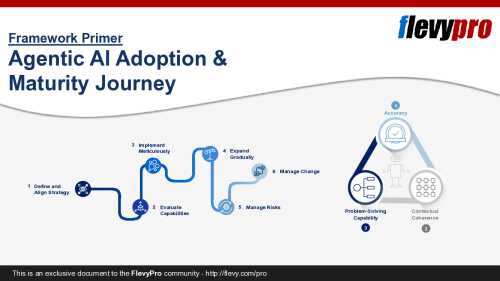
Agentic AI marks the shift from AI that analyzes and predicts to AI that acts. Autonomous agents now reason, plan, and execute multi-step workflows, collaborating with one another and with people to deliver outcomes. Executives know the stakes: 73% believe AI will fundamentally shift how their [read more]
Curated by McKinsey-trained Executives
100+ Agentic Organization SOPs Library
Complete AI-First Operating System -- Delivered in a Scalable Excel Template
Build, govern, and scale a fully Agentic Organization with confidence.
This 100+ Agentic Organization SOPs Library is a [read more]
Curated by McKinsey-trained Executives
🚀 McKinsey-Style Agentic AI Skills Toolkit
The Most Advanced Enterprise AI Operating System for Strategic Decision Intelligence
Stop using AI as a chatbot. Start deploying it as a multi-agent executive intelligence system.
This is not a prompt [read more]
 Artificial Intelligence