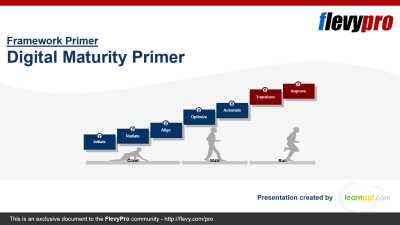
Editor's Note: Take a look at our featured best practice, Digital Insurance Maturity Model (25-slide PowerPoint presentation). This deck provides an outline for
1. The strategic necessity facing Insurers in embracing digital
2. The major technology and architectural components needed to be in place to be truly digital
3. Exploration of stages of excellence for insurers against each of these seven components, [read more]
* * * *
Agentic AI marks the shift from AI that analyzes and predicts to AI that acts. Autonomous agents now reason, plan, and execute multi-step workflows, collaborating with one another and with people to deliver outcomes rather than outputs. Executives have registered the stakes: 73% believe AI will fundamentally shift how their organizations create, deliver, and capture value within 3 years, and GenAI is projected to add between $2.6 trillion and $4.4 trillion annually to the global economy. In the energy sector alone, AI-related investment is forecast to more than triple, from $40 billion in 2023 to $140 billion by 2030.
Early adopters compound advantages across innovation, customer relationships, operational efficiency, and institutional learning, shaping industry standards while erecting entry barriers through deep AI integration. Late movers inherit the mirror image: they fight for penetration in segments already claimed, confront hurdles entrenched rivals deliberately raised, and retrofit compliance and trust after competitors have defined expectations. Late adoption saves on initial outlay, but at the expense of market influence, Customer Loyalty, and long-term profitability, advantages that cannot be recovered later.
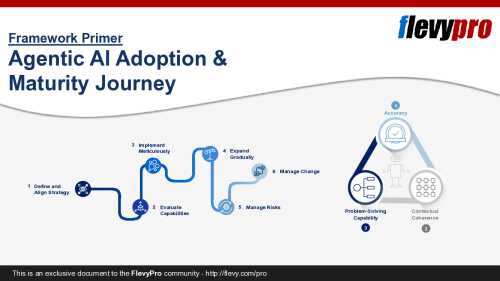
Yet knowing the stakes is not the same as knowing the path. Most organizations understand that Agentic AI matters; far fewer possess a structured route from first pilot to enterprise maturity, which is why so many efforts stall as scattered experiments. The Agentic AI Adoption & Maturity Journey framework supplies that route through 6 key steps:
Define and Align Strategy. Establish the AI vision, secure commitment, and prioritize high-impact use cases.
Evaluate Capabilities. Assess infrastructure, data, talent, and platform readiness honestly.
Implement Meticulously. Validate value through pilots and controlled releases before scaling.
Manage Risks. Embed governance, compliance, and ethical safeguards as adoption scales.
Manage Change. Reshape culture, skills, and leadership mindset to sustain the Transformation.
The journey rests on a set of pillars that span every step: clearly defined objectives, committed senior leadership, the right infrastructure and talent, the discipline to scale successful pilots, robust feedback loops, sound governance, and clear communication with continuous adaptation. Let’s examine the first 2 steps more closely, for now.
Step 1: Define and Align Strategy
Every durable AI capability begins with a deliberate strategy, and the reason is unforgiving: every subsequent stage of the journey inherits the clarity, or the confusion, established here. Organizations must define measurable business objectives, align AI initiatives with Corporate Strategy, secure executive and stakeholder commitment, and prioritize the high-impact use cases that deliver tangible value.
The work runs along 5 lines. First, define a clear AI vision tied to specific business outcomes, such as optimizing costs, enhancing profitability, or strengthening customer relationships. Second, select the projects that actually advance that vision, since an AI portfolio assembled by enthusiasm rather than intent is the most common early failure. Third, secure leadership and stakeholder buy-in, which is what unlocks resources, drives Digital Transformation, and keeps projects aligned with Enterprise Strategy when priorities collide. Fourth, identify, rank, and prioritize the use cases where AI delivers maximum near-term value, whether by resolving the most pressing challenges or by lifting revenue and ROI quickly. Fifth, engage experienced AI professionals to craft a customized strategy grounded in deliberate, data-driven decisions rather than vendor enthusiasm.
A well-defined roadmap emerging from this step keeps AI investments focused, scalable, and aligned with long-term objectives.
Step 2: Evaluate Capabilities
Ambition without readiness produces failed pilots that get blamed on the technology. The second step prevents that outcome through a broad, honest assessment of organizational readiness spanning IT infrastructure, platforms, scalability, integration, data, and talent.
The assessment covers 4 fronts. On systems, determine whether existing infrastructure can support AI workloads across computation, storage, scalability, security, and network resilience, and weigh commercial platforms against open-source options deliberately rather than by default. On integration, assess the compatibility of Agentic AI with existing systems, tools, and processes, since agents that cannot connect to the enterprise cannot act within it. On data, prepare the foundation for richer AI reasoning and establish governance for clean datasets, because agent output quality is bounded by data quality. On people, audit in-house skills in Machine Learning, data engineering, and AI ethics, then map the gaps across data infrastructure, talent, and governance frameworks, benchmarking against industry leaders to calibrate how ready the organization truly is.
Capability gaps discovered at this stage are normal and finding them now is precisely the point. Closing them deliberately, by engaging consultants or academia for specialized knowledge and investing in training that builds cross-functional adoption, is far cheaper than discovering them mid-deployment.
Case Study
A regional bank illustrates how early discipline pays off downstream. Facing rising service costs and pressure from digital-first competitors, the bank resisted the urge to deploy agents immediately and instead spent its first quarter on defining and aligning strategy and evaluating its capabilities. Their leadership defined a focused AI vision anchored in 2 outcomes, reducing cost-to-serve and deepening customer relationships. A capability assessment revealed that while its core systems could support AI workloads, its customer data was fragmented across silos and its teams lacked ML and AI governance skills. Those findings reshaped the plan. The bank consolidated its data foundation, engaged external specialists to close the skills gap, and then piloted an agentic customer-service capability in a single product line, with success indicators defined upfront. The pilot resolved a majority of routine queries autonomously and escalated the remainder with full context, lifting resolution speed and satisfaction scores while cutting service costs. Scaled gradually across product lines with governance and human-review checkpoints embedded from the start, the program delivered expansion without incident, adoption without resistance, and returns that compounded quarter over quarter.
FAQs
What distinguishes Agentic AI from earlier AI deployments?
Earlier AI analyzed data and predicted outcomes, leaving action to people. Agentic AI acts: autonomous agents reason, plan, and execute multi-step workflows, coordinating with other agents and enterprise systems to deliver outcomes with minimal human intervention.
Why do most Agentic AI initiatives stall at the pilot stage?
Usually because the journey started at step 3. Pilots launched without a defined strategy or an honest capability assessment inherit misaligned goals and hidden gaps in data, integration, or skills, and the resulting failures get misattributed to the technology.
How should organizations choose their first use cases?
Rank candidates by near-term value and strategic fit: use cases that resolve pressing challenges or lift revenue and ROI quickly, while advancing the defined AI vision. Early wins fund credibility for the longer journey.
Is it too late for organizations that have not yet started?
Later is costlier, not hopeless. The compounding advantages of early adopters are real, but a disciplined journey still beats an improvised one, and organizations that start now with structure will overtake earlier movers who scaled chaos instead of capability.
Who should own the adoption journey?
Senior leadership, jointly with the business and technology functions. Strategy cannot be delegated to the technology or to a single department, and the pillars that span the journey, from governance to communication, all require executive weight behind them.
Concluding Thoughts
The steps detailed here happen before any AI agent is deployed, and both determine what everything afterward inherits. Strategy decides what the enterprise is building toward; the capability assessment decides what it is building on. Organizations that invest in these foundations convert AI ambition into a maturity journey, while those that skip ahead accumulate pilots, technical debt, and disappointment.
Agentic AI will keep advancing regardless of any single organization’s pace. The question leadership controls is whether adoption proceeds by design or by improvisation, and organizations that follow a structured maturity journey compound their advantage at every step, while improvisers accumulate risk at the same rate.
You can download in-depth presentations on this and hundreds of similar business frameworks from the FlevyPro Library. FlevyPro is trusted and utilized by 1000s of management consultants and corporate executives.
For even more best practices available on Flevy, have a look at our top 100 lists:
Agentic AI marks the shift from AI that analyzes and predicts to AI that acts. Autonomous agents now reason, plan, and execute multi-step workflows, collaborating with one another and with people to deliver outcomes. Executives know the stakes: 73% believe AI will fundamentally shift how their [read more]
Readers of This Article Are Interested in These Resources
Driven by 8 core emerging technologies, the role of technology in an organization is shifting from being a business enabler to a business driver. As companies transform "digitally," they go through a process where their technological capabilities mature and evolve over time.
This is captured [read more]
Go digital or go home. To survive in the Digital Age, organizations must develop their digital capabilities to not only support strategies and reach customers, but also to modernize and achieve efficiencies in their internal operations and processes. The pursuit of Digital Maturity is quickly [read more]
Digital Transformation is being embraced by organizations because it offers a significant leap in operational efficiency and potential revenue gains.
For instance, RPA allows organizations to streamline processes, reduce human error, and free up staff for higher-value tasks by automating [read more]
Digital Transformation is a matter of survival now for all organizations particularly businesses.
Digital Transformation is typically more difficult than any change or Transformation program that an organization may undertake.
Most organizations struggle to make the fundamental alterations [read more]