Editor's Note: Take a look at our featured best practice, GenAI Roadmap Design (30-slide PowerPoint presentation). Organizations worldwide are embracing GenAI for its ability to generate actionable insights, predict outcomes, personalize at scale, and process natural language with human-like fluency.
Leading organizations already deploy GenAI in AI-assisted software development, workflow automation, [read more]
* * * *
Generative AI is rapidly becoming one of the most disruptive forces in modern organizational history. Unlike previous waves of technology adoption that primarily automated specific processes or improved operational efficiency, Generative AI has the potential to fundamentally reshape how organizations create value, make decisions, develop talent, and compete.
Many leaders continue to view AI through a narrow lens focused on productivity enhancement and automation. This perspective significantly understates the scale of transformation underway. Generative AI is not simply another technology investment. It is a catalyst for Organizational Reinvention.
The organizations that will achieve sustainable Competitive Advantage in the coming decade will not be those that deploy AI tools most aggressively. They will be those that redesign their Operating Models to integrate technology, talent, workflows, and Organizational Structures into a cohesive system capable of continuous adaptation.
Research from Accenture highlights the magnitude of this shift. Nearly all executives expect Generative AI to fundamentally transform their industries. Organizations that have successfully embraced AI-driven reinvention have achieved substantially stronger growth than competitors. At the same time, many leaders acknowledge that they currently lack the capabilities required to lead large-scale AI transformation initiatives. This disconnects between ambition and readiness creates one of the most significant Leadership challenges of the decade.
The GenAI-Driven Organizational Reinvention framework provides a practical roadmap for addressing this challenge. It identifies four pillars that collectively define how organizations must evolve to remain competitive in an AI-enabled economy.
The 4 Pillars of GenAI-Driven Organizational Reinvention
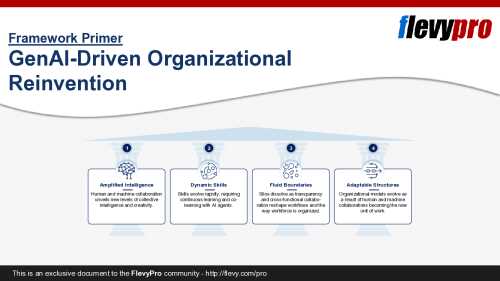
The framework is built upon four interconnected pillars:
Amplified Intelligence
Dynamic Skills
Fluid Boundaries
Adaptable Structures
Together, these pillars provide a blueprint for Organizational Transformation in an environment where technology evolves continuously and competitive advantages become increasingly temporary.
Strategic Benefits
Organizations that embrace GenAI-driven Organizational Reinvention can realize significant strategic advantages across multiple dimensions of performance. By combining human creativity with machine intelligence, they accelerate Innovation and unlock new sources of value creation. Adaptive workflows and AI-enabled decision-making processes enhance Organizational Agility, enabling faster responses to changing market conditions and emerging opportunities. Continuous learning ecosystems strengthen Workforce Resilience by ensuring employees can evolve alongside rapidly advancing technologies.
GenAI also improves collaboration across functions, geographies, and disciplines by facilitating greater transparency and knowledge sharing. As a result, organizations become more responsive to customer needs, competitive pressures, and industry disruptions. They are also able to develop scalable Operating Models that adapt continuously to technological change and evolving business demands. In contrast, organizations that fail to embrace reinvention risk becoming constrained by outdated structures, static skill models, and fragmented workflows that limit Innovation, reduce agility, and weaken long-term competitiveness.
Amplified Intelligence
The first pillar, Amplified Intelligence, represents one of the most significant shifts in Organizational Design. Traditional technology initiatives focused primarily on efficiency. Machines automated repetitive work while humans remained responsible for creativity, judgment, and problem solving. Generative AI changes this equation.
AI is increasingly functioning as a collaborative partner rather than a passive tool. Intelligent agents can generate ideas, analyze information, synthesize knowledge, identify patterns, and support decision-making activities in real time.
This creates what Accenture describes as “connective intelligence,” where humans and AI collaborate within integrated networks that distribute knowledge and insights across the organization. The result is a dramatic expansion of organizational intelligence. Employees gain immediate access to expertise and contextual insights. Leaders receive broader perspectives that improve Strategic Planning and Decision Making. Innovation cycles accelerate because ideas can be developed, evaluated, and refined significantly faster than traditional methods allow.
Amplified Intelligence transforms organizations from collections of individual expertise into interconnected intelligence ecosystems.
Dynamic Skills
The second pillar, Dynamic Skills, addresses a reality many organizations have not fully acknowledged. Skills are becoming obsolete faster than ever before. Historically, employees could rely on expertise acquired through education and experience for many years. Today, technological change is shortening the useful life of skills across nearly every industry.
Generative AI accelerates this trend dramatically. Tasks that previously required specialized expertise can increasingly be augmented or partially automated through AI systems. New roles emerge while existing roles evolve continuously. As a result, organizations can no longer treat Workforce Development as a periodic activity.
Learning must become a permanent organizational capability. According to the framework, organizations need predictive Workforce Planning, dynamic job architectures, and talent models designed around adaptability rather than static competencies.
Case Study
Accenture provides a practical example of Dynamic Skills in action through its GenAI-enabled Feedback Coach. Embedded within Microsoft Teams and Workday, the tool provides real-time guidance for performance feedback and employee self-reflection. The results were significant. Feedback completion rates increased substantially. Time required to produce quality feedback declined dramatically. The quality of performance discussions improved.
More importantly, the initiative demonstrated how AI can become an active participant in Workforce Development rather than simply an administrative tool. The organization transformed Performance Management from a periodic evaluation process into a continuous learning experience. This example illustrates how Dynamic Skills can create measurable improvements in both employee development and Organizational Effectiveness.
FAQs
Is GenAI primarily an automation technology?
No. Its greatest potential lies in Organizational Reinvention, including Decision Making, Innovation, Workforce Development, and Organizational Design.
Why are traditional Organizational Models becoming less effective?
Many traditional structures were designed for stability and predictability. GenAI creates environments that require continuous adaptation.
What is Amplified Intelligence?
Amplified Intelligence refers to the collaboration between humans and AI systems to enhance creativity, Innovation, and Decision Making.
Why are Dynamic Skills becoming important?
The rapid evolution of technology shortens skill lifecycles, making continuous learning essential for competitiveness.
What is the greatest challenge for leaders?
The greatest challenge is redesigning organizations to integrate technology, talent, and workflows into adaptive Operating Models.
Closing Thoughts
Generative AI is not simply transforming how work is performed. It is transforming how organizations are designed. The GenAI-Driven Organizational Reinvention framework provides leaders with a practical roadmap for navigating this transformation through Amplified Intelligence, Dynamic Skills, Fluid Boundaries, and Adaptable Structures.
Organizations that continue treating AI as a productivity tool will capture incremental benefits. Organizations that use AI to reinvent their Operating Models will create entirely new sources of value. The future belongs to organizations capable of continuously evolving their intelligence, skills, structures, and ways of working.
You can download in-depth presentations on this and hundreds of similar business frameworks from the FlevyPro Library. FlevyPro is trusted and utilized by 1000s of management consultants and corporate executives.
For even more best practices available on Flevy, have a look at our top 100 lists:
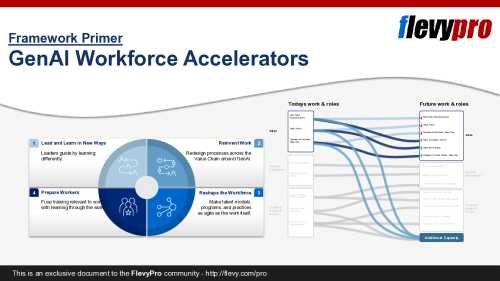
Generative AI (GenAI) is the most significant shift to work since the industrial revolution--and the Trifecta of Opportunities it unlocks (the economic, business, and people upsides) is the strategic objective. This presentation moves from the opportunity to the path: how leaders capture [read more]
Readers of This Article Are Interested in These Resources
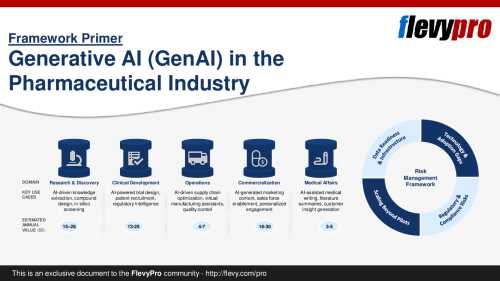
Pharmaceutical companies recognize the immense potential of Generative AI (GenAI) to accelerate drug discovery, improve clinical trials, and optimize commercial operations. Yet, capturing real value requires moving beyond hype to structured implementation strategies.
The McKinsey Global [read more]
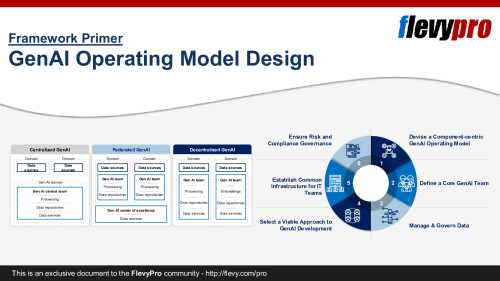
GenAI use is rising globally. Many organizations set GenAI strategies and launch pilots across functions. Yet most stall at the proof-of-concept stage and never show measurable financial or operational results.
This PPT presentation outlines the missing piece: an effective GenAI Operating [read more]
Generative AI (GenAI) marks a turning point in how organizations function and compete today. Similar to how the industrial revolution reshaped production, this wave of GenAI forces leaders to reimagine operating models, workforce design, and decision‑making at unprecedented speed.
This [read more]
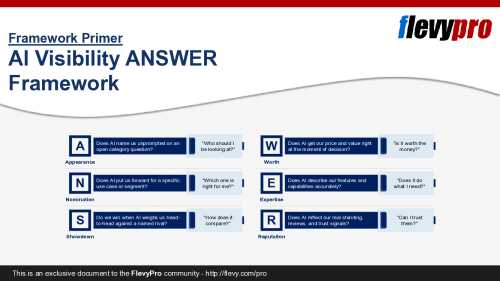
A fast-growing share of buyers now open an AI answer engine--ChatGPT, Perplexity, Google's AI answers, Claude, or Copilot--instead of a search engine, asking for an answer rather than a page of links. The engine names a few options, recommends one, and passes judgment on price and trust. [read more]
 Generative AI is rapidly becoming one of the most disruptive forces in modern organizational history. Unlike previous waves of technology adoption that primarily automated specific processes or improved operational efficiency, Generative AI has the potential to fundamentally reshape how organizations create value, make decisions, develop talent, and compete.