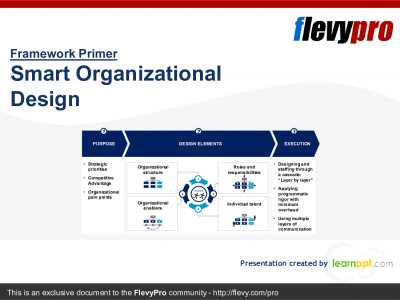
Editor's Note: Take a look at our featured best practice, Complete Organization Design Toolkit (103-slide PowerPoint presentation). Recent McKinsey research surveyed a large set of global executives and suggests that many companies, these days, are in a nearly permanent state of organizational flux. A rise in efforts in Organizational Design is attributed to the accelerating pace of structural change generated by market [read more]
* * * *
Operating Model Redesign (OMR) used to be a rare event, triggered by a merger, a new CEO, or a crisis. That is no longer the case. Roughly two-thirds of executives have been through a redesign in the past 2 years, and about half expect another within the next 2. Redesign has become a regular leadership task, and its purpose is consistent: close the gap between Strategy and Performance.
Yet too many redesigns fall short of that purpose. They rearrange reporting lines, react to the loudest complaints, and stall somewhere between the old model and the new one. Leaders often start with today’s frustrations rather than tomorrow’s aspirations. They choose a blueprint on instinct, redraw the organizational chart, and leave processes, people, rewards, and mindsets largely untouched. They under-measure the transition and under-communicate from the line. The result is wasted effort, sapped morale, and often another redesign a few years later.
Operating Model Redesign is the deliberate Restructuring of how an organization arranges its people, processes, technology, and governance to deliver its Strategy. Done well, it simplifies structures, clarifies roles, and integrates systems in ways that enable agility, efficiency, and sustainable performance. Done poorly, it moves boxes while the old organization keeps running underneath the new chart.
Research by McKinsey, drawing on the successes and failures of OMR initiatives across hundreds of enterprises, identified the Golden Rules of Operating Model Redesign framework that raises the odds of getting a redesign right. Organizations that applied more than 6 of them saw success rates rise to 73%. A 2025 follow-up study of 2,000 executives across 16 sectors confirmed that the rules remain positively associated with success, even as the operating context around them has shifted.
The 9 Golden Rules of Operating Model Redesign
The framework sets out 9 Golden Rules that align strategy, structure, and talent:
Focus First on the Longer-Term Strategic Aspirations
Take Time to Survey the Scene
Be Structured about Selecting the Right Blueprint
Go beyond Lines and Boxes
Be Rigorous about Drafting in Talent
Identify the Necessary Mindset Shifts, and Change Those Mindsets
Establish Metrics That Measure Short and Long-Term Success
Make Sure Business Leaders Communicate
Manage the Transitional Risks
Together, the rules span the full arc of a redesign, from defining what the new model must achieve to steering the organization through the transition. The first 2 rules set the foundation for everything that follows, because a redesign aimed at the wrong target or built on a faulty baseline cannot be rescued by excellent execution. Let’s examine the first 2 rules more closely, for now.
Rule 1: Focus First on the Longer-Term Strategic Aspirations
The most common mistake in Operating Model Redesign is starting in the wrong place. Leaders tend to fixate on today’s pain: vocal complaints from a business unit, a bottleneck in a regional office, a visible gap in a function that keeps missing deadlines. But a redesign built only around symptoms treats the noise rather than the system. It usually creates the next set of problems instead of solving the root issues.
The better starting point is the outcomes the enterprise must deliver over the coming years. Once those outcomes are clear, every structural choice can be tested against the strategy they require. Does this reporting line accelerate the growth agenda? Does this consolidation support the shift to a new customer segment? A design that cannot answer these questions convincingly is a design built for the past.
Precision matters here. Broad ambitions such as “be more agile” or “get closer to the customer” sound strategic but give designers little to work with. Nearly any structure can be defended against them. Strategy-linked goals stated with specificity, such as cutting time to market for new products by half or building a dedicated capability to serve mid-market accounts, give far sharper design guidance. They turn the redesign from a debate about preferences into a test of fit.
This rule also changes the role of pain points. They do not disappear from the analysis. Instead, they become evidence about where the current model fails to support the strategy, rather than the brief for the redesign itself.
Rule 2: Take Time to Survey the Scene
The second rule addresses an uncomfortable admission. Most executives concede that they moved to a new design without a rigorous understanding of the current state. Familiarity with the organizational chart creates an illusion of knowledge. In practice, the underlying data, including headcount files, role descriptions, and process maps, is often outdated or simply wrong.
A proper baseline looks well beyond spans and layers. It establishes how work actually flows across the organization, how roles are defined in practice rather than on paper, and where decisions are really made today. These details are rarely visible from the top, yet they often hold the true drivers of performance problems. A team that appears overloaded may in fact be absorbing work that belongs elsewhere. A slow approval process may reflect unclear decision rights rather than insufficient staff.
A clean baseline does 2 things. First, it exposes the real drivers behind the pain points, reducing the odds of another redesign within a few years. Second, when set against the strategic aspiration from the first rule, it reveals the gap the redesign must close. That comparison shows what needs fixing. Equally important, it shows which strengths the new design must protect, preventing leaders from dismantling capabilities that already work.
Case Study
Consider a mid-sized property and casualty insurer whose leadership team had grown frustrated with slow claims handling and repeated complaints from its broker network. The initial proposal was to centralize claims under a single national leader and remove a regional management layer.
Before approving the change, the executive team stepped back to define its longer-term aspirations. The strategy called for profitable growth in small commercial lines and a 30% reduction in claims cycle time over 3 years. Those 2 goals became the test for every design option.
The team then surveyed the scene. Process Mapping revealed that claims delays stemmed less from regional management than from unclear authority limits, which forced adjusters to escalate routine settlements. Role descriptions had not been updated in 6 years. The baseline also showed that regional offices held strong broker relationships, a strength critical to the small commercial growth agenda.
The final design retained regional leadership, clarified settlement authority, and created a dedicated small commercial unit. Centralization would have solved the wrong problem and damaged a key asset.
FAQs
How often should organizations expect to redesign their operating model?
More often than in the past. With about half of executives expecting another redesign within 2 years, redesign readiness is best treated as an ongoing capability rather than a one-time project.
Should pain points be ignored during a redesign?
No. They should be treated as diagnostic evidence about where the current model fails the strategy, not as the primary design brief.
What makes a strategic aspiration specific enough to guide design?
It should be measurable and tied to outcomes, such as growth in a defined segment or a target reduction in cycle time, so that design options can be scored against it.
How detailed should the current-state baseline be?
Detailed enough to show how work flows, how roles operate in practice, and where decisions are made. Spans and layers alone are insufficient.
Do the Golden Rules still predict success today?
They remain positively associated with success, although their predictive power has declined as conditions have changed. Recent research keeps 5 of the original rules and adds 4 updated ones.
Concluding Thoughts
The first 2 Golden Rules establish what a redesign is for and where it starts from. Anchoring the effort in longer-term strategic aspirations keeps it from becoming a reaction to noise, and a rigorous baseline ensures the design addresses real drivers rather than perceived ones.
The remaining rules build on that foundation. They cover how to choose the blueprint, how to move beyond lines and boxes, how to place talent and shift mindsets, and how to measure, communicate, and manage the risky transition period. Organizations that work through all 9 deliberately give their redesign a far better chance of improving performance rather than simply rearranging the chart.
You can download in-depth presentations on this and hundreds of similar business frameworks from the FlevyPro Library. FlevyPro is trusted and utilized by 1000s of management consultants and corporate executives.
For even more best practices available on Flevy, have a look at our top 100 lists:
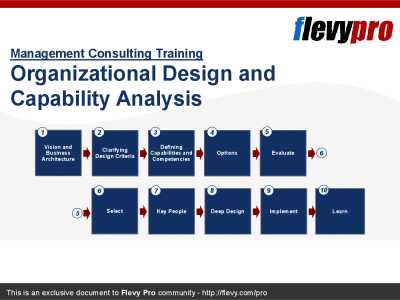
Organizational Design involves the creation of roles, processes, and structures to ensure that the organization's goals can be realized. Organizational Design span across various levels of the organization. This framework focuses on the following 3 initial steps of the full 10-step Organizational [read more]
Readers of This Article Are Interested in These Resources
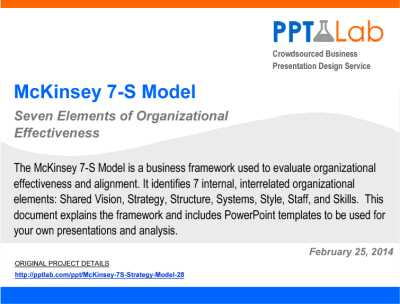
The McKinsey 7-S Strategy Model is a business framework used to evaluate organizational effectiveness and alignment. It identifies 7 internal, interrelated organizational elements: Shared Vision, Strategy, Structure, Systems, Style, Staff, and Skills. These elements need to be aligned for the [read more]
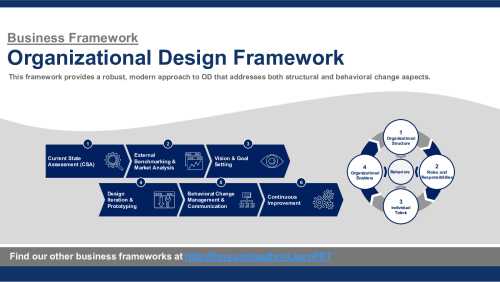
Organizational Design (OD) is a structured approach to aligning the structure, processes, and systems of an organization to achieve its strategic objectives and enhance performance. It encompasses various components, including defining the purpose of reorganization, determining supportive [read more]
Business environment has transformed drastically and has become immensely challenging due to competition, disruptive technologies, laws, and globalization. These challenges warrant better performance to address customer needs and to survive--and outpace--intense competition.
Consequently, [read more]
The objectives of this document are:
- Explain organisation design in relation to the other attributes of an organisation, such as its people and strategy
- Outline the key success factors in designing an organisation structure
- Explain the high level process and supporting [read more]
 Operating Model Redesign (OMR) used to be a rare event, triggered by a merger, a new CEO, or a crisis. That is no longer the case. Roughly two-thirds of executives have been through a redesign in the past 2 years, and about half expect another within the next 2. Redesign has become a regular leadership task, and its purpose is consistent: close the gap between