Editor's Note: Take a look at our featured best practice, Mastering High Tariff Markets (A Complete Guide) (326-slide PowerPoint presentation). Curated by McKinsey-trained Executives
Unlock the Secrets to Mastering Tariff Management: The Ultimate 300-Page Guide
Are you struggling to navigate the complexities of global tariffs and trade policies? Whether you're a business leader, policymaker, or analyst, understanding how to [read more]
* * * *
For decades, tariffs were a planning variable that Procurement and Logistics teams handled in the background. That era is over. The scale and unpredictability of recent US tariff actions, along with the legal rulings that keep reshaping them, have made trade policy a critical C-suite agenda item. In a recent survey of CEOs of NYSE-listed companies, 89% said they now regard tariffs and trade policy as a business risk, an increase of 20% from 2024.
The impact reaches well beyond import costs. Tariffs raise the landed cost of products and components almost overnight, squeezing gross margins wherever competitive intensity, price sensitivity, or long-term contracts limit the ability to pass costs on. Responses vary widely. Among manufacturers and retailers, 76% report raising prices more quickly than before, yet half of manufacturers and a third of retailers are still absorbing tariff-related increases.
The second pressure point is cash. Inventory accounts for 70% or more of the Cash Conversion Cycle in many industries, so tariff volatility strikes directly at working capital. Organizations stockpile ahead of anticipated increases, shift sourcing locations, or hold extra safety stock to protect service levels. Each move buys short-term protection but ties up cash and invites markdowns and obsolescence.
Historical playbooks offer a starting point, but they were built for discrete cost shocks, not a policy environment that changes month to month. The real challenge is not absorbing a single tariff increase. It is continuously adapting pricing, inventory, sourcing, and operating decisions as tariffs keep moving.
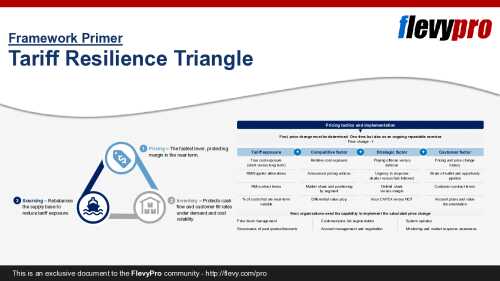
The Tariff Resilience Triangle framework addresses that challenge. It manages tariff uncertainty as a continuous cycle of strategy, planning, execution, and review, tackling margin pressure, working capital exposure, and structural Supply Chain risk at the same time rather than one after another.
The 3 Levers of the Tariff Resilience Triangle
The framework brings these priorities together through 3 interconnected levers:
Pricing
Inventory
Sourcing
Pricing is the fastest lever, protecting margin in the near term. Inventory protects cash flow and customer fill rates under cost and demand volatility. Sourcing rebalances the supply base to reduce tariff exposure over time. The levers are deeply interdependent. Leaders must rebalance all 3 together rather than optimize one in isolation. Let’s examine the first 2 levers more closely, for now.
Pricing
Most organizations today respond to tariffs in fragments. Some raise prices, others absorb costs entirely, a sizable share are seeking new US suppliers, and roughly 1 in 7 companies has scaled down operations. Each move may be defensible on its own, yet uncoordinated responses leak margin. The Pricing lever replaces improvisation with a structured approach to what gets passed through, to whom, and when.
Selectively passing through tariff-related increases protects margin without waiting for slower changes to the supply base or operating model. Speed matters more than it once did. During the 2018 US-China trade war, price increases followed tariff implementation within 1 to 3 months. In today’s faster-moving environment, organizations have far less time to assess exposure, decide, and communicate changes to customers.
A tariff-driven price change is not a mechanical cost pass-through. The optimal adjustment depends on 4 factors: tariff exposure, competitive position, strategic posture, and the customer relationship.
Determining the right price is only half the work. The other half is building the capability to implement it repeatedly. Dynamic Pricing requires pricing infrastructure, from price book management and quote governance to account negotiation and market monitoring. A one-time adjustment fails in either direction: a static increase erodes margin if costs keep rising, and damages demand if tariff conditions later ease. Pricing must therefore operate as an ongoing part of the tariff response, balancing margin protection, volume retention, positioning, and relationships as conditions evolve. Its value lies not in raising prices, but in raising them selectively.
Inventory
Inventory sits at the center of the tariff challenge because it dominates the Cash Conversion Cycle, the days between paying suppliers and collecting from customers. A disciplined Inventory Strategy must preserve cash while maintaining fill rates, the share of demand fulfilled immediately from available stock. Higher inventory protects fill rates but ties up working capital. Running lean frees cash but risks stockouts when supply is disrupted. Tariff-induced cost pressure and fluctuating demand sharpen this trade-off.
Resolving it requires each function to answer its own strategic question. Sales must ask whether inventory reflects shifting customer preferences, including lower volumes from slowdowns or demand migration. Finance must ask whether the right product mix sits at strategic locations to minimize cost without sacrificing service. Supply Chain must confirm that stocking and replenishment policies have been reset for new lead times. Manufacturing must consider whether production can be balanced across locations to curtail tariff impact. Procurement must check whether supplier terms, such as minimum order quantities and lead times, reflect current volatility.
Answering these questions demands a multidimensional strategy. Organizations redesign the product flow path, rerouting goods to bypass high-tariff origins and consolidating distribution or shipping directly to customers. They build proactive Demand Planning that anticipates preference shifts before inventory becomes stranded. They create granular, real-time visibility into every component of inventory. Together, these moves allow organizations to hold less stock while serving customers better.
Case Study
Consider a mid-sized distributor of industrial fasteners and fittings, sourcing heavily from Asia and selling to both OEMs and maintenance contractors. When new tariffs landed, its initial reaction was fragmented. Sales applied a flat increase to every product, while procurement ordered several months of extra stock to get ahead of further hikes.
Within a quarter, both were backfiring. Contractors pushed back on increases for low-exposure items, and the stockpile consumed cash just as demand from one OEM segment softened. Leadership reset the response around the Pricing and Inventory levers. The pricing team scored each product family on tariff exposure, competitive position, and account importance, raising prices sharply on highly exposed items with few substitutes and holding them on commodity lines where rivals were absorbing costs. It also tightened quote governance.
On inventory, the company centralized slow-moving items in one distribution center and positioned tariff-sensitive, high-velocity items closer to key customers. A renegotiation of minimum order quantities with 2 major suppliers reduced batch sizes. Within 6 months, the distributor recovered most of its tariff exposure, released a significant portion of the cash tied up in excess stock, and improved on-time fulfillment.
FAQs
Why is Pricing considered the fastest lever?
It can be adjusted within weeks, whereas inventory policies and supplier networks take months or longer to change.
Should every tariff increase be passed through to customers?
No. The right adjustment depends on tariff exposure, competitive position, strategic posture, and the customer relationship, and it often varies by product and account.
Is building inventory ahead of tariffs a good strategy?
Only selectively. Stockpiling protects against cost increases but ties up cash and risks markdowns or obsolescence if demand shifts.
How can inventory fall while fill rates improve?
By positioning the right products in the right locations, supported by better Demand Planning and real-time visibility.
Which functions need to be involved in the Inventory lever?
Sales, Finance, Supply Chain, Manufacturing, and Procurement each own part of the inventory trade-off.
Concluding Thoughts
Tariff volatility rewards organizations that treat their response as a discipline rather than a scramble. Pricing protects margin quickly when it is selective, data-driven, and repeatable. Inventory preserves cash when stock is positioned deliberately instead of accumulated defensively. Neither lever works well alone, which is why the framework insists on managing them together.
The third lever, Sourcing, completes the structural response by rebalancing where products are made. Organizations that run all 3 as a continuous cycle protect margins, preserve working capital, and turn trade instability into an opportunity.
You can download in-depth presentations on this and hundreds of similar business frameworks from the FlevyPro Library. FlevyPro is trusted and utilized by 1000s of management consultants and corporate executives.
For even more best practices available on Flevy, have a look at our top 100 lists:
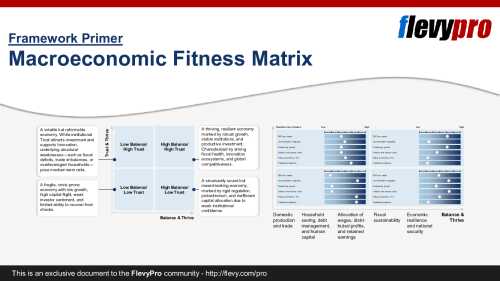
Geopolitical tensions, protectionist policies, and trade fragmentation are reshaping the global economy. Tariffs and retaliatory tariffs have not only disrupted supply chains but also eroded public trust in governments, institutions, and the multilateral trading system.
In a post-globalization [read more]
Readers of This Article Are Interested in These Resources
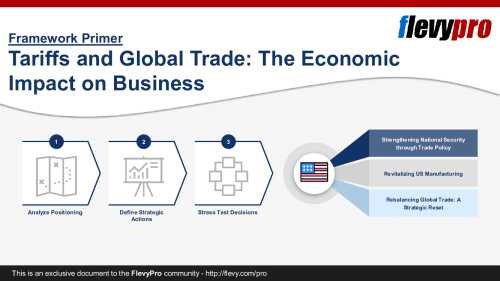
The recent wave of tariff measures and retaliatory trade actions is reshaping the global economic landscape.
These shifts have introduced deep uncertainty across multiple dimensions--cost structures, consumer demand, cross-border trade, and supply continuity. Government responses have diverged [read more]
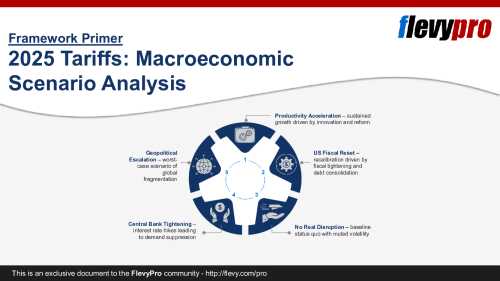
The global economy is entering a period of persistent instability.
In 2025, tariff wars, monetary tightening, and geopolitical tensions are converging to reshape the macroeconomic environment--posing serious challenges for executives trying to chart a long-term course.
Leaders cannot control [read more]
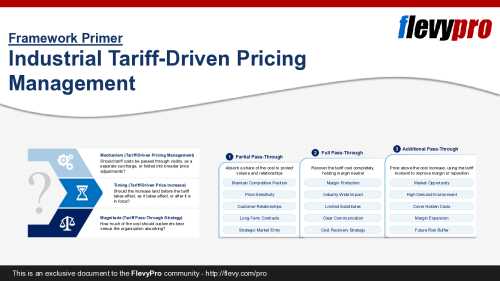
Global tariff uncertainty has made pricing a central dilemma for industrial businesses. Cost increases arrive with no universal formula, and leaders must adjust prices without losing customers or ceding ground to rivals.
Three questions dominate the debate: whether to pass costs through visibly [read more]
The scale and unpredictability of recent US tariff actions have complicated decision-making. The uncertainty extends well beyond import costs, pressuring profit margins, working capital, inventory decisions, sourcing strategies, and broader Supply Chain planning.
The challenge for executives is [read more]
 For decades, tariffs were a planning variable that Procurement and