Editor's Note: Take a look at our featured best practice, Complete Organization Design Toolkit (103-slide PowerPoint presentation). Recent McKinsey research surveyed a large set of global executives and suggests that many companies, these days, are in a nearly permanent state of organizational flux. A rise in efforts in Organizational Design is attributed to the accelerating pace of structural change generated by market [read more]
* * * *
Excessive hierarchical layers impose a persistent coordination tax. A substantial portion of managerial and specialist time is consumed by routing information, reconciling inputs across functions, preparing status updates, and managing sequential handoffs. These activities lengthen cycle times and raise costs even when the core work is relatively routine. The layers originated as responses to information scarcity and sequential workflows, yet they now constrain organizational speed.
The Organizational Delayering and Role Fusion framework offers a practical response to tall organizational hierarchies. Artificial Intelligence (AI) absorbs much of the routine coordination and first-pass production that previously justified middle layers. This enables an Operating Model characterized by fewer layers, fused outcome-owning roles, signal-driven governance, and human attention directed toward exceptions, judgment, and development. The framework does not eliminate management or entry-level positions; it redefines what both contribute. Without deliberate redesign, however, organizations can lose the developmental pathways that build judgment while recreating coordination friction through informal workarounds.
What Has Shifted for Apprentices and Managers
AI has altered the apprenticeship model. Traditional junior roles developed employee capability mainly by producing first drafts, data reconciliations, slide assemblies, and initial analyses. Repetition built domain knowledge, and subsequent review layers caught errors. Under the AI-enabled model, first-pass production is automated. Junior professionals shift toward verifying facts and data integrity, validating reasoning and assumptions, conducting quality checks, testing model outputs, handling exceptions, and escalating issues that fall outside thresholds. Learning moves from production to evaluation. Because fewer intermediate layers exist to intercept problems, judgment must develop earlier. The principal risk is a capability gap if early-career production work disappears without structured alternatives.
Managerial roles undergo a parallel shift. Tasks that once defined middle management—status collection, minute-taking, information routing, summary preparation, and handoff chasing—are largely absorbed by AI. Remaining responsibilities center on higher-judgment activities. Managers design intelligent decision environments by establishing rules, data flows, thresholds, and escalation criteria. They govern uncertainty by defining when automated outputs may proceed, when human review is mandatory, and how variance limits and audit trails operate. They coach teams to evaluate AI outputs and exercise domain judgment, and they safeguard time for analysis and exception resolution so that teams do not recreate manual processes.
Removing layers without redesigning workflows leaves the same handoffs and escalations in place. Automating a flawed process scales the problem, and coordination issues reappear in less obvious forms. Informal workarounds such as shadow approvals or undocumented exceptions return because the process still requires them.
The Five-Step Implementation Process
Successful Role Fusion Implementation follows a calculated sequence rather than concurrent reductions in layers and roles. The 5 steps are:
Map the Work
Instrument Governance
Fuse Roles Selectively
Add Guardrails
Rebuild the Career Ladder
The preferred sequence is to establish governance before fusing roles, and to fuse roles before reducing guardrails. Skipping the sequence recreates hidden bureaucracy or raises operational risks.
Let’s discuss the first 3 steps of the framework in detail, for now.
Step 1: Mapping the Work
Mapping the work begins with actual workflows rather than the organogram, so that leaders understand how work truly moves through the enterprise before any redesign of roles or reporting lines. Major process steps are documented to show how information, decisions, and outputs progress; handoff points between teams or functions are identified, as these transitions typically generate delays, rework, misunderstandings, and coordination cost. Bottlenecks and sources of friction such as approvals, reviews, or information gaps are located, while decision ownership is clarified at each stage to reduce ambiguity and unnecessary escalation. The resulting work map is visualized as a process-focused view of tasks, decisions, and data flows, making handoffs and delays visible and revealing opportunities to streamline, automate, or consolidate activities before roles are fused.
Step 2: Instrument Governance
The next step instruments governance so that oversight operates on continuous signals rather than status meetings and multi-layer approvals. Governance mechanisms generate real-time insights directly from the work being performed, capturing the digital footprint of workflows through systems such as ERP transactions, Project Management tools, CRM updates, and operational dashboards. Telemetry sources are configured to automatically record cycle times, backlog levels, productivity metrics, resource utilization, and exception rates, while workflow interactions and dependencies are traced to reveal where delays and breakdowns occur. Process metrics shift from subjective status reports to objective measures—including error rates, rework levels, customer satisfaction, compliance adherence, and delivery accuracy. Manual status collection is replaced by automated performance monitoring and real-time dashboards, and unnecessary approval chains are minimized through predefined thresholds, alerts, and escalation triggers that surface only true exceptions. This enables governance by exception, allowing leaders to focus on activities that fall outside expected performance ranges rather than reviewing every routine task and decision.
Step 3: Fuse Roles Selectively
Selective role fusion then combines complementary responsibilities into broader, end-to-end roles where risk permits. Adjacent tasks within the same workflow are consolidated to expand ownership from initiation to delivery, reducing handoffs and information loss. AI supports the broader scope by automating administrative and synthesis tasks. Separation is retained where regulatory, financial-control, or high-risk requirements demand independent review. Pilots in interconnected, manageable-risk functions precede wider application, with continuous monitoring of performance, quality, workload, and control effectiveness.
Case Study
A mid-market manufacturer implemented the sequence in its demand-planning and supplier-coordination processes, which had relied on multiple layers for data collection, exception escalation, and status reporting. After mapping the workflow and identifying repeated handoffs, the company instrumented governance with automated telemetry on inventory signals, lead-time variances, and exception rates, eliminating most weekly coordination meetings. Complementary planner and coordinator roles were fused into outcome-owning positions supported by AI for first-pass forecasts and alert generation, with guardrails retained for high-value supplier commitments. Apprenticeship was redesigned through exception-handling rotations in which early-career staff resolved low-confidence cases flagged by the system and debriefed with supervisors. Cycle time for routine adjustments shortened, exception resolution quality improved, and managers redirected effort toward supplier relationship development and capability coaching.
FAQs
Why is a sequenced approach required for role fusion?
Simultaneous layer reduction and role changes leave underlying handoffs intact or scale flawed processes, typically recreating informal coordination and elevating risk.
What does “map the work” involve in practice?
Documenting actual process steps, handoffs, bottlenecks, and decision ownership from a workflow perspective, then visualizing data and decision flows to identify simplification opportunities.
How does selective fusion protect control?
Roles are combined only where tasks are interconnected and risk is manageable; independent review is retained for regulatory, financial, or high-stakes activities, and pilots validate results before scaling.
How do managers’ responsibilities change?
They move from routine coordination to designing decision environments, setting and governing uncertainty thresholds, coaching teams on AI evaluation, and protecting capacity for higher-judgment work.
What must accompany role fusion to sustain capability?
Apprenticeship redesign through protected verification, comparative, and exception-handling activities, plus rebuilt career ladders that emphasize breadth, judgment, and outcome ownership.
Concluding Thoughts
Role fusion provides a structured path to organizational delayering when organizations first understand how work moves, instrument continuous governance, and only then consolidate roles with explicit guardrails. The approach reduces coordination cost while shifting both early-career and managerial effort toward the evaluative and exception-handling work that remains essential. Sustained results depend on treating apprenticeship redesign and career-ladder reconstruction as integral to the operating-model change rather than secondary activities.
You can download in-depth presentations on this and hundreds of similar business frameworks from the FlevyPro Library. FlevyPro is trusted and utilized by 1000s of management consultants and corporate executives.
For even more best practices available on Flevy, have a look at our top 100 lists:
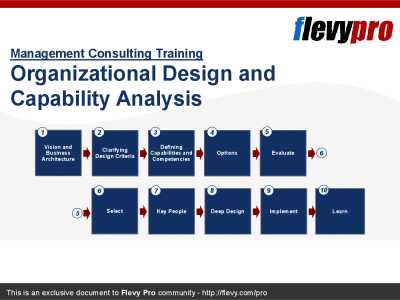
Organizational Design involves the creation of roles, processes, and structures to ensure that the organization's goals can be realized. Organizational Design span across various levels of the organization. This framework focuses on the following 3 initial steps of the full 10-step Organizational [read more]
Readers of This Article Are Interested in These Resources
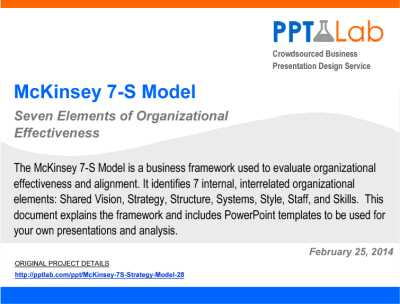
The McKinsey 7-S Strategy Model is a business framework used to evaluate organizational effectiveness and alignment. It identifies 7 internal, interrelated organizational elements: Shared Vision, Strategy, Structure, Systems, Style, Staff, and Skills. These elements need to be aligned for the [read more]
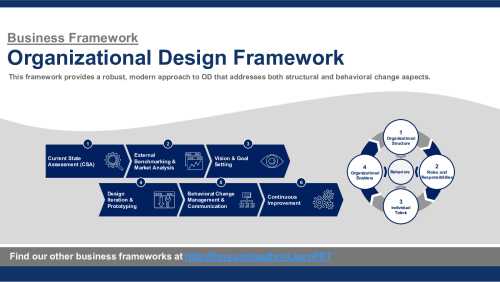
Organizational Design (OD) is a structured approach to aligning the structure, processes, and systems of an organization to achieve its strategic objectives and enhance performance. It encompasses various components, including defining the purpose of reorganization, determining supportive [read more]
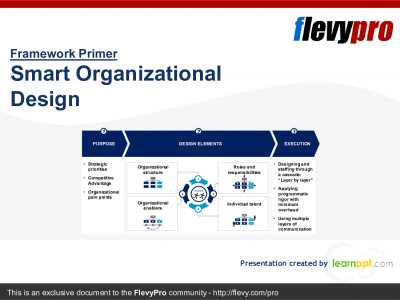
Business environment has transformed drastically and has become immensely challenging due to competition, disruptive technologies, laws, and globalization. These challenges warrant better performance to address customer needs and to survive--and outpace--intense competition.
Consequently, [read more]
The objectives of this document are:
- Explain organisation design in relation to the other attributes of an organisation, such as its people and strategy
- Outline the key success factors in designing an organisation structure
- Explain the high level process and supporting [read more]
 Excessive hierarchical layers impose a persistent coordination tax. A substantial portion of managerial and specialist time is consumed by routing information, reconciling inputs across functions, preparing status updates, and managing sequential handoffs. These activities lengthen cycle times and raise costs even when the core work is relatively routine. The layers originated as responses to information scarcity and sequential workflows, yet they now constrain organizational speed.