Editor's Note: Take a look at our featured best practice, Hofstede's 6 Dimensions of National Cultures (35-slide PowerPoint presentation). Cultural differences can act as a barrier to communication. This could affect our organization's ability to build connections and motivate people. While we may be excited with the opportunities that global connectedness has brought forth, yet we are cautious of making cross-cultural faux [read more]
* * * *
Global expansion has outpaced the leadership models used to manage it. Many organizations continue to deploy standardized leadership approaches that assume consistency in behavior, motivation, and decision making. This assumption is structurally flawed. Leadership effectiveness is not universal in execution. It is context dependent and shaped by deeply embedded societal values.
The GLOBE Cultural Dimensions framework provides a rigorous foundation for addressing this gap. Developed through a multi-phase research program spanning 61 nations and thousands of managers, GLOBE establishes a clear premise. Societal culture directly shapes organizational behavior and leadership expectations.
This insight has direct implications for Strategy Development, Organizational Design, and Leadership Effectiveness. Leaders are not evaluated in isolation. They are assessed through “Implicit Leadership Theories,” which are culturally embedded mental models that define what effective leadership looks like. These models determine whether a leader is trusted, followed, or resisted.
A leadership behavior that signals strength in one culture may signal arrogance in another. A participative approach may be perceived as empowering in one environment and ineffective in another. Without cultural alignment, even well-designed strategies fail during execution. The Global Leadership and Organizational Behavior Effectiveness framework addresses this challenge through a structured set of Cultural Dimensions that translate cultural complexity into actionable leadership insights.
The 9 Cultural Dimensions
The GLOBE framework identifies 9 Cultural Dimensions that define how societies shape organizational practices and leadership expectations.
Uncertainty Avoidance
Power Distance
Institutional Collectivism
In-Group Collectivism
Gender Egalitarianism
Assertiveness
Future Orientation
Performance Orientation
Humane Orientation
These dimensions do not merely describe differences. They provide predictive insight into how organizations function, how decisions are made, and how individuals respond to leadership.
Strategic Benefits of Applying the GLOBE Framework
Organizations that operationalize Cultural Intelligence through the GLOBE framework gain measurable advantages.
They improve Strategy Execution by aligning leadership behaviors with local expectations.
They enhance Organizational Effectiveness by reducing friction in cross-cultural collaboration.
They strengthen Leadership Credibility across diverse markets.
They enable more precise Talent Management and Performance Management systems.
They accelerate Business Transformation by reducing resistance to change.
The absence of cultural alignment produces the opposite outcome. Miscommunication increases. Decision making slows. Engagement declines. Execution becomes inconsistent.
Uncertainty Avoidance
Uncertainty Avoidance defines how a culture responds to ambiguity, risk, and unpredictability. It directly influences Risk Management, decision making speed, and Operational Design.
High Uncertainty Avoidance environments prioritize structure, stability, and predictability. Organizations operating in these contexts rely on formal rules, standardized processes, and strong compliance systems. Decision making is deliberate and guided by established frameworks. Leaders are expected to provide clarity, reduce ambiguity, and enforce discipline. Employees in these environments value security, long-term planning, and adherence to norms. Innovation tends to be incremental and carefully managed.
Low Uncertainty Avoidance environments operate with a fundamentally different logic. Flexibility, adaptability, and experimentation are prioritized. Organizations encourage rapid iteration and informal problem solving. Decision making is faster and less constrained by rigid structures. Leaders are expected to be agile, open to risk, and comfortable navigating ambiguity. Employees thrive in dynamic environments where creativity and initiative are rewarded. The leadership challenge is not choosing one model over the other. It is calibrating the balance between structure and flexibility. Organizations must provide enough stability to build trust while maintaining the adaptability required for Innovation and competitiveness.
Power Distance
Power Distance defines how a culture perceives and accepts unequal distribution of authority. It directly shapes Organizational Design, decision making authority, and leadership interaction models.
High Power Distance cultures accept hierarchy as a natural and necessary structure. Authority is centralized, and decision-making flows from the top. Leaders are expected to be directive, authoritative, and status conscious. Legitimacy is derived from position rather than consultation. Employees in these environments expect clear direction and are less likely to challenge authority. Organizational structures emphasize formal reporting lines, titles, and defined roles.
Low Power Distance cultures operate on principles of equality and participation. Authority is decentralized, and employees are encouraged to contribute to decision making. Leaders are expected to be accessible, consultative, and empowering. Employees are comfortable questioning ideas and engaging in dialogue. Organizational structures tend to be flatter and more collaborative.
Misalignment in Power Distance creates immediate performance risks. A directive leadership style in a low Power Distance culture may be perceived as autocratic. A participative style in a high Power Distance environment may be perceived as weak or indecisive. Effective organizations align Leadership Style with cultural expectations while maintaining Strategic Consistency. This requires disciplined Leadership Development and deliberate Change Management.
Case Study
A multinational organization headquartered in Northern Europe acquired a fast-growing Southeast Asian organization to expand its regional presence. The acquiring organization operated with low Power Distance and low Uncertainty Avoidance. It emphasized flat structures, rapid decision making, and informal collaboration. The acquired organization operated in a high-Power Distance and high Uncertainty Avoidance environment. It relied on hierarchical authority, structured processes, and formal communication. The integration strategy imposed the parent organization’s leadership model without adaptation. Decision rights were decentralized. Formal processes were reduced. Leaders were instructed to adopt a participative style.
The result was immediate misalignment. Employees in the acquired organization perceived the new leadership approach as lacking authority and clarity. Decision making slowed as employees waited for direction that never came. Risk tolerance increased beyond what the organization was culturally prepared to manage.
Within twelve months, key talent attrition increased significantly. Operational performance declined. Integration timelines were missed. A course correction was implemented. Leadership structures were realigned to reflect higher Power Distance expectations. Clear decision rights were reintroduced. Structured processes were reinstated to match higher Uncertainty Avoidance levels. Performance stabilized within two quarters. The organization then implemented a gradual transition model that balanced global standards with local expectations.
The case reinforces a critical lesson. Cultural misalignment is not a soft issue. It is a primary driver of execution failure.
FAQs
Is there a universal leadership style that works across all cultures?
No. While certain attributes such as integrity and vision are universally valued, leadership effectiveness depends on how these attributes are expressed within specific cultural contexts.
How should organizations standardize leadership while adapting to culture?
Organizations should define a global leadership framework anchored in universal principles, then adapt execution based on Cultural Dimensions such as Power Distance and Uncertainty Avoidance.
Can Cultural Intelligence be developed systematically?
Yes. Cultural Intelligence can be embedded into Leadership Development through training, cross-cultural exposure, and structured decision making frameworks aligned with the GLOBE dimensions.
What is the biggest risk of ignoring cultural differences?
The primary risk is execution failure. Misaligned leadership behaviors lead to disengagement, slow decision making, and reduced organizational performance.
How should Cultural Dimensions influence Organizational Design?
Organizational structures, decision rights, and communication models should be aligned with cultural expectations regarding hierarchy, risk tolerance, and collaboration.
Closing Thoughts
Global Leadership is no longer defined by consistency in behavior. It is defined by precision in adaptation. The GLOBE framework provides a structured approach to understanding how culture shapes leadership effectiveness. It enables organizations to move beyond assumptions and manage cultural complexity with discipline. Cultural Intelligence must be embedded into Strategy Development, Leadership Development, and Organizational Design. It cannot remain a peripheral capability.
Organizations that master this capability achieve stronger alignment, faster execution, and greater resilience in global operations. Those that do not will continue to face avoidable friction, inconsistent performance, and failed transformations. Cultural Intelligence is not a soft skill. It is a core driver of Business Transformation and sustained competitive advantage.
You can download in-depth presentations on this and hundreds of similar business frameworks from the FlevyPro Library. FlevyPro is trusted and utilized by 1000s of management consultants and corporate executives.
For even more best practices available on Flevy, have a look at our top 100 lists:
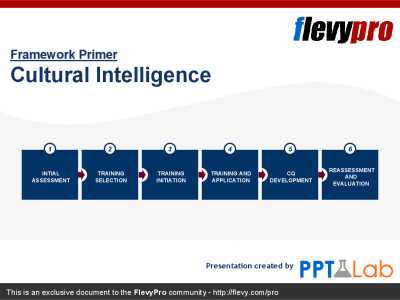
Cultural Intelligence (CQ) is a model that ability to cope with national, corporate, and vocational cultures. It was developed by Christopher Earley and Elaine Mosakowski, based on a study of 2,000 managers across 60 countries. CQ is the ability to understand unfamiliar contexts, and then to [read more]
Readers of This Article Are Interested in These Resources
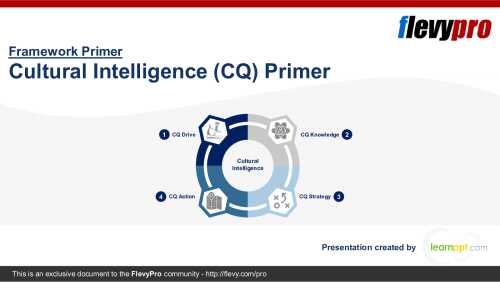
Today's business environment demands more than just market knowledge and technical expertise. It calls for Cultural Intelligence (CQ)--the ability to cross boundaries and thrive in multiple cultures.
In this PowerPoint presentation, we will explore the essence of CQ, focusing on its 4 core [read more]
In today's modern era driven by Technology and Innovation, organizations can only survive if they are swift and agile; and have the capability of learning and adjusting rapidly.
Organizations have become cognizant of this and have introduced Agile methodologies in their Operations to allow them [read more]
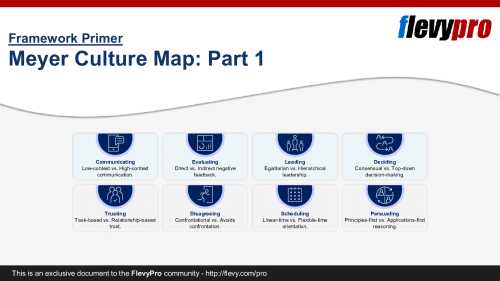
As organizations operate across increasingly complex international environments, cultural friction remains a persistent leadership challenge to navigate. Cultural differences weaken collaboration, disrupt trust, and create hidden operational drag.
This PPT presentation discusses the Meyer [read more]
Societal Culture shapes how organizations and societies define problems, make decisions, and pursue goals. It evolves over time through internal innovation and external influences. Differences in culture across geographies often lead to miscommunications, misalignment, and conflict.
This PPT [read more]
 Global expansion has outpaced the leadership models used to manage it. Many organizations continue to deploy standardized leadership approaches that assume consistency in behavior, motivation, and decision making. This assumption is structurally flawed. Leadership effectiveness is not universal in execution. It is context dependent and shaped by deeply embedded societal values.