Editor's Note: Take a look at our featured best practice, Supplier Relationship Management (SRM) - Supplier Segmentation (24-slide PowerPoint presentation). Competition has forced industries to converge on efficiency. Most of them have recognized that they must investigate all potential levers for creating value. As a result, they are actively pursuing collaboration across the supply chain.
Supplier segmentation is one of the foremost lever that [read more]
* * * *
In 2026, CNC machining procurement needs more than a capable factory list. It needs a risk-control system that tells sourcing teams when to proceed, when to pause, and when to escalate. A practical supplier risk matrix should score 4 areas before award: cost exposure, tolerance confidence, IP control, and delivery reliability.
The matrix is especially useful when procurement teams move from traditional local quoting to online CNC sourcing. Choosing the best cnc machining platform is not only about price discovery. A serious platform decision should consider RFQ structure, CAD-file handling, CNC milling and turning coverage, quote comparability, factory profile depth, tolerance evidence, NDA workflow, communication ownership, and whether the process helps teams document why one manufacturing route was chosen over another.
This article presents the matrix as a management tool, not a machining tutorial. The goal is to help procurement leaders turn CNC sourcing into a governed workflow with clear evidence, decision rights, and exception controls.
The Executive Issue: CNC Sourcing Creates Hidden Decision Risk
CNC sourcing often looks operational. A part is needed, a drawing is shared, factories quote, and procurement selects a supplier. In practice, the decision has strategic risk because it affects margin, product quality, engineering confidence, launch timing, and supplier dependency.
The problem is that the risk is rarely visible in one place.
Procurement may see a 12% lower unit price. Engineering may see an unclear datum reference. Legal may see uncontrolled CAD disclosure. Operations may see a lead time that assumes perfect material availability. Finance may see a quote that excludes freight, inspection, or rework.
A supplier risk matrix gives these teams one structured view. It does not replace technical review. It prevents the award decision from being reduced to the fastest quote or the lowest unit price.
The Operating Model: 5 Decisions before Supplier Selection
Before scoring any factory or platform, the organization should define the operating model for CNC procurement. These 5 decisions keep the matrix from becoming a spreadsheet exercise.
Management decision
Why it matters
Owner
What risk level is acceptable for this part family?
A prototype fixture and a production medical component should not have the same threshold
Engineering and procurement
Who can approve a supplier exception?
Keeps urgent sourcing from bypassing quality or IP controls silently
Procurement leadership
What evidence is mandatory before award?
Prevents subjective scoring and quote-based bias
Quality and engineering
Which files can be shared before NDA?
Reduces uncontrolled CAD and drawing exposure
Legal and engineering
What post-award data updates the next score?
Turns supplier selection into continuous improvement
Operations and procurement
This is where many sourcing programs break down. They introduce a supplier scorecard but never define who can override it, which evidence counts, or how actual delivery performance changes the next decision.
The Supplier Risk Matrix
The matrix below uses a 100-point model. It is simple enough for a sourcing review and specific enough to stop weak evidence from passing as confidence.
Risk domain
Weight
What a low score means
What a high score means
Cost exposure
25
Price is attractive but assumptions are incomplete
Landed cost, setup, inspection, finishing, and freight are visible
Tolerance confidence
30
The factory says it can meet the drawing but provides little process evidence
Equipment, inspection method, CTQ dimensions, and measurement records support the claim
IP control
20
Files are shared before confidentiality and access rules are clear
NDA level, file release, and contact ownership are documented
Delivery reliability
25
Lead time is quoted as a single date with weak milestone visibility
Capacity, material timing, inspection, finishing, packing, and shipment milestones are defined
The weighting is intentional. For CNC machined parts, tolerance confidence deserves more weight than headline cost when the part affects product fit, safety, assembly, or repeatability.
Scoring Rules Procurement Can Defend
Each risk domain should be scored from 1 to 5, then multiplied by its weight. The score should be based on evidence submitted with the RFQ response.
Score
Evidence standard
Procurement interpretation
1
Claim only
High risk; do not award production work without intervention
2
Partial evidence
Risk visible; require clarification or sample validation
3
Adequate evidence
Acceptable for standard parts with moderate risk
4
Strong evidence
Suitable for most production sourcing decisions
5
Strong evidence plus prior performance
Preferred route when cost and capacity are also acceptable
Missing information should not receive a neutral score. If a quote does not show inspection scope, NDA process, material assumption, or milestone plan, the matrix should treat that gap as risk.
Control 1: Cost exposure
Cost exposure is wider than unit price. A quote that looks low can become expensive if it excludes setup, special tooling, heat treatment, surface finishing, dimensional reports, protective packaging, duties, or freight.
For CNC procurement, the cost-control evidence pack should include:
Unit price by quantity band
Setup or programming charge
Material grade and source assumption
Finishing and secondary-process scope
Inspection documents included in the quote
Packaging, Incoterms, and freight assumption
Validity period for the quote
The management question is not “Who is cheapest?” It is “Which quote exposes the least unpriced work?”
Control 2: Tolerance Confidence
Tolerance confidence determines whether procurement is buying a production outcome or buying a promise. This is where engineering must have explicit decision rights.
For parts with tight tolerances, the evidence pack should confirm:
Machine type and axis capability
Workholding or fixture approach for the geometry
Inspection method for critical dimensions
Whether CMM, gauges, surface roughness testing, or material certification is required
Whether first article inspection is included
Which dimensions are critical-to-quality
This control matters even when the supplier has a strong profile. A factory can be capable in general and still be a poor fit for a specific geometry, material, or tolerance stack.
Control 3: IP Control
IP control belongs inside procurement governance because file release often happens during sourcing, before legal teams review the final commercial agreement.
A controlled CNC sourcing process should define what can be shared at each stage:
Stage
File-sharing position
Control
Market scan
No sensitive CAD files
Use summary requirements and anonymized part descriptions
Initial RFQ
Limited technical package
Share only what factories need to assess capability
Qualified RFQ
Controlled CAD release
Require NDA level and named recipients
Award
Full manufacturing package
Release complete files only after supplier selection and terms
This staged approach is useful for overseas sourcing because it separates supplier discovery from full technical disclosure. It also creates an audit trail if a project later needs to review who saw what.
Control 4: Delivery Reliability
Delivery reliability should be scored on milestones, not stated lead time alone. A single promised delivery date does not show whether the supplier has material access, available machine capacity, finishing capacity, inspection bandwidth, or export readiness.
The delivery evidence pack should include:
Current capacity assumption
Material procurement date
Programming and setup window
Machining window
Inspection date
Finishing and packing date
Shipment handoff and Incoterms
Escalation contact
This gives operations a real control point. If material arrival slips, the team knows the delivery date is at risk before the shipment is late.
Award-Decision Thresholds
The matrix should produce a decision, not just a score. A practical threshold model can look like this:
Weighted score
Decision
Required action
85-100
Approve
Proceed if commercial terms fit budget
70-84
Conditional approve
Close named gaps before purchase order
55-69
Controlled trial
Use sample order, audit, or second-source comparison
Below 55
Do not award
Escalate only for urgent exceptions
Two rules make the threshold model stronger.
First, any IP score of 1 should block file release, regardless of total score.
Second, any tolerance score of 1 or 2 should block production award for functional parts unless engineering signs an exception.
These stop a strong price from hiding an unacceptable risk.
Platform Risk: Why the Sourcing Channel Should Also Be Scored
Procurement teams often score factories but ignore the sourcing channel. That is a mistake. The platform or marketplace affects quote quality, factory transparency, file security, communication speed, and whether teams can compare responses in a structured way.
The sourcing channel should be scored against 4 questions:
Does it show enough factory information before award?
Does it support comparable RFQ responses rather than isolated email quotes?
Does it provide a clear process for CAD files and NDA status?
Does it give procurement one accountable communication path from RFQ to delivery?
This does not mean every company needs a platform for every job. Local shops, direct factory relationships, and specialist brokers all have a place. But when procurement is comparing multiple overseas factories, the sourcing channel becomes part of the control environment.
Governance Cadence after the First Order
Supplier evaluation should continue after award. The first delivery creates data that is more useful than the original quote.
Procurement teams should update the matrix after 4 events:
First article inspection
Batch completion
Delivery and customs clearance
Internal production or assembly feedback
Each event should update the supplier record. A factory that quoted well but delivered late should lose delivery points. A factory that challenged a vague tolerance before machining should gain engineering confidence. A factory that asked for uncontrolled file transfers should remain restricted even if its price was good.
This turns sourcing history into a management asset.
Where China Sourcing Fits and Where It Does Not
China can be a strong route for CNC machining when the part is well specified, the RFQ package is complete, multiple qualified factories can quote, and the timeline allows proper inspection and shipping control. It is especially relevant when procurement needs cost competition, capacity access, or repeat production beyond what local workshops can quote quickly.
Local sourcing can be the better route for urgent repairs, early engineering iteration, restricted programs, or parts that require frequent face-to-face design review. The matrix should not force a location choice. It should clarify the risk-adjusted sourcing route for the part in front of the team.
Limitations of the Matrix
No matrix removes sourcing judgment. It only makes judgment more disciplined.
The model can still fail if the input evidence is weak, if teams over-score familiar factories, or if leadership overrides controls without documenting the reason. It can also slow emergency purchases if the organization treats every part as equally critical.
The best implementation is pragmatic. Use stricter scoring for production, safety-critical, and IP-sensitive parts. Use lighter controls for simple fixtures, non-critical prototypes, and low-risk repeat orders.
Closing Perspective
A supplier risk matrix gives CNC machining procurement a clear operating discipline. It separates price from risk, assigns decision rights, and shows which controls must be in place before the purchase order is released.
For procurement leaders, the value is not the spreadsheet itself. The value is the conversation it forces before money, drawings, and delivery commitments move outside the organization.
Small & medium size businesses and manufacturing companies deal with scores of external suppliers of goods & services. These dealings require some level of negotiations with goods & services suppliers, major OEM corporations, and software solution providers. While business negotiation skill is a [read more]
Do You Want to Implement Business Best Practices?
You can download in-depth presentations on Supplier Management and 100s of management topics from the FlevyPro Library. FlevyPro is trusted and utilized by 1000s of management consultants and corporate executives.
For even more best practices available on Flevy, have a look at our top 100 lists:
These best practices are of the same as those leveraged by top-tier management consulting firms, like McKinsey, BCG, Bain, and Accenture. Improve the growth and efficiency of your organization by utilizing these best practice frameworks, templates, and tools. Most were developed by seasoned executives and consultants with over 20+ years of experience.
Readers of This Article Are Interested in These Resources
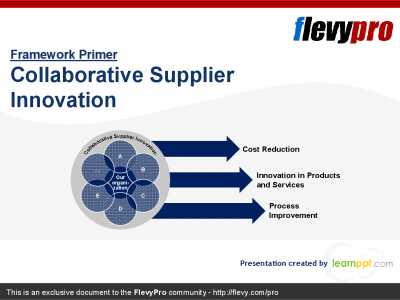
More and more organizations are now pursuing Collaborative Supplier Innovation initiatives. Collaborative Supplier Innovation is defined as the joint development of capabilities for both the customer and supplier for the purpose of reduced cost, process improvements, and innovation in products and [read more]
Sourcing decides the price. Everything after signature decides whether you actually get it. This toolkit is the post-award half of procurement, built around one uncomfortable observation: almost every organisation names more strategic suppliers than it has the capacity to manage, and the resulting [read more]
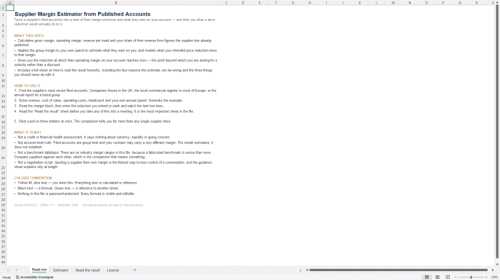
Negotiations run on assertion until somebody introduces a fact. This model
introduces one, from a source the supplier cannot dispute: their own filed
accounts.
WHAT IT DOES
Enter revenue, cost of sales, operating costs, headcount and your own
annual spend. All of it is public for most [read more]
Businesses of all sizes enter into commercial transactions with suppliers regularly in order to get the goods and services they need to operate, and generate a profit. Yet are we doing a good job of ensuring that we are getting the best possible deal?
This paper draws together the thoughts of [read more]
 In 2026, CNC machining procurement needs more than a capable factory list. It needs a risk-control system that tells sourcing teams when to proceed, when to pause, and when to escalate. A practical supplier risk matrix should score 4 areas before award: cost exposure, tolerance confidence, IP control, and delivery reliability.