
SME Guide to Negotiating with Suppliers   31-page PDF document
$29.95

SME Guide to Negotiating with Suppliers (31-page PDF document) Preview Image
Log in to unlock full preview.
SME Guide to Negotiating with Suppliers (31-page PDF document) Preview Image
Arrow   Click main image to view in full screen.

SME Guide to Negotiating with Suppliers – PDF

PDF document 31 Pages

$29.95

Add to Cart


Immediate download
Editable with PDF editor
Free lifetime updates

SUPPLIER MANAGEMENT PDF DESCRIPTION

Editor Summary 31-page PDF supplier negotiation guide for SMEs that provides a practical planning and meeting framework and 10 ready-to-use templates/tools (LAA/MDO/BATNA position template, negotiation briefing document, first-meeting agenda, meeting action plan, unbundled pricing request model, Volume/Tenure Pricing Matrix, KPI penalty model, incentive example, supplier research checklist, post-negotiation debrief). Read more

Businesses of all sizes enter into commercial transactions with suppliers regularly in order to get the goods and services they need to operate, and generate a profit. Yet are we doing a good job of ensuring that we are getting the best possible deal?

This paper draws together the thoughts of purchasing managers and negotiation teams from a range of industries to help small to medium sized businesses better understand how to plan and conduct professional negotiations with suppliers. Negotiations which when done well can save thousands on the bottom line of a business each and every year.

Issues addressed in this guide include:

•  Why sales and negotiation are not the same thing
•  How to be polite and still get what you want
•  Planning negotiations with suppliers
•  Managing the negotiation process
•  Tricks of the trade

Let's face it: your bottom line will always benefit from smart sustainable deals to acquire the products and services you need to do business.

This guide has a single objective: helping business owners to improve how they negotiation with suppliers for a better outcome by using a structured negotiation process couple with some simple tools and techniques.

This guide emphasizes the importance of humility, generosity, and appreciation in negotiations. It provides actionable insights on setting clear expectations, understanding the market, and knowing your counterpart. The PDF also covers essential concepts like LAA, MDO, and BATNA, ensuring you are well-prepared to walk away if necessary. By mastering these strategies, you can secure favorable terms without compromising on professionalism or integrity. This resource is indispensable for any business leader aiming to refine their negotiation skills and achieve sustainable success.

Got a question about the product? Email us at support@flevy.com or ask the author directly by using the "Ask the Author a Question" form. If you cannot view the preview above this document description, go here to view the large preview instead.

MARCUS OVERVIEW

This synopsis was written by Marcus [?] based on the analysis of the full 31-slide presentation.


Executive Summary

This PDF is a practical supplier negotiation guide written for SMEs that want to improve how they negotiate price, volume, tenure, terms, and contract outcomes with vendors. The document frames negotiation as a distinct business activity, separate from marketing and sales, and focuses on how a buyer can prepare, structure meetings, and use simple negotiation tools before accepting supplier terms. It gives the reader a concrete planning method built around LAA, MDO, and BATNA, then extends that preparation into a negotiation briefing document, meeting agenda, action plan, and post-deal review. It also covers behavioral guidance, including how to be assertive without being arrogant and how to stay professional when faced with pressure tactics. Later sections add practical supplier negotiation tools such as unbundled pricing, a Volume/Tenure Pricing Matrix, and the use of sticks and carrots in contract design. A buyer using this guide will be better equipped to define a walk-away position, assess vendor flexibility, ask for component-level pricing, research supplier risk, and negotiate a more sustainable agreement.

Who This Is For and When to Use

•  Procurement managers negotiating with suppliers on price, service scope, delivery terms, or contract tenure
•  SME owners who handle vendor negotiations directly and need a more disciplined negotiation process
•  Finance and operations leaders reviewing supplier pricing, bundled offers, and commercial terms
•  Consultants advising smaller businesses on procurement strategy, supplier management, or contract preparation
•  Commercial managers who need a practical framework for preparing negotiation positions and meeting agendas
•  Teams that want a more structured approach to vendor research, meeting follow-up, and negotiation debriefs

Best-fit moments to use this deck:

•  Before entering a supplier negotiation where price, discounts, volume, or tenure are still open
•  During contract renewal discussions when bundled pricing or service guarantees need to be challenged
•  When a business needs to define its BATNA, walk-away point, and desired outcome before meeting a vendor
•  When a team wants to standardize supplier negotiation preparation with written notes, agendas, and action plans
•  When procurement needs a simple framework for researching vendor viability, reputation, and pricing structure

Learning Objectives

•  Define negotiation as a separate discipline from sales and marketing
•  Establish clear negotiation positions using LAA, MDO, and BATNA
•  Build a negotiation plan around purchase scope, volume, tenure, and supplier context
•  Prepare a written negotiation briefing document before entering supplier meetings
•  Structure a first meeting with an agenda, rules of engagement, and clear next steps
•  Run subsequent meetings with action items, responsibilities, and issue tracking
•  Apply practical pricing tools such as unbundled pricing and a Volume/Tenure Pricing Matrix
•  Use incentives and penalties to strengthen delivery and service performance in contracts
•  Conduct pre-negotiation supplier research across company, product, competition, sales team, and market factors
•  Review negotiation outcomes and improve the process for future supplier discussions

Table of Contents

•  Introduction (page 3)
•  What Are the Attributes of a Negotiator? (page 4)
•  Are You Just Too Polite? (page 5)
•  Aren’t Sales and Negotiation the Same? (page 7)
•  Measures of a Negotiation (page 9)
•  Planning a Negotiation (page 10)
•  The Negotiation Process (page 14)
•  How Do You Handle Yourself? (page 18)
•  Tricks of the Trade (page 20)
•  Pre Negotiation Research (page 25)
•  Conclusion (page 28)
•  About Accretive Research (page 29)

Primary Topics Covered

•  Negotiation Positioning Framework - The guide uses three core measures to define a deal position before meetings begin: Least Acceptable Agreement, Most Desirable Outcome, and Best Alternative To a Negotiated Agreement. These are used to decide what outcome is acceptable, what outcome is preferred, and what action to take if the deal does not meet the minimum threshold.
•  Negotiation Planning and Preparation - Planning is treated as a formal exercise that starts with defining what is being bought, how much will be bought, how long it will be bought, how much can be spent, and what the fallback option is. The guide also stresses researching the supplier and putting key points in writing before the meeting.
•  Supplier Meeting Structure - The negotiation process is organized into offer, consideration, and acceptance, then translated into first meeting, subsequent meetings, and agreement. The first meeting is expected to establish the rules of engagement, guiding principles, and required follow-up information.
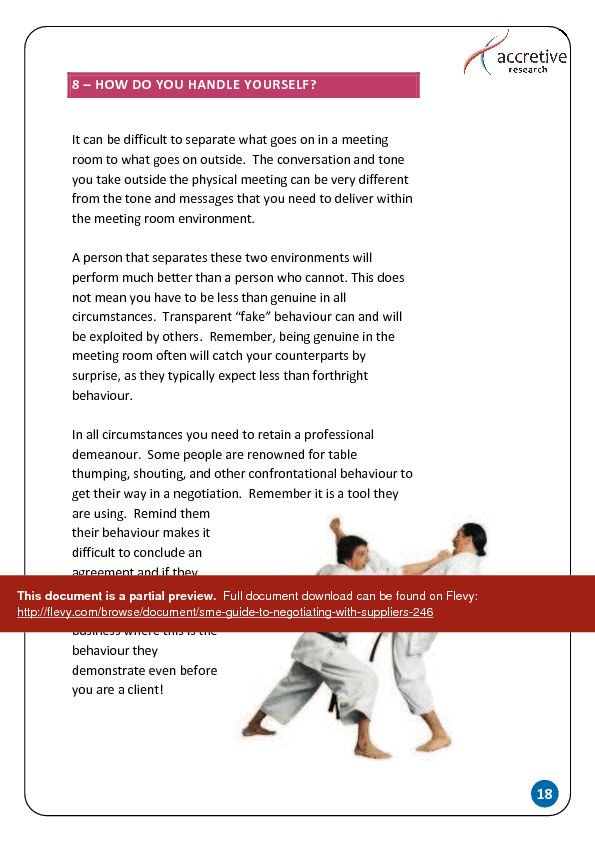
•  Professional Negotiation Conduct - The document emphasizes being assertive but polite, respectful but determined, and professional under pressure. It also explains how to use agendas and expected behavior standards to manage tense or confrontational meeting dynamics.
•  Pricing Analysis Techniques - The guide recommends not making the first offer, asking for unbundled pricing when offers appear padded, and using a Volume/Tenure Pricing Matrix to see where economies of scale improve pricing. These tools are aimed at exposing price flexibility and removing low-value extras from the deal.
•  Contract Performance Levers - The paper introduces sticks and carrots as a way to hold suppliers accountable and reward overperformance. It links penalties to specific KPI failures and suggests incentives such as bonus payments or contract renewal benefits for exceeding expectations.
•  Pre Negotiation Supplier Research - A dedicated section explains what to research before negotiating, including company history, financial viability, market share, product maturity, competition, sales incentives, and economic or environmental factors that may affect delivery. It also outlines methods for gathering that information through internet search, customer references, annual reports, and credit checks.
•  Relationship-Based Negotiation - The guide argues against purely adversarial negotiation and instead promotes agreements that are palatable and sustainable for both parties. It ties this to respect, concern, humility, generosity, and appreciation as attributes that support productive business relationships.

Deliverables, Templates, and Tools

•  LAA, MDO, and BATNA negotiation position template for defining minimum, target, and fallback outcomes
•  Negotiation briefing document template to capture purchase scope, spend limits, tenure, and supplier research
•  Negotiation meeting agenda example for first-meeting structure and rules of engagement
•  Meeting action plan template for assigning tasks, owners, and due dates after each negotiation session
•  Unbundled pricing request model to break bundled supplier offers into components
•  Volume/Tenure Pricing Matrix example for comparing pricing across unit volumes and contract lengths
•  KPI penalty model for building service failure consequences into a contract
•  Incentive example for rewarding suppliers that deliver ahead of time or below budget
•  Supplier research checklist covering company background, product, competition, sales team, and market conditions
•  Post-negotiation debrief template to review how close the result came to the MDO and what to improve next time

Slide Highlights

•  Introduction page that reframes everyday business purchases as negotiable commercial events rather than fixed-price transactions
•  Early chapter on negotiator attributes that ties business relationships to respect, concern, humility, generosity, and appreciation
•  Section on politeness and assertiveness that uses salary negotiation research to show the cost of not asking for what you want
•  Comparison page separating marketing, negotiation, and sales into distinct commercial activities
•  LAA, MDO, and BATNA section that gives the document its clearest decision-making framework
•  Negotiation process page that shows the three-phase structure of offer, consideration, and acceptance, alongside a meeting agenda visual
•  VTP pricing matrix page that presents a simple volume-versus-tenure pricing table for discount analysis
•  Sticks and carrots discussion that links contract KPIs, service credits, bonuses, and delivery incentives to negotiation outcomes
•  Pre negotiation research section that breaks supplier due diligence into company, product, competition, sales team, and economic factors
•  Conclusion that ties negotiation capability directly to margin pressure and vendor-customer conversations about utility

Potential Workshop Agenda

Negotiation Strategy and Position Setting Session (60-90 minutes)
•  Define the purchase scope, required outcomes, and measures of a good versus bad deal
•  Set the LAA, MDO, and BATNA before supplier discussions begin
•  Align the team on what can be traded and what must not be conceded

Supplier Preparation and Research Session (60-90 minutes)
•  Review supplier history, financial viability, reputation, and market context
•  Assess product maturity, competitor options, and recurring versus upfront cost drivers
•  Build a short written briefing document for use during meetings

Negotiation Process and Pricing Session (90 minutes)
•  Draft the first-meeting agenda, rules of engagement, and expected next steps
•  Review how to handle bundled pricing, volume discounts, and tenure discounts
•  Prepare action plans and checklists for follow-up meetings

Contract Terms and Debrief Session (60 minutes)
•  Identify KPIs, penalties, and incentives that belong in the contract
•  Confirm final agreement process and ownership of closing actions
•  Debrief the outcome against the MDO and document process improvements

Customization Guidance

•  Replace the generic pricing examples with your actual supplier categories, unit volumes, and contract durations
•  Tailor the negotiation briefing document to your approval process, budget limits, and supplier risk criteria
•  Adapt the meeting agenda to reflect your internal stakeholders, decision rights, and required pre-read material
•  Add your own KPI measures, service credits, incentives, or renewal triggers to the sticks and carrots approach
•  Expand the supplier research checklist with industry-specific risk factors such as exchange rates, production constraints, or customer concentration

Secondary Topics Covered

•  Business relationship attributes in negotiation
•  Assertiveness versus arrogance
•  Long-term supplier relationship sustainability
•  Home ground advantage and adversarial negotiation pitfalls
•  Strategic versus tactical sales framing
•  Volume purchasing and long-term contract tenure
•  Rules of engagement in meetings
•  Minutes distribution and follow-up ownership
•  Behavioral tactics such as shouting or confrontation in meetings
•  Customer references and financial due diligence
•  Internet research and annual report review
•  Margin pressure and vendor utility in commercial discussions

Topic FAQ

What core elements should a buyer define before entering supplier negotiations?

Buyers should define the purchase scope, unit volumes, contract tenure, spend limits, and fallback options using a position-setting framework. The guide frames the decision around 3 measures: Least Acceptable Agreement, Most Desirable Outcome, and Best Alternative To a Negotiated Agreement (LAA, MDO, BATNA).

How should a first supplier meeting be structured to keep negotiations professional?

The first meeting should set rules of engagement, establish background and relationship context, present guiding principles, and agree next steps and information requests. Using a prepared meeting agenda and a negotiation briefing folio helps keep conduct disciplined and expectations clear, guided by a first-meeting agenda and rules of engagement.

What pricing techniques can expose supplier flexibility and hidden costs?

Ask for component-level or unbundled pricing rather than accepting a single bundled offer, avoid making the first monetary offer, and map prices across order size and contract length using a Volume/Tenure Pricing Matrix to reveal economies of scale and hidden margin — unbundled pricing and a Volume/Tenure Pricing Matrix.

How can contracts use incentives and penalties to manage supplier performance?

Build KPI-linked penalties for missed service levels (sticks) and incentives or bonus payments for overperformance (carrots), and tie renewal or commercial benefits to exceeded targets. The guide recommends specifying service KPIs and related consequences or rewards using a KPI penalty model and incentive examples.

What should I look for when choosing a supplier negotiation toolkit for an SME?

Prioritize templates that support position-setting (LAA/MDO/BATNA), a written negotiation briefing document, a first-meeting agenda, action-plan tracking, pricing analysis tools, and a supplier research checklist. Flevy's SME Guide to Negotiating with Suppliers lists these specific items including a VTP pricing matrix and meeting agenda.

How much time should I plan to train a small team on a negotiation framework?

The guide outlines a suggested workshop broken into 4 sessions: strategy and position setting (60–90 minutes), supplier preparation and research (60–90 minutes), negotiation process and pricing (90 minutes), and contract terms and debrief (60 minutes), totaling about 4.5–5.5 hours across 4 sessions.

What budget and customization considerations matter when adopting negotiation templates for SMEs?

Consider the time needed to replace generic examples with your supplier categories, actual unit volumes, contract durations, and approval limits. Expect to tailor the negotiation briefing document, VTP inputs, and KPI measures to reflect your unit volumes and contract durations.

I need to renegotiate a renewal that currently uses bundled pricing—what practical steps should I take?

Before the meeting, set LAA, MDO, and BATNA; request unbundled pricing to identify low-value components; use a Volume/Tenure Pricing Matrix to test discount scenarios; establish an agenda and rules of engagement; and document follow-up with an action plan and post-negotiation debrief using an unbundled pricing request and a Volume/Tenure Pricing Matrix.

As an SME with limited procurement resources, which preparation activities should I prioritize?

Prioritize defining your negotiation position (LAA/MDO/BATNA), creating a short negotiation briefing document, and completing targeted supplier research on company viability, product maturity, and competition. These steps supported by a supplier research checklist and a negotiation briefing document will focus limited resources effectively.

Document FAQ
These are questions addressed within this presentation.


What is the main purpose of this supplier negotiation guide?
The document is designed to help SMEs negotiate goods and services more successfully with suppliers. It focuses on preparation, meeting structure, pricing analysis, and contract tactics rather than generic sales advice.

How does the guide define a good negotiation outcome?
It recommends defining that in advance through LAA, MDO, and BATNA. These three measures help the buyer decide the worst acceptable deal, the best realistic deal, and the fallback option if negotiations fail.

Does the guide treat sales and negotiation as the same thing?
No. It explicitly separates marketing, negotiation, and sales, and describes negotiation as the step that aligns what you need with what you get before the actual sale is completed.

What should be prepared before the first supplier meeting?
The guide recommends homework on what you are buying, volume, tenure, spending limits, fallback options, and the supplier itself. It also advises putting the details in writing in a negotiation briefing document or prepared folio.

What should happen in the first negotiation meeting?
The first meeting should establish the rules of engagement and set the framework for future discussions. The guide says it should cover background and relationship context, guiding principles, and next steps for follow-up information.

What is the VTP pricing matrix used for?
It is a Volume/Tenure Pricing Matrix used to understand how price changes with higher order volumes and longer contract lengths. The guide presents it as a way to identify where economies of scale start to generate better pricing outcomes.

Why does the guide recommend unbundled pricing?
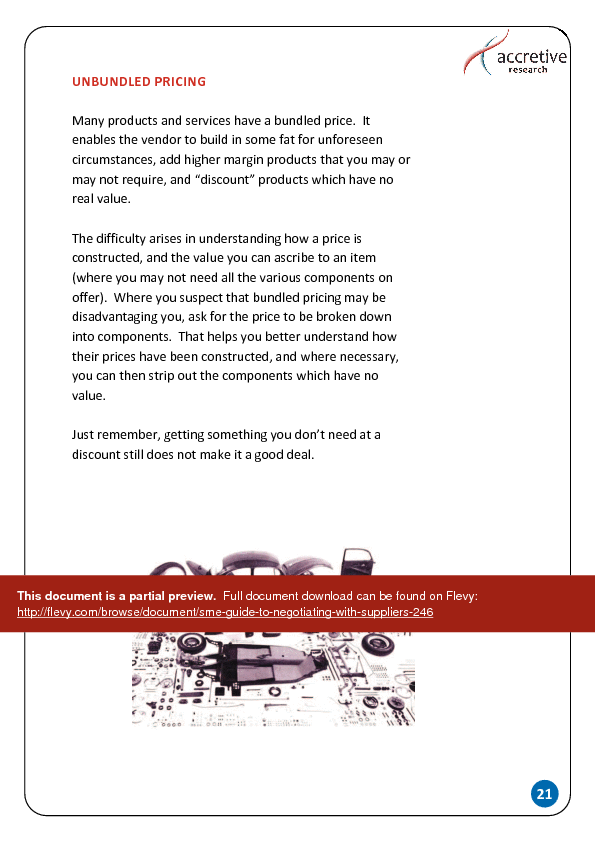
Bundled pricing can hide margin, unnecessary components, or discounts on items that have little value. Breaking the offer into components helps the buyer understand price construction and remove items that are not needed.

Does the guide recommend making the first offer?
Usually no. It argues that making the first offer can reveal too much about your budget position and reduce the pressure on the vendor to show how flexible they are on price.

How does the guide suggest handling supplier performance in contracts?
It recommends using both sticks and carrots. Sticks are KPI-linked consequences when service or delivery fails, while carrots are incentives for exceeding expectations such as faster delivery or better-than-agreed commercial performance.

What kind of supplier research does the guide expect before negotiation?
It expects research into the supplier’s history, financial viability, market position, product maturity, competition, sales structure, and economic factors that could affect delivery or pricing. It also lists internet searches, customer references, annual reports, and credit checks as research methods.

Does the guide support aggressive, adversarial negotiation?
Not as the preferred model. It criticizes crude, price-led negotiation that leaves one side feeling forced down and instead promotes outcomes that are workable and sustainable for both parties.

Glossary

•  Negotiation - The art of ensuring that what you need and what you get are one and the same
•  LAA - Least Acceptable Agreement, meaning the very worst deal you are willing to accept
•  MDO - Most Desirable Outcome, meaning the realistic best offer you think you can get
•  BATNA - Best Alternative To a Negotiated Agreement, meaning what you will do if the negotiated deal is worse than your LAA
•  Volume - The quantity being purchased, used in the guide to evaluate pricing and strategic buying leverage
•  Tenure - The length of time the goods or services will be purchased or contracted for
•  Unbundled Pricing - Breaking a bundled supplier price into components so the buyer can see how the total was constructed
•  VTP Pricing Matrix - A Volume/Tenure Pricing Matrix used to compare price points across order size and contract length
•  Rules of Engagement - Agreed principles and expected conduct for negotiation meetings
•  Action Plan - A documented list of tasks, owners, and deadlines created after a meeting
•  KPI - Key Performance Indicator used in contracts to define service or delivery expectations and related consequences
•  Sticks - Penalties or negative consequences used when agreed supplier performance is missed
•  Carrots - Incentives or rewards used when a supplier exceeds agreed expectations
•  Bundled Price - A combined price that may include multiple items, contingencies, or extras in one offer
•  Prepared Folio - Written negotiation material taken into the meeting to support discipline and professionalism
•  Work-to-Rule - A negative commercial response described in the guide when one party feels forced down in a deal
•  Reference - A current customer contact used to validate a supplier’s product or service performance
•  Credit Check - A financial stability review used to assess whether a supplier may pose delivery or performance risk

Source: Best Practices in Supplier Management, Procurement Negotiations PDF: SME Guide to Negotiating with Suppliers PDF (PDF) Document, speffer


$29.95

Add to Cart
  

ABOUT THE AUTHOR

Author: speffer

Stuart is the Managing Director of Accretive, a consulting and business advisory firm based in Sydney, Australia. A business author and member of the University of Western Sydney Human Research Ethics Committee, he has extensive experience in strategic planning, business growth, operations and efficiency management. He has 18 years' experience in helping some of the largest companies in the ... [read more]

Ask the Author a Question

You must be logged in to contact the author.

Click here to log in Click here register

Did you know?
The average daily rate of a McKinsey consultant is $6,625 (not including expenses). The average price of a Flevy document is $65.


Trusted by over 10,000+ Client Organizations
Since 2012, we have provided business templates to over 10,000 businesses and organizations of all sizes, from startups and small businesses to the Fortune 100, in over 130 countries.
AT&T GE Cisco Intel IBM Coke Dell Toyota HP Nike Samsung Microsoft Astrazeneca JP Morgan KPMG Walgreens Walmart 3M Kaiser Oracle SAP Google E&Y Volvo Bosch Merck Fedex Shell Amgen Eli Lilly Roche AIG Abbott Amazon PwC T-Mobile Broadcom Bayer Pearson Titleist ConEd Pfizer NTT Data Schwab


Read Customer Testimonials

 
"I have used FlevyPro for several business applications. It is a great complement to working with expensive consultants. The quality and effectiveness of the tools are of the highest standards."

– Moritz Bernhoerster, Global Sourcing Director at Fortune 500
 
"As an Independent Management Consultant, I find Flevy to add great value as a source of best practices, templates and information on new trends. Flevy has matured and the quality and quantity of the library is excellent. Lastly the price charged is reasonable, creating a win-win value for "

– Jim Schoen, Principal at FRC Group
 
"Last Sunday morning, I was diligently working on an important presentation for a client and found myself in need of additional content and suitable templates for various types of graphics. Flevy.com proved to be a treasure trove for both content and design at a reasonable price, considering the time I "

– M. E., Chief Commercial Officer, International Logistics Service Provider
 
"I have used Flevy services for a number of years and have never, ever been disappointed. As a matter of fact, David and his team continue, time after time, to impress me with their willingness to assist and in the real sense of the word. I have concluded in fact "

– Roberto Pelliccia, Senior Executive in International Hospitality
 
"As a consultant requiring up to date and professional material that will be of value and use to my clients, I find Flevy a very reliable resource.

The variety and quality of material available through Flevy offers a very useful and commanding source for information. Using Flevy saves me time, enhances my expertise and ends up being a good decision."

– Dennis Gershowitz, Principal at DG Associates
 
"As a consulting firm, we had been creating subject matter training materials for our people and found the excellent materials on Flevy, which saved us 100's of hours of re-creating what already exists on the Flevy materials we purchased."

– Michael Evans, Managing Director at Newport LLC
 
"As a young consulting firm, requests for input from clients vary and it's sometimes impossible to provide expert solutions across a broad spectrum of requirements. That was before I discovered Flevy.com.

Through subscription to this invaluable site of a plethora of topics that are key and crucial to consulting, I "

– Nishi Singh, Strategist and MD at NSP Consultants
 
"The wide selection of frameworks is very useful to me as an independent consultant. In fact, it rivals what I had at my disposal at Big 4 Consulting firms in terms of efficacy and organization."

– Julia T., Consulting Firm Owner (Former Manager at Deloitte and Capgemini)


Customers Also Bought These Documents


Customers Also Like These Documents

Explore Templates on Related Management Topics


Your Recently Viewed Documents
Receive our FREE presentation on Operational Excellence

This 50-slide presentation provides a high-level introduction to the 4 Building Blocks of Operational Excellence. Achieving OpEx requires the implementation of a Business Execution System that integrates these 4 building blocks.