 Every PEO buys benefits technology at a moment of relative calm. The evaluation happens between renewals, with sample data, on a plan year that has not yet started. That timing shapes what gets tested.
Most comparisons of PEO software solutions center on the enrollment event, because enrollment is the easiest part of benefits administration to follow from end to end. Elections go in. A file goes out. A confirmation comes back.
The work that decides whether a system holds up starts after that point. It arrives as changes to elections already processed, invoices that disagree with the enrollment record, and client structures that were never standard.
A Retroactive Termination Reveals More Than a Full Enrollment Cycle Does
Sample data holds records that were entered correctly the first time. Live data stops looking like that early in a plan year.
One backdated termination touches almost every part of the operation. The carrier has to be notified, the premium has to be credited, the client invoice has already gone out, and the deduction has already been taken.
Systems differ widely in how they absorb it. Some recalculate the affected periods and carry the credit forward with a record of why it exists. Others take the new effective date and leave the financial correction elsewhere.
That difference never appears in a feature list. It appears the first time a benefits team has to explain a credit the system produced but cannot account for.
An evaluation gets more useful when a few real events run through the software instead of a clean cycle:
- A termination dated into a closed billing period
- A dependent added after invoicing
- A plan change that crosses a rate tier
- A contribution strategy revised mid-year
Rate Structure Belongs to the Client Relationship, Not to the Plan
A PEO offers master health plans, but the money behind them is client-specific. Two client companies on the same plan can carry different rate structures, different contribution splits, and different effective dates for changes.
Platforms designed around one employer’s benefits program tend to store rates on the plan. Everything client-specific then lives in an adjustment layer, and the adjustment layer is where reconciliation loses its footing.
This is one of the sharpest dividing lines in PEO software, and the test is structural rather than functional. A system should hold a rate that belongs to one client company, on a shared plan, for a defined period, without a workaround.
Every Adjustment Has to Be Explainable to the Client, the Carrier, and the Worksite Employee
Benefits billing inside a PEO is not a two-party transaction. The same premium dollar shows up on a carrier invoice, on a consolidated client invoice, and in a worksite employee’s deduction.
When those views disagree, the question is never only which number is correct. It is which change produced the difference, when it was made, and what it was based on.
That is an audit requirement, and it belongs in the evaluation as one. A system that records the calculation but not the reason behind it will pass a demonstration and fail a client audit.
The trail worth requiring covers the reason, not only the result:
- The change made and its effective date
- The source that entered it
- The prior value it replaced
- The billing cycle it landed in
Integration Is a Question about Which System Owns Each Record
The word integrated usually means two systems exchange data. That is a lower standard than it sounds, because both can exchange data faithfully and still disagree about what is true.
The narrower version of the question is more useful. For each record, one system has to be authoritative, and every other system has to defer to it.
Where ownership is unclear, reconciliation work becomes permanent. Someone compares the two versions every cycle, and that comparison is the only control.
Ownership is worth mapping before a decision, record by record:
- Eligibility and effective dates
- Rates and contribution splits
- The enrollment sent to each carrier
- The amount billed to each client company
- The deduction taken in payroll
Implementation Is the Only Honest Preview of How a System Will Behave
Onboarding a client company is mostly a data exercise. Plan setup, rate tables, contribution rules, and eligibility history have to be represented before any feed matters.
A PEO learns more about a system during implementation than in any evaluation, because that is where configuration limits surface. A structure that cannot be modeled has to be approximated, and the approximation carries forward for the life of the client.
Which client structures need custom configuration, what historical data can come across, and how the first reconciliation cycle gets validated belong in the selection conversation.
Configuration Limits in PEO Software Turn into Headcount
When a system cannot represent something, the work does not disappear. It becomes a side calculation, a checklist, or a person who remembers the exception.
That is rarely a deliberate decision. It accumulates one client structure at a time, until part of the team’s capacity is committed to holding the gaps together.
So the technology decision and the staffing plan are the same decision. A system that models the business as it operates keeps the team on client work. A system that approximates it turns the team into an interface layer.
A Strong Evaluation Ends with a List of Exceptions, Not a List of Features
Feature comparisons converge. Most platforms describe similar capabilities, and the descriptions are usually accurate.
What separates them is the treatment of cases outside the standard path, and those cases are specific to each PEO’s book of business. The reliable way to surface them is to bring real exceptions into the evaluation and require that each be shown rather than described.
The output is a written record of how the system handles the operation’s known hard cases. That record doubles as the implementation plan.
Conclusion: The System of Record Decides What a PEO Can Say with Confidence
The threads converge on one requirement. Retroactive change, client-level rates, agreement across carrier and client and employee views, and clear ownership of each record are versions of the same demand: the system has to account for itself without help.
A decision about PEO software is usually framed as an efficiency question. It works more like a commitment. Whatever the system can account for is what the organization can state plainly to a client, a carrier, or an auditor, without reconstructing the answer first.
That standard also sets the growth constraint. A PEO can take on the client structures its technology can represent, and every structure held together by manual work lowers the ceiling.
Do You Want to Implement Business Best Practices?
You can download in-depth presentations on Human Resources and 100s of management topics from the FlevyPro Library. FlevyPro is trusted and utilized by 1000s of management consultants and corporate executives.
For even more best practices available on Flevy, have a look at our top 100 lists:
These best practices are of the same as those leveraged by top-tier management consulting firms, like McKinsey, BCG, Bain, and Accenture. Improve the growth and efficiency of your organization by utilizing these best practice frameworks, templates, and tools. Most were developed by seasoned executives and consultants with over 20+ years of experience.
Readers of This Article Are Interested in These Resources
17-slide PowerPoint presentation
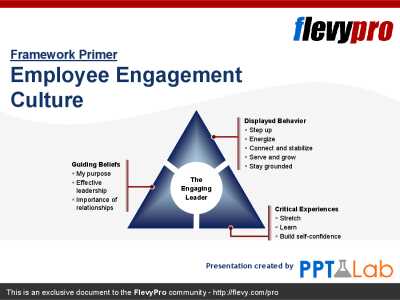
Improving Employee Engagement is a priority in most Talent and HR Strategies. This presentation provides a 5-step approach to building a culture of Employee Engagement. This processed was developed by Aon Hewitt based on the Aon Hewitt Top Companies for Leaders study.
Best practices from the
[read more]
18-slide PowerPoint presentation
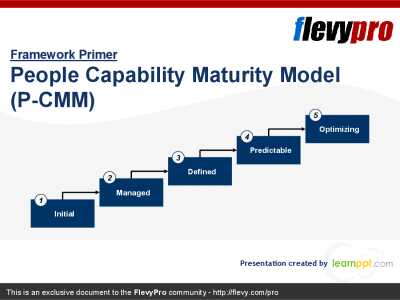
Following the success of Capability Maturity Model for Software, Carnegie Mellon University developed the People Capability Maturity Model (People CMM or P-CMM). The People CMM is based on best practices—in areas such as human resources, knowledge management, and organizational development—for
[read more]

27-slide PowerPoint presentation
Today's information-based, knowledge intensive, and service-driven economy has forced organizations to make substantial changes to the way they do business. With talented Human Capital now becoming the key strategic resource, the locus of the battle front has shifted. Managers not only have to
[read more]
19-slide PowerPoint presentation
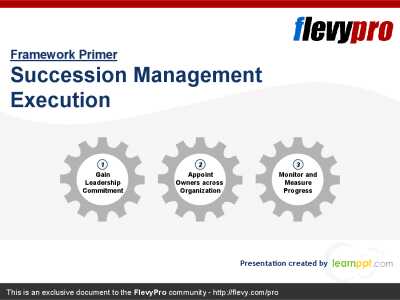
The changing business landscape calls for business to adopt a high-impact succession management system. Succession Management is not a mere listing of potential leaders. Succession Management both identifies and develops high-potential leaders capable of executing our company’s
[read more]