Editor's Note: Take a look at our featured best practice, Training Needs Analysis (TNA) (72-slide PowerPoint presentation). Training Needs Analysis (TNA) goes beyond mere employee preferences or superficial surveys. It's a strategic process focused on aligning training with business objectives and bridging performance gaps.
This training PowerPoint will provide you with a comprehensive understanding of TNA, [read more]
* * * *
When you’re talking about working hours, we very much don’t all have the same 24 hours in a day. Anyone responsible for staff scheduling, payroll accuracy or working time regs compliance will know that it’s a bit more complicated than this.
We don’t work all day. And we can’t all work the same days. So working out how many working hours in a year for yourself, or your team in the UK, is far from simple. But it’s necessary, because that total needs to be both legally compliant and contractually correct. It’s a number that underpins everything from annual leave entitlement to hourly pay rates and pro-rata calculations for part-timers. Get it right, and your workload planning will be smooth sailing, your leave calendar beautifully balanced and your forecasts spot on. But get it wrong, and you tip the first domino on a run of payroll errors, staff disputes and admin headaches…
What Is a “Working Hour?”
According to the Working Time Regulations 1998, a “working hour” is any time the worker is at the employer’s disposal and carrying out work duties.
The Quick Answer: How Many Working Hours in a Year UK?
Assuming 261 working days in a year (365 days minus 104 weekend days – in a leap year you’ll need to add a day) and a standard full-time employment contract with 37.5 hours a week with 28 days’ statutory leave, the total gross number of working hours is 1,957.5. Take off 210 hours for annual leave, and you have a grand total of 1,747.5 net working hours.
You’ve also got to factor in bank holidays, which is potentially another 75 hours. Some employers include these within annual leave entitlement, others offer them on top. Using an annual leave software like Leave Dates can help you easily account for all leave and bank holidays.
And for the Non-standard?
The reality for most companies is a bit more complex. Using 1,745.5 hours as your full-time gold standard, the total working hours for any other type of contract will be a percentage of that figure. For example, a part-time worker doing 60% of full-time hours would be working 1,048.5 hours per year (1,747.5 x 0.60 = 1,048.5).
Compliance
Getting your net working hours figure is the backbone of HR, payroll and compliance for your business. Small business owners/managers, HR teams and payroll admin all need to know this number so that they can effectively:
Work out annual salaries and hourly rates. This ensures people are paid fairly and is used to calculate overtime, sick pay and average earnings. An accurate hourly rate is found by dividing annual salary by net working hours per year.
Manage staffing. The total net working hours figure is what dictates your capacity, allowing you to accurately forecast the volume of products and/or services you can deliver.
Accurately track leave and work out holiday entitlements. All types of leave can be measured against the annual working hours. This is especially useful for automating tricky calculations for part-time staff.
Ensure compliance. The Working Time Regulations set a max of 48 hours in an average working week over a 17-week rolling period. Knowing your expected net annual hours gives you a baseline to work from and you should get fair warning if you’re at risk of being non-compliant.
Key Takeaways
How many working hours in a year? There is a simple answer – 1747.5 net working hours – but the world of work is never simple. For small business managers, manually tracking variations, managing accruals, and ensuring WTR compliance across a mix of full-time, part-time, flexi-time and even zero-hour contracts is… a lot. Fortunately, Leave Dates can help you to automate everything, so you can put your calculators and spreadsheets away, freeing up time to focus on people instead.
About the Author
Phil is the co-founder of Leave Dates, the employee annual leave planner. He loves problem-solving and making life easier for small businesses. If you book a Leave Dates demo, he will give you a warm welcome and show you everything that you need to know.
The TWI Job Instruction (JI) program trains supervisors in how to instruct a person to perform a job correctly and safely; and to be productive as quickly as possible, while creating less scrap, rework, and damage to tools and equipment.
This tried and tested methodology is based on the [read more]
Do You Want to Implement Business Best Practices?
You can download in-depth presentations on Employee Training and 100s of management topics from the FlevyPro Library. FlevyPro is trusted and utilized by 1000s of management consultants and corporate executives.
For even more best practices available on Flevy, have a look at our top 100 lists:
These best practices are of the same as those leveraged by top-tier management consulting firms, like McKinsey, BCG, Bain, and Accenture. Improve the growth and efficiency of your organization by utilizing these best practice frameworks, templates, and tools. Most were developed by seasoned executives and consultants with over 20+ years of experience.
Readers of This Article Are Interested in These Resources
ISO 9001:2026 QUALITY MANAGEMENT SYSTEM (QMS) AWARENESS & IMPLEMENTATION TOOLKIT
Transform standard quality management from a rigid administrative burden into a dynamic driver of strategic performance, process agility, and stakeholder confidence. Fully tailored to address the ISO 9001:2026 [read more]
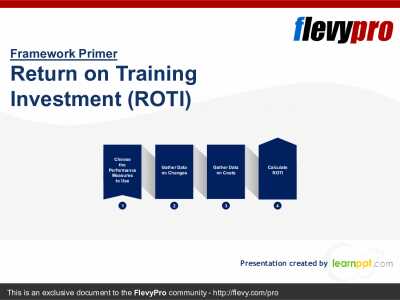
The concept of Return on Investment (ROI) originated in the Manufacturing sector, where it's simple to measure time and output. Next to adopt the concept was the Banking industry, where it is used consistently. ROI calculation is now a common feature in every type, industry, and function of [read more]
The Training Within Industry (TWI) Job Relations (JR) program teaches supervisors how to evaluate and take proper actions to handle and to prevent people problems. This skill in leading helps the supervisor to improve his ability in working with people.
There are basic principles that, [read more]
The TWI Job Methods (JM) program trains supervisors in how to improve the way jobs are performed in order to consistently produce greater quantities of quality products in less time using available manpower, machines and materials.
Participants are taught how to break down jobs into their [read more]
 When you’re talking about working hours, we very much don’t all have the same 24 hours in a day. Anyone responsible for staff scheduling, payroll accuracy or working time regs compliance will know that it’s a bit more complicated than this.
 Phil is the co-founder of