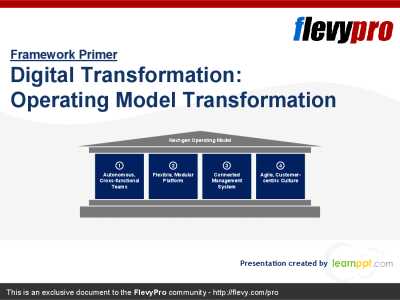
Editor's Note: Take a look at our featured best practice, End-to-end (E2E) Operating Model Transformation (30-slide PowerPoint presentation). In many industries, executives have had their hands full staying competitive and surviving market downturns. This is done by making cuts, often silo by silo, and occasionally in ways that negatively affected customers.
It is time for organizations to rework their Operating Models in a new way, [read more]
* * * *
A decade ago, leaders planning an Operating Model Redesign (OMR) had a reliable playbook. A widely cited set of 9 golden rules gave them a checklist of practices that, when followed, raised the odds of success considerably. Organizations that applied most of those rules saw their redesigns succeed far more often than those that improvised.
The business environment has changed since then. Disruption arrives faster, work is organized across more digital tools and fewer rigid hierarchies, and OMRs have become routine rather than exceptional. A playbook written for one era cannot be expected to perform equally well in the next.
That question prompted McKinsey to revisit its original research in 2025. The new study confirmed that the original golden rules remain positively associated with OMR success, but their influence has weakened. Applying more than 6 of the original rules today is linked to a 55% success rate. Applying all 9 lifts that figure only to about 59%.
The study then tested what works better. It identified a framework of 9 New Golden Rules of Operating Model Redesign Success that reflect current organizational realities, and the results are striking. Organizations using more than 6 of the refreshed rules achieved a 95% success rate, where success means meeting strategic goals and improving performance. Those using all 9 reached 97%. In practical terms, the updated rules nearly double the likelihood that a redesign delivers what leaders intended.
The 9 New Golden Rules of OMR Success
The refreshed framework comprises 9 golden rules:
Don’t Just Fix the Pain Points, Enable the Strategy
Go beyond “Boxes and Lines” to Rewire the Business
Use a Rigorous Process for Talent Selection
Align the Senior Team through a Shared Vision and Clear Design Principles
Stack the Redesign Team with Top Talent and Expertise
Equip People Leaders with the Skills to Drive Change
Identify and Embrace New Behaviors and Mindsets
Link Leadership Incentives to Redesign Success
Proactively Manage Transition Risks
Five of these rules carry forward from the original set, sometimes with sharper emphasis. Four are new or substantially evolved, reflecting the growing importance of top team alignment, leadership incentives, manager capability, and the caliber of the redesign team itself. Collectively, the rules cluster around 4 themes that connect redesign to value: Leadership Alignment, Workflow Rewiring, Investment in People, and a Performance Culture. Let’s examine the first 2 rules more closely, for now.
Rule 1: Don’t Just Fix the Pain Points, Enable the Strategy
This rule survived the transition from the original set intact, which says something about its durability. Its central message is that a redesign should not stop at the loudest complaints or at a redrawn reporting line. It must be anchored in the outcomes the Strategy requires.
Pain points still have a role. They are useful evidence of where the current model is failing. They are simply a poor design brief. A redesign that only removes today’s friction tends to recreate it in a new organizational chart, because the forces that produced the friction were never addressed.
Enabling the Strategy requires 4 disciplines working together. The first is prioritizing strategic alignment over quick fixes, so that long-term objectives rather than current irritations guide design choices. The second is a holistic perspective. Processes, decision rights, and rewards all need to reinforce the same strategy, not just the structure.
The third discipline is a focus on Value Creation. Resources and accountability should flow toward the activities that generate disproportionate value and away from work that does not. The fourth is clarity across functions. Each function should carry a small set of performance metrics tied directly to the strategy, communicated widely enough that local decisions point in the same direction.
When every structural change, resource shift, and accountability assignment is tested against the value agenda in this way, the redesign becomes a vehicle for growth. Without that test, it becomes a way to quiet the organization for a quarter.
Rule 2: Go beyond “Boxes and Lines” to Rewire the Business
The second rule is also evergreen, but its emphasis has shifted. A successful redesign is not a cleaner organizational chart. It changes how work gets done, who holds decision rights, and how teams collaborate across processes. Those changes unlock efficiency and agility that structural moves alone cannot deliver.
A useful way to frame the shift is from organizational charts to work charts. Reporting lines show who sits where. They do not show how value is created. Work charts map how tasks, information, and decisions actually flow across teams, and they reveal where handoffs break down or approvals pile up.
Technology is central to this rule in a way it was not a decade ago. Digital tools should be designed into the workflow from the start rather than layered on afterward. The aim is for technology to carry the routine flow of work, leaving people to focus on the interactions that require judgment.
The rule also calls for a root-cause approach to one of the most common complaints in any organization: slow decisions. Sluggish decision making is rarely a span-of-control problem. It is usually a matter of unclear process ownership, missing decision frameworks, and behaviors that keep decisions bouncing between groups. Adjusting the hierarchy will not fix any of these. Clarifying ownership, building decision frameworks, and shifting behaviors will.
Ultimately, processes, culture, and technology have to be rewired together. Structure without that rewiring leaves the old operating system running beneath a new drawing.
Case Study
A mid-sized third-party Logistics provider set out to redesign its operating model after 2 years of rising customer churn. Account managers blamed the warehouse network, warehouse leaders blamed sales, and the initial proposal was to merge the two functions under a single executive.
Applying the first rule, leadership set aside the internal blame and defined the strategic outcome: grow e-commerce fulfillment revenue by 40% over 3 years while cutting customer onboarding time in half. Each function received 2 or 3 metrics tied directly to those goals.
Applying the second rule, a cross-functional team built work charts for customer onboarding. The exercise showed that a new account passed through 11 handoffs and required sign-off from 4 separate managers, none of whom owned the end-to-end process. Customer data was rekeyed into 3 systems.
The redesign appointed a single onboarding owner with clear decision rights, introduced a shared digital workflow that eliminated duplicate data entry, and reduced approvals to 1. Reporting lines changed only modestly. Onboarding time fell sharply within 2 quarters, and churn began to decline.
FAQs
Why did the original golden rules lose predictive power?
Business conditions, the pace of disruption, and the way work is organized have all changed. The original rules still help, but they no longer capture what most reliably drives success today.
What makes the refreshed rules more effective?
They place greater weight on leadership alignment, investment in people, workflow rewiring, and a performance culture, which better match how organizations now create value.
Which of the 9 rules are entirely new?
Aligning the senior team, stacking the redesign team with top talent, equipping people leaders to drive change, and linking leadership incentives to redesign success reflect the most significant evolution.
What is a work chart, and how does it differ from an organizational chart?
An organizational chart shows reporting relationships. A work chart shows how tasks, information, and decisions flow across teams, exposing bottlenecks the hierarchy conceals.
Do organizations need to apply all 9 rules?
Applying more than 6 already yields a 95% success rate in the research, but applying all 9 produced the strongest outcomes.
Concluding Thoughts
The updated golden rules show that the fundamentals of redesign still matter, but the emphasis has moved. Enabling the strategy keeps the effort focused on value rather than on noise, and rewiring the business ensures change reaches the workflows, decision rights, and technology where performance is actually determined.
The remaining 7 rules extend that logic to people and leadership. They address rigorous talent selection, senior team alignment, the caliber of the redesign team, manager capability, new behaviors and mindsets, incentives tied to outcomes, and proactive management of transition risks. Organizations that apply the full set give their redesign the strongest possible chance of delivering lasting value.
You can download in-depth presentations on this and hundreds of similar business frameworks from the FlevyPro Library. FlevyPro is trusted and utilized by 1000s of management consultants and corporate executives.
For even more best practices available on Flevy, have a look at our top 100 lists:
With recent developments and challenges, such as the impact of COVID-19, the extent of organisation flux is predicted to rapidly increase, such that many organisations are likely to be in a nearly permanent state of organisational flux. We can characterize organisational flux as the continuous [read more]
Readers of This Article Are Interested in These Resources
In an M&A situation, a fundamental question is what the Target Operating Model (TOM) of the resultant organization will look like. This framework addresses the topic of TOM Development in an M&A.
In formulating the Target Operating Model, there are 6 core areas that must be analyzed in an [read more]
Lean Management plays a significant role in putting in place processes, capabilities, and tools to improve how businesses operate. But the Digital Age has increased both the opportunities for businesses who know how to react and the difficulty of getting it right.
Tasks performed by humans [read more]
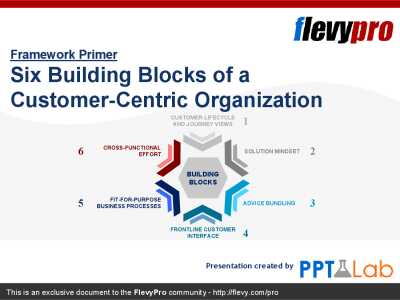
More and more organizations are shifting a traditional Product-focused model to becoming a Customer-centric Organization. To do this without incurring debilitating costs from added process and organizational complexity, the organization must be build a true Customer-centric Organization by [read more]
Curated by McKinsey-trained Executives
🚀 How to Create Standard Operating Procedures (SOPs) – The Ultimate Business Guide to Scaling, Efficiency, and Profit
Stop Losing Time, Money, and Control -- Build SOPs That Actually Work
If your business depends on people remembering what [read more]
 A decade ago, leaders planning an Operating Model Redesign (OMR) had a reliable playbook. A widely cited set of 9 golden rules gave them a checklist of practices that, when followed, raised the odds of success considerably. Organizations that applied most of those rules saw their redesigns succeed far more often than those that improvised.