Editor's Note: Take a look at our featured best practice, Omni-channel Retail Strategy (44-slide PowerPoint presentation). The e-commerce market continues to grow exponentially. More consumers are opting for the convenience of online shopping. This trend has been accelerated by COVID-19.
The future of e-commerce is Omni-channel Retailing. A single channel is no longer enough. The challenge is to find a seamless [read more]
* * * *
Retail CRM has changed significantly over the past few years. What was once largely about managing customer databases and sending promotional emails has evolved into a much broader discipline involving lifecycle automation, behavioral segmentation, SMS, personalization, predictive analytics, and AI.
Yet, despite the rapid adoption of these technologies, many retail brands are still struggling to translate their CRM investments into meaningful customer relationships and revenue growth.
The latest Mavlers Retail CRM & Lifecycle Marketing Benchmark Report 2026 offers an interesting look at where retail CRM stands today. Drawing on benchmark data from nine industry sources and primary survey data collected across 50 retail clients, the research examines CRM adoption, email and SMS performance, lifecycle automation, revenue benchmarks, and AI usage.
So, what can retail marketers learn from the latest benchmarks?
1. CRM Adoption Is High, But Maturity Varies
Retail and consumer goods already represent a significant share of the global CRM market.
Around 68% of retail enterprises actively use CRM systems for activities such as loyalty tracking, promotional campaigns, and buying behavior analysis. Retail organizations also account for nearly 24% of advanced CRM analytics usage.
However, CRM adoption doesn’t necessarily mean CRM maturity. Some brands continue to use their platforms primarily for campaign scheduling and basic customer communications. More mature organizations are using CRM to power predictive segmentation, automated customer journeys, personalization, and retention programs.
This creates an important opportunity for retailers: rather than focusing only on adopting new technology, brands need to maximize the capabilities of the technology they already have.
2. Email Marketing Remains a Major Revenue Driver
Despite predictions that email would lose relevance as new channels emerged, it continues to be one of the strongest channels in retail marketing.
The research shows that email remains exceptionally effective from an ROI perspective, while automated flows consistently outperform traditional campaigns.
Across retail categories, lifecycle flows generate substantially higher click rates than campaigns. In fact, the benchmark data shows flows delivering 3–4× higher click rates than campaigns across verticals.
The reason is relatively straightforward. Campaigns are generally designed around what the brand wants to communicate. Lifecycle flows are triggered by what the customer does.
That distinction can have a significant impact on engagement. A customer abandoning a cart, browsing a product, completing an order, or approaching their typical replenishment date has already provided a valuable signal. Lifecycle marketing allows brands to respond to that signal rather than relying on a generic broadcast.
3. Personalization Is Moving From Segmentation to Behavior
Personalization has been a major focus for marketers for years, but the definition of personalization is changing. Simply addressing a customer by name or segmenting an email list based on demographics is no longer enough. The strongest retail CRM programs are increasingly using behavioral signals such as:
Products viewed
Purchase history
Cart activity
Purchase frequency
Loyalty status
Predicted customer value
Replenishment timing
Engagement behavior
This is particularly evident in lifecycle automation. Most retail brands currently operate only 4–6 active lifecycle flows, while more mature programs typically run 12–16. The most commonly missing journeys include browse abandonment, replenishment, VIP tiering, price drops, back-in-stock alerts, and cross-sell campaigns.
For retailers, expanding lifecycle coverage can therefore be a relatively straightforward way to identify incremental revenue opportunities without necessarily increasing acquisition spend.
4. Replenishment Marketing Is an Underused Opportunity
For brands selling products that customers purchase repeatedly, replenishment marketing deserves particular attention.
Consider categories such as skincare, supplements, food and beverages, pet products, or household products. The customer has already purchased the product and, in many cases, already demonstrated that they want it. The challenge is timing.
A well-designed replenishment journey can remind customers to repurchase around the point when they are likely to need the product again. The benchmark data shows replenishment flows achieving 35–50% open rates, 5–10% click rates, and 6–12% conversion rates, with revenue per recipient reaching $2–$5.
For retailers with naturally recurring purchase behavior, this makes replenishment one of the most compelling lifecycle marketing opportunities.
5. Transactional Emails Shouldn’t Be Overlooked
Transactional emails are usually viewed as operational communications. But they can also represent some of the highest-attention interactions a brand has with its customers. The research shows transactional emails achieving a 51.4% open rate and an extremely low 0.007% unsubscribe rate.
That creates an opportunity for retailers to think beyond simply delivering the required information. Depending on the context, transactional communications can also support:
Product recommendations
Loyalty education
Cross-sell opportunities
Post-purchase content
Replenishment reminders
Customer education
The key is relevance. Transactional emails should continue to serve their primary purpose while using the customer’s existing context to create additional value.
6. SMS Is Becoming an Important Part of Retail CRM
Email continues to anchor retail CRM, but SMS is gaining momentum. SMS send volume increased 19% year over year in 2025, with brands expanding usage beyond welcome messages into browse abandonment, post-purchase, and loyalty communications.
SMS flows are particularly noteworthy. The benchmark shows SMS flows generating 9–10%+ click rates, while order rates can be 6–8× higher than SMS campaigns. However, retailers shouldn’t simply treat SMS as another version of email.
Email works well for storytelling, education, and detailed product communication. SMS is more effective when immediacy matters. The strongest omnichannel strategies therefore use each channel according to its strengths rather than sending identical messages across every channel.
7. AI Adoption Is Rising. But There Is Still a Long Way to Go.
AI is quickly becoming part of the retail CRM stack. The research identifies several growing AI use cases, including:
Subject line and send-time optimization
AI-powered CRM assistants
Product recommendations
Predictive segmentation
Content generation
Automated response workflows
But one finding is particularly interesting. While AI adoption is high, fewer than 20% of Klaviyo accounts use predicted CLV for segmentation, despite the capability being available. Brands that use it report 15–25% higher revenue per recipient on campaigns.
This highlights an important distinction between using AI to make marketing teams more productive and using AI to make CRM programs more intelligent. Generating email copy is useful. Understanding which customers are most valuable, most likely to churn, or most likely to purchase next can have a much greater strategic impact.
8. Consumer Expectations Are Creating a New CRM Challenge
There is another issue retailers need to consider. Marketers increasingly believe AI is helping them understand customers better. However, there is still a significant gap between marketer perception and customer experience.
92% of retail marketers say AI gives them a stronger understanding of customer preferences, while only 53% of consumers feel brands truly understand what they want. At the same time, consumers are becoming increasingly selective about the data they are willing to share. Only 26% are comfortable sharing demographic or purchase data, 21% browsing data, and 14% location data.
This means personalization can’t simply be about collecting more data. Brands need to demonstrate why sharing data benefits the customer.
What Retail Marketers Should Focus on Next
The benchmarks point toward a few clear priorities for retail CRM teams.
Expand lifecycle automation: Look beyond welcome and cart abandonment. Replenishment, browse abandonment, loyalty, post-purchase, cross-sell, and winback journeys can create additional revenue opportunities.
Connect customer data: A sophisticated CRM platform won’t deliver sophisticated personalization if customer data remains fragmented. Only 27% of brands in the research have a fully integrated CDP.
Move beyond broadcast marketing: Behavior-based and journey-based communications consistently outperform broad campaigns. The more relevant the trigger, the greater the opportunity to engage the customer.
Use AI for smarter decisions: AI can do more than generate content. Predictive segmentation, customer lifetime value modeling, recommendations, and next-best-action strategies represent the next stage of CRM maturity.
Measure business outcomes: As inbox technology continues to change, opens are becoming a less reliable standalone metric. Revenue per recipient, conversions, repeat purchases, retention, and customer lifetime value provide a stronger view of CRM performance.
The Future of Retail CRM Is Lifecycle-First
The latest benchmarks don’t suggest that traditional CRM channels are disappearing. Quite the opposite.
Email remains highly valuable. SMS is growing. Automated flows continue to outperform campaigns, and AI is creating new opportunities for personalization and predictive marketing. The bigger change is happening in how these channels are being used.
Retailers are moving from campaigns to customer journeys, from broad audiences to behavioral signals, and from channel-specific marketing to coordinated lifecycle experiences. The brands that benefit most won’t necessarily be the ones with the largest technology stacks. They’ll be the ones that understand their customers well enough to deliver the right message, through the right channel, at the right point in the customer journey. And that’s ultimately where the next phase of retail CRM maturity will be won.
About the Research
The Mavlers Retail CRM & Lifecycle Marketing Benchmark Report 2026 examines CRM adoption, email and SMS performance, revenue benchmarks, lifecycle automation, channel usage, and AI adoption across retail. The research combines publicly available benchmark data from nine industry sources with primary survey data collected across 50 retail clients.
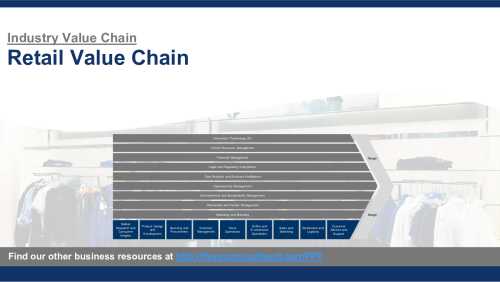
An Industry Value Chain is a visual representation of the series of steps an organization in a specific industry takes to deliver a product or service to the market. It captures the main business functions and processes that are involved in delivering the end product or service, illustrating how [read more]
Do You Want to Implement Business Best Practices?
You can download in-depth presentations on Retail Strategy and 100s of management topics from the FlevyPro Library. FlevyPro is trusted and utilized by 1000s of management consultants and corporate executives.
For even more best practices available on Flevy, have a look at our top 100 lists:
These best practices are of the same as those leveraged by top-tier management consulting firms, like McKinsey, BCG, Bain, and Accenture. Improve the growth and efficiency of your organization by utilizing these best practice frameworks, templates, and tools. Most were developed by seasoned executives and consultants with over 20+ years of experience.
Readers of This Article Are Interested in These Resources
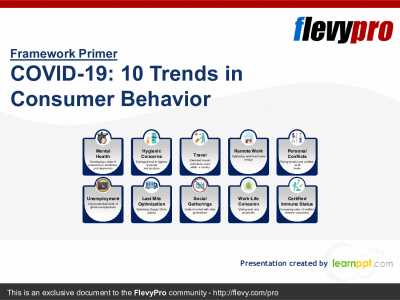
COVID-19 has taken the world by a storm. Financial markets, manufacturing, services, and tourism have been hit hard. In fact, it has also changed the way we work, communicate, interact, and shop more than any other disruption in the decade.
As a result, there have been key changes in Consumer [read more]
This presentation discusses profit recovery for retailers. Profit recovery includes improving shrink along the entire enterprise and supply chain--e.g. inventory loss, damages, shipping errors, credit/debit card loss, coupon abuse, other store discounting, etc.
This document delves into the [read more]
This is a sales presentation example for Consumer Driven Replenishment (CDR) project work. CDR is an analytical approach to supply chain integration between a consumer goods supplier and its customers.
This document provides a comprehensive overview of the Consumer-Driven Replenishment (CDR) [read more]
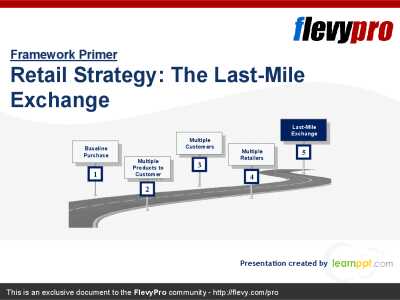
Keeping up with the growing volume of e-commerce will require delivery companies to disrupt their long-standing business model. All this growth can bring some peril.
Retailers and transportation companies are now faced with challenges in this fast-changing marketplace. With the boom in [read more]
 Retail CRM has changed significantly over the past few years. What was once largely about managing customer databases and sending promotional emails has evolved into a much broader discipline involving lifecycle automation, behavioral segmentation, SMS, personalization, predictive analytics, and AI.