 A misspelling on a client proposal. An ambiguous sentence from a contract. A passive-heavy report no one reads through. These are not mere style issues – they influence judgments, harm credibility, and sometimes cost actual money. Business writing is functional first. And when it doesn’t operate, the consequences show up in lost negotiations, misunderstood directions, and wasted hours on follow-up.
Most writing challenges are not dramatic. They build up. A team that frequently produces ambiguous internal memos creates confusion that slows down every project they touch. The sales team with a punctuation error in their email text loses credibility before the product gets a fair shot.
Grammar Errors Can Affect Business Credibility
Readers pick up errors even if they are unaware of them consciously. A proposal with persistent spelling mistakes in writing shows carelessness. A client who reads such material begins to question what else was done negligently. Trust goes before the talk even begins.
For companies that create a lot of written output – proposals, internal reports, client communications, documentation – the error rate multiplies. One person catching their own mistakes is slower and less reliable than a systematic review method. Proofreading by the author invariably misses errors since authors tend to read what they planned to write rather than what’s actually on the page. Running drafts through Getsolved grammar and spell checker before sending them out catches these errors. The program indicates grammar flaws, spelling faults, and punctuation problems in context, so repairs come with enough information to understand why something is incorrect – not simply that it is. That contextual input makes a huge difference in speed of improvement for teams when not everyone writes in their first language.
This is important beyond just polish. Good writing advice often boils down to the same truth: documents that are easy to read get read. Effortful documents are glossed over, miscomprehended, or ignored.
The Top Mistakes
Probably the most common fault in business writing is poor sentence construction. Readers have to work too hard when long, multi-clause sentences load condition onto condition. By the time someone gets to the major point of a paragraph, you’ve lost the thread. Short sentences aren’t always better – they can feel abrupt – but a range of lengths is what makes prose readable.
Passive voice is formal and overused in professional contexts. “The committee reviewed the report” is faster and clearer, and it puts accountability somewhere. There is a time and place for passive constructs in legal or compliance writing. They usually just add words in everything else.
There are two basic kinds of comma misuse: the comma splice (when you link two independent clauses with simply a comma) and the missing comma (when you don’t add the pause that separates a subordinate clause from the main phrase). Both are writing faults that distort meaning or make sentences more difficult to understand. The classic example is “Let’s eat, Sarah” versus “Let’s eat Sarah” – punctuation is not decorative.
Common sentence construction errors that impede corporate communication:
- Placing a number of conditions in front of the primary point (“If the client approves and the timeline is confirmed and the budget is finalized we can proceed”)
- Starting each sentence with “We” or “The” throughout a document
- Using a noun phrase to hide the activity (e.g. “make a decision” instead of “decide”)
- Subject phrases that are too long (6 or more words) before the verb
- Passive constructions where the actor is known and relevant
Vocabulary and Word Choice Issues
Jargon is a real problem in business writing and it works both ways. External readers are confused by acronyms, product names, department abbreviations, and other internal jargon. Industry jargon in client-facing materials generally suggests insecurity, not expertise. For clarity, plain language is nearly always better than technical terminology.
The other vocabulary issue is hedging. Phrases such as “it might be possible that,” “in certain circumstances we could potentially,” and “there may be some opportunity to” sap sentences of meaning. They’re written not to commit, but neither do they communicate. Often how to write better in a commercial context is simply a matter of removing these phrases first.
| Problem Type |
Weak Example |
Stronger Version |
| Passive voice |
“The report contained errors” |
“The audit team found three errors” |
| Buried verb |
“We have to make a decision about…” |
“We need to decide…” |
| Comma splice |
“The project is delayed, the team is working on it” |
“The project is delayed. The team is working on it.” |
| Hedging |
“It might be possible to move forward” |
“We can move forward” |
| Jargon overload |
“We will leverage synergies to optimize output” |
“We’ll pool resources to work more efficiently” |
Business Document Structural Issues
Even nicely written sentences don’t work if the structure of the content doesn’t help the reader. Often, structural-level problems in business writing go overlooked as writers focus on phrases and paragraphs without taking a step back to view the whole.
The most prevalent structural errors:
- Putting the key point at the end of a long document rather than at the beginning
- No clear hierarchy (all sections seem to be of similar importance)
- Headers that explain the topic, not the conclusion (“Budget” vs. “Budget Increase Needed for Q3”)
- Gaps between sections that don’t connect ideas – the reader has to make the logical leap themselves
- Conclusions that only rehash the introduction with no resolution
Active vs. Passive in Different Document Types
Not all documents are created equal. Writers who understand when passive voice is acceptable versus when it detracts from clarity can make better choices in context.
Reports describing processes commonly use passive constructs correctly – “samples were collected,” “data was recorded.” The actor doesn’t matter; the procedure does. In persuasive writing, proposals, or any document that demands accountability, passive voice eliminates the very information the reader needs.
Clear writing recommendations for business situations seem to boil down to one principle: if you know who did something, say it. Ambiguity is not neutral – it frequently reads as evasion.
Editing vs. Proofreading
These two are often confused, and the confusion results in documents that get one when they need both.
Editing addresses structure, logic, clarity, and argumentation. It asks: does this document say what it needs to convey, in the right order, at the right level of detail? Proofreading catches surface problems – spelling, punctuation, grammar, consistency in formatting. Editing and proofreading tips consistently recommend doing them separately, because attempting both at once means neither gets done well.
A practical order for business documents: draft, then edit for structure and clarity, then proofread for errors, then evaluate the final version with fresh eyes or a second reader. Skip the editing phase and you end up with polished text that has logical problems. Skip proofreading and you get well-organized documents filled with grammar mistakes in writing that damage credibility.
Conclusion
Most of the errors discussed here do not require a writing course to correct. They need attention – read your own work as if you don’t already know what it means. A misplaced comma, a buried verb, a sentence that hedges three times before delivering a point: these are not fatal in themselves. Accumulated across a proposal or a report, they create friction that costs time and, sometimes, the deal.
The true cost is the follow-up email that asks a question you already covered in your document. Build a review step into the process before anything goes out, and most of these problems disappear before the reader ever sees them.
Do You Want to Implement Business Best Practices?
You can download in-depth presentations on Structured Communication and 100s of management topics from the FlevyPro Library. FlevyPro is trusted and utilized by 1000s of management consultants and corporate executives.
For even more best practices available on Flevy, have a look at our top 100 lists:
These best practices are of the same as those leveraged by top-tier management consulting firms, like McKinsey, BCG, Bain, and Accenture. Improve the growth and efficiency of your organization by utilizing these best practice frameworks, templates, and tools. Most were developed by seasoned executives and consultants with over 20+ years of experience.
Readers of This Article Are Interested in These Resources
40-slide PowerPoint presentation
This presentation talks to the topics of structure communication, presentation development, and storyboarding. These topics related to formulating a cohesive, powerful business presentation.
This document dives deep into the essential elements of structured communication, ensuring your message
[read more]
21-slide PowerPoint presentation
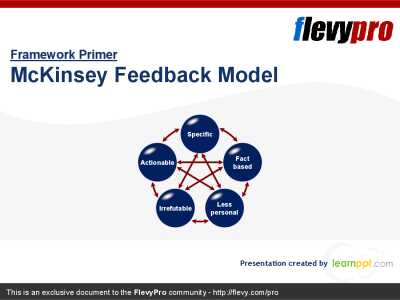
Giving feedback can be difficult and it can be a challenge. When not founded on specific framework and structure, it may result into predominantly negative feedback. It is essential that giving feedback is done in a most effective way.
When done right, feedback can have a multiplier effect. It
[read more]
20-slide PowerPoint presentation
This PowerPoint deck introduces the seven most commonly used storyline patterns in business and explains how to transform each one into a PowerPoint deck of its own.
Based on the Pyramid Principle, each of these seven patterns help you clarify your thinking around an important business issue so
[read more]

74-slide PowerPoint presentation
In the realm of senior management, proficient communication skills are more than just a necessity--they're your ticket to making a lasting impact. Whether it's penning down compelling narratives or presenting influential pitches, the ability to convey ideas crisply and persuasively is
[read more]