Every product that reaches a customer on time owes its arrival to a plan, even if nobody outside operations ever sees it. Raw materials had to be ordered in advance. Production lines had to be booked, and finished goods had to reach the right warehouses. When any step slips, the result is empty shelves, rushed freight, or cash locked in stock nobody needs.
Supply planning is the discipline that keeps those moving parts coordinated. Many companies still run it in spreadsheets, while others rely on tools such as Sunstice supply planning software to connect production, procurement, inventory, and distribution decisions in one model. This guide explains what the process involves and why it looks different for manufacturers than for distributors.
What Supply Planning Actually Means
Supply planning is the process of deciding how a business will meet expected demand with the resources it has. It answers practical questions: what to make, what to buy, how much stock to hold, and where to position it. The output is a time-phased plan that balances customer service against cost and capacity.
It is often confused with demand planning. Demand planning estimates what customers will want, based on sales history, market signals, and commercial input. Supply planning turns that forecast into decisions the business can execute. A forecast may say 10,000 units will sell in March, but the supply plan determines whether you can produce, source, and ship them.
The Four Building Blocks of a Supply Plan
1. Production Planning
Production planning sets how much to make, on which lines or plants, and when. It must respect constraints such as machine capacity, labor, changeover times, and yields. In process industries like food and chemicals, it may also account for co-products and by-products from the same run.
2. Procurement and Material Planning
Every production plan generates a list of materials to buy. Material requirements planning (MRP), developed in the 1960s and popularized by Joseph Orlicky of IBM, uses the bill of materials to calculate what is needed and when. Procurement planning then factors in supplier lead times, minimum order quantities, and price breaks.
3. Inventory Planning
Inventory acts as the shock absorber between supply and demand. Planners set safety stock based on demand variability, lead time variability, and target service levels. Too little stock leads to missed orders. Too much ties up working capital and raises the risk of write-offs for perishable or seasonal goods.
4. Distribution Planning
Distribution planning decides how finished goods flow from plants to warehouses and customers. Distribution requirements planning (DRP) calculates replenishment needs at each location. When supply is short, allocation rules determine which customers or channels get served first.
How the Supply Planning Process Works
Supply planning is a recurring cycle, often weekly for operational decisions and monthly for broader alignment through sales and operations planning (S&OP). A typical cycle looks like this:
Import the latest demand forecast and open customer orders.
Update inventory positions, capacities, and supplier lead times.
Generate an initial plan, either unconstrained or constrained.
Review exceptions such as shortages, overloaded resources, or excess stock.
Compare scenarios and agree on trade-offs with sales, finance, and operations.
Release the approved plan to ERP and execution systems.
The distinction in step three matters. An unconstrained plan shows what the business would need to meet all demand, which helps reveal gaps. A constrained plan shows what it can realistically deliver, and that is the version operations teams can commit to.
How Planning Differs for Manufacturers and Distributors
The fundamentals stay the same across industries, but the emphasis shifts depending on where a company sits in the supply chain.
Manufacturers
For manufacturers, capacity is usually the binding constraint. Planners coordinate multi-level bills of materials, shared production lines, and sequencing decisions that affect changeovers. A plan that looks fine on paper can fail on the shop floor if it ignores a single bottleneck machine. FMCG producers face extra pressure from promotions and short shelf lives, so it pays to compare the best supply chain planning software for FMCG manufacturers before choosing a platform.
Distributors
Distributors rarely deal with production lines, but they manage thousands of SKUs across many locations. Their main levers are purchasing, replenishment, and inventory positioning. Getting stock to the right place often matters more than total volume, since a surplus in one region does not help a shortage in another.
Common Challenges That Undermine Supply Plans
One of the best-known problems is the bullwhip effect, where small changes in consumer demand grow into larger swings in orders further up the chain. Jay Forrester described the dynamic in the early 1960s, and a widely cited 1997 paper by Hau Lee, V. Padmanabhan, and Seungjin Whang identified causes such as order batching and price fluctuations.
Other challenges are more mundane but just as damaging. Lead times vary, master data goes stale, and teams in disconnected spreadsheets spend hours reconciling numbers. Disruptions expose these weaknesses fast, as many companies learned during the COVID-19 pandemic.
What Good Supply Planning Delivers
When supply planning works well, the benefits show up across the business. Service becomes more predictable, inventory can come down without hurting availability, and expediting costs fall. Finance also gets a clearer view of working capital.
Perhaps the biggest gain is speed. Teams that can test scenarios before committing respond to disruptions with more confidence. For manufacturers and distributors facing constant volatility, that ability is what separates a resilient supply chain from a fragile one.
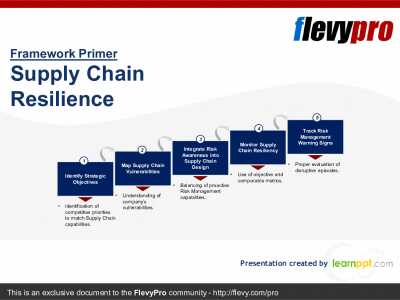
Supply Chain "resilience" is the Supply Chain's ability to respond and recover quickly to potential disruptions. It can return to its original situation or grow by moving to a new, more desirable state in order to increase customer service, market share, and financial performance.
Resilience is [read more]
Do You Want to Implement Business Best Practices?
You can download in-depth presentations on Supply Chain Management and 100s of management topics from the FlevyPro Library. FlevyPro is trusted and utilized by 1000s of management consultants and corporate executives.
For even more best practices available on Flevy, have a look at our top 100 lists:
These best practices are of the same as those leveraged by top-tier management consulting firms, like McKinsey, BCG, Bain, and Accenture. Improve the growth and efficiency of your organization by utilizing these best practice frameworks, templates, and tools. Most were developed by seasoned executives and consultants with over 20+ years of experience.
Readers of This Article Are Interested in These Resources
This deck was developed to support supply chain visioning and strategic diagnostics. It provides checklists of key questions to ask in formulating a supply chain strategy, core frameworks, tools and techniques that facilitate the strategic thinking process.
See also "Supply Chain Performance and [read more]
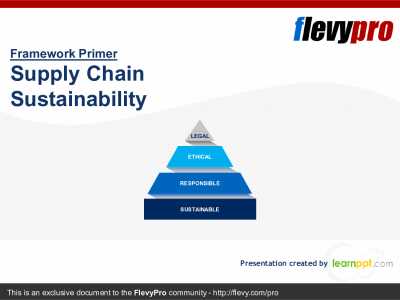
In the modern age, organizations are striving to form a sustainable Supply Chain system to cope with the challenges that are arising. Such issues include emission of hazardous substances, excessive resource consumption, Supply Chain risks, and complex procedures.
Organizations around the globe [read more]
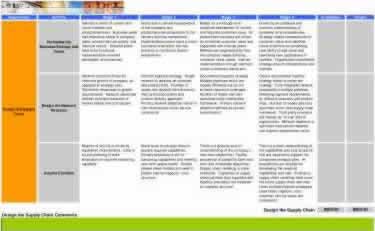
The purpose of the 4 Stage Model is to provide a high-level qualitative assessment of an organizations practices and processes. The model aligns with the Supply Chain Council's SCOR model and is broken down into Plan, Source, Make and Deliver. Within each of these major processes are a series of [read more]
Supply Chain Performance & Metrics document gives an overview of key performance metrics used to measure the operating effectiveness of a supply chain. The metrics are categorized for each stage of the supply chain with definition provided at the back of the document.
The objective of this [read more]
 Every product that reaches a customer on time owes its arrival to a plan, even if nobody outside operations ever sees it. Raw materials had to be ordered in advance. Production lines had to be booked, and finished goods had to reach the right warehouses. When any step slips, the result is empty shelves, rushed freight, or cash locked in stock nobody needs.
 The fundamentals stay the same across industries, but the emphasis shifts depending on where a company sits in the supply chain.