Editor's Note: Take a look at our featured best practice, Designing Operational Risk Management (ORM) Framework (48-slide PowerPoint presentation). Operational Risk is the risk of loss resulting from inadequate or failed internal processes, people, and systems or from external events. Operational Risk Management (ORM) is the management function of identifying, analyzing, and responding to these operational risks. ORM involves the [read more]
* * * *
For decades, risk management was viewed as a mandatory exercise for the compliance department or a footnote in the annual report. Those days are over. Especially during rapid scaling or complex acquisitions, operational risks have a direct impact on a company’s valuation. Executives who ignore these variables undermine their own growth strategy. Linking risk matrices and quality frameworks to your strategic decision-making is no longer a defensive cost item, but an absolute prerequisite for sustainable value creation.
Why Risk Management Must Start with Strategy
In many companies, risk teams and strategists still work at cross-purposes. Executive management outlines an ambitious expansion plan, while finance and legal only identify the vulnerabilities afterward. This results in strategies that seem sound on paper but, in practice, run aground due to supply chain disruptions, system failures, or human error. During a merger or acquisition, hidden process flaws can delay integration and reduce the value of the deal. By bringing risk experts to the strategy table from day one, you can make adjustments before capital has already been committed.
From Abstract Risk Appetite to Concrete Frameworks
A well-structured framework for enterprise risk management bridges the gap between management ambitions and day-to-day execution. Many executive boards do formulate a general risk appetite, but fail to translate it into clear thresholds on the shop floor. A procurement manager is of little use with a policy document on “controlled growth” if he must choose between a low-cost supplier and a more expensive dual-sourcing strategy.
This is where formalized risk matrices and quality frameworks make the difference. They convert abstract tolerances into measurable parameters for each business function. Through targeted scenario analyses, teams assess in advance what an accelerated product launch or an acquisition means for operational stability. In this way, risk management becomes an active control mechanism that protects enterprise value during growth spurts, rather than a brake on innovation.
Embed Risk Thinking into the Board’s Decision-Making Cycle
A one-time risk session during the annual budget cycle is insufficient. Strategic decisions are made throughout the year: during quarterly reviews, investment proposals, and responses to new competitors. That’s why up-to-date risk information must be a regular part of every board meeting. Invest in dashboards that show current vulnerabilities rather than outdated figures from the previous quarter.
The biggest pitfall remains reducing risk management to mere paperwork. Thick risk registers and colorful heat maps add no value if no one uses them to change course. Often, these lists grow every year without anyone critically assessing whether the old control measures still work in a changing market. The real benefit lies not in the reporting itself, but in the in-depth discussions at the top that result from it.
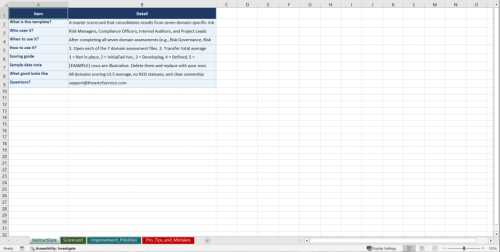
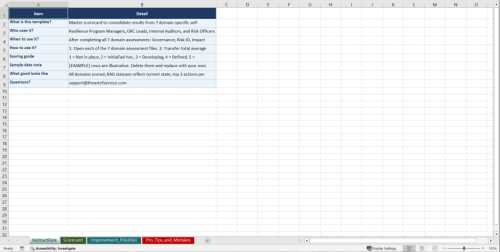
This Excel workbook captures the identification and assessment of Operational Risks within the context of projects. It allows you to document preventative/corrective actions and has a risk questionnaire.
Do You Want to Implement Business Best Practices?
You can download in-depth presentations on Operational Risk and 100s of management topics from the FlevyPro Library. FlevyPro is trusted and utilized by 1000s of management consultants and corporate executives.
For even more best practices available on Flevy, have a look at our top 100 lists:
These best practices are of the same as those leveraged by top-tier management consulting firms, like McKinsey, BCG, Bain, and Accenture. Improve the growth and efficiency of your organization by utilizing these best practice frameworks, templates, and tools. Most were developed by seasoned executives and consultants with over 20+ years of experience.
Readers of This Article Are Interested in These Resources
A Course in Occupational Health & Safety (OH&S) Hazards & Risks including the Hazard Identification & Risk Assessment (HIRA) Process
(Based on the expectations & requirements of ISO 45001:2018, an International Standard on OH&S Management System)
The knowledge on identification of [read more]
Curated by McKinsey-trained Executives
🚨 100+ OPERATIONAL RISK MANAGEMENT CONSULTING SOPs 🚨
THE COMPLETE ENTERPRISE ORM OPERATING SYSTEM BUILT TO ELIMINATE RISK BLIND SPOTS, PASS AUDITS WITH CONFIDENCE & INSTALL REAL GOVERNANCE ACROSS YOUR ORGANIZATION
💣 WHY MOST "RISK [read more]
ISO 31000 Operational Risk Management Implementation Playbook for Nigerian Telec
64 professional files (6 PDFs + 58 Excel workbooks) | 349+ spreadsheet tabs | 2,730+ rows of structured content | 11 organised folders
Enterprise risk management works when it is embedded in how the [read more]
Operational Resilience Framework Playbook
Regulators are asking for evidence of operational resilience and you cannot produce it. Your business impact analysis is outdated, your recovery plans are untested, and your third-party dependencies are not mapped.
Operational disruptions cost [read more]
 For decades, risk management was viewed as a mandatory exercise for the compliance department or a footnote in the annual report. Those days are over. Especially during rapid scaling or complex acquisitions, operational risks have a direct impact on a company’s valuation. Executives who ignore these variables undermine their own growth strategy. Linking risk matrices and quality frameworks to your strategic decision-making is no longer a defensive cost item, but an absolute prerequisite for sustainable value creation.