Editor's Note: Take a look at our featured best practice, Lean Manufacturing (167-slide PowerPoint presentation). [NOTE: Our Lean Manufacturing presentation has been trusted by an array of prestigious organizations, including industry leaders such as Apple, DHL, Cummins, Stryker, Avery Dennison, Volvo Cars, Baker Tilly, Viasat, Rubix, Techaerospace, Pacific Helmets, BBA, to name just a few.]
This [read more]
* * * *
A mechanical aptitude test measures how well a person understands and applies basic physical principles: how levers balance, which way a gear turns, why a ramp reduces effort, and which tool fits a task. Employers use these tests to screen candidates for machine operation, maintenance, assembly, and skilled trades work, often before an interview.
The most widely used options for industrial roles are the Bennett Mechanical Comprehension Test (BMCT-II), the Wiesen Test of Mechanical Aptitude (WTMA), Ramsay’s Mechanical Aptitude Test (MAT-5), Criteria’s Mechanical Reasoning Assessment (CMRA), TestGorilla’s Mechanical Reasoning test, and configurable platform assessments that let employers add their own job-specific questions. They differ in length, content, and the roles they are built for, so the right choice depends on the job.
This guide covers what each test looks like, which topics appear most often, how scores are used, and 14 practice questions with worked answers.
What Is a Mechanical Aptitude Test?
Most mechanical aptitude tests use short, picture-based multiple-choice questions. A diagram shows a lever, pulley, gear train, or everyday object, and the candidate picks the outcome: which side lifts, which way a wheel turns, or which arrangement needs less force.
Two related terms often appear in job postings:
Mechanical aptitude describes the potential to learn mechanical tasks. Several publishers describe their tests as measuring the ability to learn to use and maintain equipment and machinery.
Mechanical knowledge describes what someone already knows, such as how to read a caliper or identify a tool.
Some tests lean toward one, and some mix both. Knowing the difference helps candidates prepare and helps employers choose a test that fits the role.
Major Mechanical Aptitude Tests Compared
The table below summarizes vendor-published information for six tests used in industrial hiring. Format and timing help with planning; they do not show which test is more effective.
Test
Publisher
Format and time
What it measures
Roles it is described for
eSkill Mechanical Aptitude
eSkill
Duration not published; tests can be customized
Mechanical concepts, tools, and problem-solving, including spatial reasoning, force and motion, tool recognition, and troubleshooting
Manufacturing, engineering, and skilled trades
Criteria Mechanical Reasoning Assessment (CMRA)
Criteria
Up to 30 questions in 15 minutes
Ability to learn how to operate, maintain, install, and repair equipment and machinery
Occupations that involve operating, maintaining, and servicing tools, equipment, and machinery
Wiesen Test of Mechanical Aptitude (WTMA)
Criteria (also sold through Ramsay)
60 multiple-choice questions in 30 minutes
Ability to learn to use and maintain equipment and machinery; written at about a sixth-grade reading level, with a Spanish version
Positions that use machinery, such as electricians, utility workers, and service technicians
Ramsay Mechanical Aptitude Test (MAT-5)
Ramsay Corporation
36 multiple-choice items in 20 minutes
Ability to learn production and maintenance job activities
Solving technical problems, learning mechanical concepts, and applying physical principles; mechanical reasoning and spatial perception
Recruitment and training for technical roles
TestGorilla Mechanical Reasoning
TestGorilla
10 minutes; 21 questions per test
Basic physical and mechanical concepts, including force and movement, velocity, and pulleys, gears, and wheels
Candidates who need to apply mechanical principles to solve problems
Military applicants meet a similar subtest in the ASVAB’s Mechanical Comprehension section, which covers knowledge of mechanical and physical principles. Civilian employers usually rely on the tests above.
What Topics Do Mechanical Aptitude Tests Cover?
Exact content varies by publisher, but most tests draw from the same core areas.
Topic
What questions ask
Where it shows up on the job
Levers
Which side lifts, how much effort balances a load, where to place a fulcrum
Pry bars, clamps, pedals, linkages
Pulleys
How much force a pulley system needs and how far the rope travels
Hoists, cranes, overhead lifting
Gears and belt drives
Direction and speed of driven gears and pulleys
Gearboxes, conveyors, drive systems
Inclined planes and screws
How ramp length or thread pitch changes the force needed
Loading ramps, jacks, fasteners
Hydraulics and fluids
How pressure transfers between pistons; how depth affects pressure
Presses, lifts, hydraulic tools
Forces and motion
Inertia, friction, speed, and the direction of a resulting force
Moving loads, rotating equipment
Structures and stability
Center of gravity, load support, and which object tips first
Racking, stacking, lifting safety
Tools and measurement
Identifying tools and reading measuring instruments
Calipers, micrometers, torque wrenches
Configurable assessments can add job-specific content on top of these areas, such as shop math, blueprint reading, or a plant’s own tolerance rules.
Who Takes a Mechanical Aptitude Test?
These tests appear most often in hiring for:
Machine operators and tool setters
Maintenance mechanics and industrial machinery mechanics
Millwrights
Electricians and utility workers
Service and field technicians
Assembly and production workers
Apprentices and trainees in skilled trades
Many employers give the test early in the process, sometimes online, so they can compare applicants on the same scale before investing interview time. Some also review the skills their current team already has first, since better skills visibility can show whether a role needs an outside hire at all.
How Employers Choose a Mechanical Aptitude Test for Industrial Roles
The best test is the one that matches the work. The US Office of Personnel Management (OPM) treats job analysis as the foundation for assessment decisions, and its guidance separates skills needed on the first day from skills taught after hiring. Only the first group belongs in a selection test.
A simple way to apply that:
List the essential tasks. Write down what a new hire does in the first month, such as reading a process sheet, checking a part against a tolerance, or following an assembly sequence.
Mark each skill as “needed on entry” or “trainable.” If every operator learns your changeover procedure during onboarding, testing applicants on it only measures prior exposure.
Pick the evidence type. Use an aptitude test for learning potential, job-knowledge questions for skills needed on day one, and a safe work sample (diagrams, sample instruction sheets, or de-energized training fixtures) for task performance. OPM notes that a work sample may not be appropriate when the activity will be taught after selection.
Fill gaps with job-specific questions. A generic test may not cover your process-sheet format or quality rules.
That last step is where configurable platforms help. For teams that need to combine standard mechanical content with their own questions, E Skill lists mechanical aptitude among its manufacturing hiring assessments. The platform also lets employers build customized tests from their own job-specific questions. Check each added question against an entry requirement, and avoid testing procedures that new hires will learn on the job.
Before choosing any test, ask each vendor for:
Technical documentation covering the relevant job family
Accommodation options for applicants with disabilities
A sample candidate report
Proctoring, device, and applicant tracking system requirements
How Are Mechanical Aptitude Tests Scored?
Most publishers report a raw score and a percentile. Criteria, for example, reports the number of questions answered correctly along with a percentile ranking that compares the candidate with others who took the test.
There is no universal passing score. Each employer sets its own threshold, ideally based on job requirements and supporting evidence. OPM encourages organizations unfamiliar with validation research to consult a measurement expert, and that advice applies to private employers too.
A few scoring practices make results fairer and easier to defend:
Treat every applicant the same way, with the same test, instructions, and time limit.
Keep an aptitude percentile separate from a knowledge score on a different scale; averaging them hides what each one means.
Offer a clear route to request accommodations. EEOC guidance notes that employers may need to provide testing materials in alternative formats or make other adjustments.
Record why a threshold was chosen, and review it when the job changes.
Mechanical Aptitude Practice Questions
These original practice questions reflect the topics above. They are not items from any published test. Unless stated otherwise, ignore friction and the weight of pulleys and ropes.
Levers. A 120 N load sits 0.5 m from a lever’s fulcrum. What force applied 1.5 m from the fulcrum on the other side balances it?
A) 20 N
B) 40 N
C) 60 N
D) 120 N
Answer: B. Load × load distance = effort × effort distance. 120 × 0.5 = 60, and 60 ÷ 1.5 = 40 N.
Gears. A 20-tooth driver gear turns clockwise at 60 rpm and meshes with a 40-tooth gear. How does the 40-tooth gear turn?
A) 120 rpm clockwise
B) 30 rpm clockwise
C) 30 rpm counterclockwise
D) 120 rpm counterclockwise
Answer: C. Meshed gears turn in opposite directions. The driven gear has twice as many teeth, so it turns at half the speed: 60 × (20 ÷ 40) = 30 rpm.
Gear trains. Four gears sit in a straight line, each meshing with the next. Gear 1 turns clockwise. Which way does gear 4 turn?
A) Clockwise
B) Counterclockwise
C) It does not turn
D) It depends on gear size
Answer: B. Direction alternates with each mesh: gear 2 turns counterclockwise, gear 3 clockwise, and gear 4 counterclockwise. Gear size changes speed, not direction.
Pulleys. A single movable pulley supports a 200 N load. How much force is needed to lift it?
A) 50 N
B) 100 N
C) 200 N
D) 400 N
Answer: B. Two rope segments share the load, so the effort is halved. The trade-off is distance: you pull 2 m of rope for every 1 m the load rises.
Belt drives. A 10 cm driver pulley turns at 300 rpm. A crossed belt connects it to a 30 cm driven pulley. What happens to the driven pulley?
A) 900 rpm, same direction
B) 100 rpm, same direction
C) 100 rpm, opposite direction
D) 900 rpm, opposite direction
Answer: C. The driven pulley is three times larger, so it turns at one-third the speed: 300 ÷ 3 = 100 rpm. A crossed belt reverses direction; an open belt keeps it the same.
Hydraulics. A 10 N force pushes a small piston with an area of 2 cm². The large piston in the same system has an area of 20 cm². What force does the large piston produce?
A) 1 N
B) 10 N
C) 50 N
D) 100 N
Answer: D. Pressure is equal throughout a closed fluid (Pascal’s law). The pressure is 10 ÷ 2 = 5 N per cm², and 5 × 20 = 100 N.
Inclined planes. Two ramps rise to the same 1 m platform. Ramp A is 2 m long and ramp B is 4 m long. Which needs less force to push a box up?
A) Ramp A
B) Ramp B
C) Both need the same force
D) It depends on the box’s color
Answer: B. The longer ramp spreads the same work over more distance, so it needs about half the force of ramp A. The total work to raise the box is the same.
Fluid pressure. Two tanks hold water to the same 3 m depth. Tank X is twice as wide as tank Y. Where is the pressure at the bottom greater?
A) Tank X
B) Tank Y
C) The pressure is the same
D) It depends on the tank material
Answer: C. Water pressure depends on depth, not on the width or total volume of the tank.
Stability. Which object is least likely to tip over?
A) A tall, narrow cabinet with heavy items on the top shelf
B) A tall, narrow cabinet with heavy items on the bottom shelf
C) A short, wide cabinet with heavy items on the bottom shelf
D) A short, wide cabinet with heavy items on the top shelf
Answer: C. A wide base and a low center of gravity give the most stability. This is the same principle behind loading heavy items low on racks and pallets.
Rotating wheels. A small wheel and a large wheel are fixed to the same shaft and turn together. Which point moves faster: a point on the rim of the small wheel or a point on the rim of the large wheel?
A) The small wheel’s rim
B) The large wheel’s rim
C) Both move at the same speed
D) Neither moves
Answer: B. Both wheels complete one turn at the same time, but the large wheel’s rim travels a longer distance per turn, so it moves faster.
Tools. Which tool is best for measuring the inside diameter of a machined bore to within a few hundredths of a millimeter?
A) Tape measure
B) Try square
C) Vernier caliper
D) Feeler gauge
Answer: C. A vernier caliper has jaws for both outside and inside measurements and reads to fine increments. A feeler gauge measures small gaps, not diameters.
Tools. A maintenance procedure says to tighten a bolt to a specified torque. Which tool should you use?
A) Adjustable wrench
B) Torque wrench
C) Pipe wrench
D) Socket extension
Answer: B. A torque wrench measures or limits the applied torque so the bolt reaches the specified value.
Shop math. A drawing gives a dimension of 0.375 in. What is that as a fraction?
A) 1/4 in
B) 5/16 in
C) 3/8 in
D) 7/16 in
Answer: C. 0.375 = 375/1000, which reduces to 3/8.
Tolerances. A part must measure 25.00 mm ± 0.05 mm. Five readings are 24.96, 25.04, 25.06, 24.94, and 25.05 mm. How many parts fail?
A) One
B) Two
C) Three
D) None
Answer: B. The acceptable range is 24.95 to 25.05 mm. The readings of 25.06 and 24.94 fall outside it. A reading of 25.05 sits exactly on the limit and passes.
How to Prepare for a Mechanical Aptitude Test
Learn the core principles, not just answers. Most questions test a handful of ideas: mechanical advantage, gear direction and speed ratios, pressure, and center of gravity.
Practice under time limits. Published tests range from about 10 to 30 minutes, so pacing matters. Time yourself on short sets.
Draw it out. Sketch arrows for force and rotation when a diagram is unclear.
Review common shop tools. Know what calipers, micrometers, torque wrenches, and feeler gauges measure.
Brush up on shop math. Fractions, decimals, and tolerance ranges appear on many industrial assessments.
Ask about format and accommodations. Employers can tell you which test you will take, how long it runs, and how to request an adjustment if you need one.
Frequently Asked Questions
Which skills assessment tools evaluate mechanical aptitude for industrial roles?
Common options include the Bennett Mechanical Comprehension Test (BMCT-II), the Wiesen Test of Mechanical Aptitude (WTMA), Ramsay’s MAT-5, Criteria’s CMRA, TestGorilla’s Mechanical Reasoning test, and configurable platform assessments that combine standard mechanical content with employer-specific questions. Compare their content, length, documentation, and accommodation options against the tasks in the role.
How long is a mechanical aptitude test?
It depends on the test. Published timings range from 10 minutes for TestGorilla’s test to 30 minutes for the WTMA, with the CMRA at 15 minutes, the MAT-5 at 20 minutes, and the BMCT-II at 25 minutes.
What is the difference between mechanical aptitude and mechanical knowledge?
Aptitude is the potential to learn mechanical tasks. Knowledge is what someone already knows, such as how to read a caliper or identify a tool. Employers should test for knowledge only when the role requires it on the first day.
Is there a passing score for a mechanical aptitude test?
No single passing score applies across tests or employers. Each employer sets its own threshold based on the job’s requirements, ideally with advice from an assessment specialist.
Can a mechanical aptitude test replace a hands-on assessment?
No. An aptitude test shows learning potential, while a safe work sample shows whether someone can already perform a task. Many employers use both, along with a structured interview.
What jobs require a mechanical aptitude test?
Machine operators, maintenance mechanics, millwrights, electricians, service technicians, assembly workers, and skilled trades apprentices are among the roles most often screened with these tests.
A manufacturing company produces goods by transforming raw materials into finished products using labor, machinery, and technology. These companies operate across various industries--such as electronics, automotive, textiles, or food--and often include stages like design, production, assembly, and [read more]
Do You Want to Implement Business Best Practices?
You can download in-depth presentations on Manufacturing and 100s of management topics from the FlevyPro Library. FlevyPro is trusted and utilized by 1000s of management consultants and corporate executives.
For even more best practices available on Flevy, have a look at our top 100 lists:
These best practices are of the same as those leveraged by top-tier management consulting firms, like McKinsey, BCG, Bain, and Accenture. Improve the growth and efficiency of your organization by utilizing these best practice frameworks, templates, and tools. Most were developed by seasoned executives and consultants with over 20+ years of experience.
Readers of This Article Are Interested in These Resources
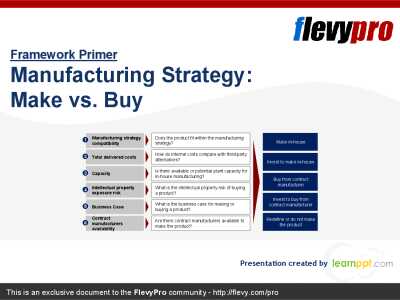
Internal manufacturing of a product versus procurement from external supplier sources is a difficult decision requiring careful and thorough assessment of multiple elements. The assessment includes organization's core competencies, business strategy, manufacturing strategy, internal capacity, [read more]
Good Manufacturing Practices (GMP) are a set of guidelines and regulations that ensure the production and manufacturing of safe and high-quality products, including food, drugs, and medical devices. These practices are designed to minimize the risks involved in any pharmaceutical production that [read more]
Curated by McKinsey-trained Executives
Unlock Your Manufacturing Business Potential with Our Complete Strategic Planning Toolkit
Are you ready to take your manufacturing business to the next level? Our Complete Strategic Planning Toolkit is designed to provide you with everything you need for [read more]
Offshoring from the US and other high cost economies to low cost emerging market countries was a dominant theme of manufacturing in the late 1990s and 2000s.
Now, Reshoring offers the promise of re-establishing the link between product design and manufacturing, between original equipment [read more]
 A mechanical aptitude test measures how well a person understands and applies basic physical principles: how levers balance, which way a gear turns, why a ramp reduces effort, and which tool fits a task. Employers use these tests to screen candidates for machine operation, maintenance, assembly, and skilled trades work, often before an interview.
 Exact content varies by publisher, but most tests draw from the same core areas.