 For many years, organizations have focused more on hiring new talent, closing skills gaps and improving employee development. However, it is only recently that businesses have realized a new kind of contradiction. Valuable skills already exist within the workforce, but managers cannot clearly see or utilize them. Now, for many companies, the goal is not to get new skills, but to identify and make better use of skills that already exist internally.
Interestingly, there is a huge disconnect between how managers perceive workforce skills and how employees experience them. This growing visibility gap is transforming skills management from a traditional HR function into a broader corporate management priority. It’s clear that skills management directly affects operational efficiency, workforce planning, employee retention and long-term growth.
Why Skills Visibility Matter More Than Ever
The business world has changed dramatically over the past few years. Automation, AI, hybrid models, and digital transformation initiatives are reshaping job requirements faster than anyone could have predicted.
The issue is no longer simply about hiring new employees. Organizations now need a real-time understanding of workforce skills to make informed decisions on whatever needs to be done. This puts pressure on employers to accurately map employee capabilities, or else risk falling behind competitors that redeploy talent more efficiently.
For corporate leaders, relying on assumptions about workforce capabilities is getting riskier. When a manager makes decisions based on incomplete or outdated capabilities data, the impact can be significant.
Organizations that lack accurate workforce visibility often struggle with:
- Strategic workforce planning
- Internal mobility initiatives
- Succession management
- Leadership development
- Timely innovation
- Resource allocation
- Talent retention
With organizations becoming more skills-driven, executives have come to the realization that workforce intelligence is now a competitive advantage rather than just an HR metric.
The Cost of Hidden Skills
Managers should know that hidden skills create major financial and operational costs for businesses. Unfortunately, companies often put in significant investment for external hiring, when talent already exists internally.
According to the TalentLMS skills visibility Report, many organizations struggle to identify, track and fully utilize the talent that already exist within their workforce. In fact, half of the respondents said their company hires externally for skills that current employees already possess.
The disconnect creates inefficiencies across the organization. For one, external hiring is quite expensive and onboarding new employees also requires significant time and resources. At the same time, underutilized employees often become disengaged. The report found that 49% of employees believe their talents are underused within their organizations.
When employees feel like their capabilities are ignored, a number of business problems crop up at the same time:
- Productivity declines because skills are unmatched with appropriate tasks
- Innovations slow because hidden expertise never reaches strategic projects
- Retention rates decline as employees seek opportunities in other places
The Gap between Managers and Employees
One of the most striking findings in recent workforce research is the perception gap between managers and employees in regards to understanding skills. Many managers believe that their visibility into employee capabilities is high, but employees often experience things differently.
According to the skills visibility report by TalentLMS, 90% of managers believe that they actually understand their team’s skills. However, only 69% of employees agree with this. Additionally, while 90% of managers are confident that they support employee skill development, only 60% of employees feel supported. Also, as mentioned above, only 49% of employees feel like their talents are being used well, while 75% of managers believe their employees’ skills are fully utilized.
These perception gaps can have serious consequences for employee development and retention. In the same report, more than half of the employees surveyed stated that their career growth becomes stunted because no one notices their skills. In fact, nearly one-third of them said that they could consider leaving their organizations due to insufficient development opportunities. This creates a dangerous cycle for organizations.
Moving from Skills Chaos to Business Clarity
To improve skills visibility, organizations are moving towards more structured, data-driven workforce management strategies. Also, many are increasingly investing in centralized workforce systems that can:
- Track employee skills in real time
- Connect skills data with business goals
- Support internal mobility programs
- Identify leadership potential
- Improve succession planning
AI is also playing a growing role in workforce visibility. AI-driven systems get to analyze employee performance, learning activity, certifications, project experience and competency development to create more dynamic workforce profiles. Without systems that capture these evolving capabilities, organizations are at risk of overlooking large portions of employee expertise.
Why Skills Visibility Supports Long-term Growth
It is important that businesses have stronger visibility as they become better positioned to adapt to changing business conditions and reduce unnecessary hiring costs. Instead of turning to external recruitment markets, companies are able to identify internal candidates for emerging roles. This supports internal mobility, which is quite vital for employee retention and organizational stability.
With time, corporate management teams benefit because workforce planning becomes more predictive and strategic, not just reactive. Now, organizations that can rapidly identify, deploy and develop workforce skills gain greater agility during periods of market change.
Conclusion
Many organizations have started to realize that their biggest challenge was not really a lack of talent. In many cases, talent already exists within the organization.
Now, as workforce demands continue to evolve, companies that can turn invisible skills into measurable organizational capability are gaining a significant competitive advantage in the modern business environment.
Do You Want to Implement Business Best Practices?
You can download in-depth presentations on Employee Training and 100s of management topics from the FlevyPro Library. FlevyPro is trusted and utilized by 1000s of management consultants and corporate executives.
For even more best practices available on Flevy, have a look at our top 100 lists:
These best practices are of the same as those leveraged by top-tier management consulting firms, like McKinsey, BCG, Bain, and Accenture. Improve the growth and efficiency of your organization by utilizing these best practice frameworks, templates, and tools. Most were developed by seasoned executives and consultants with over 20+ years of experience.
Readers of This Article Are Interested in These Resources
129-slide PowerPoint presentation
The TWI Job Instruction (JI) program trains supervisors in how to instruct a person to perform a job correctly and safely; and to be productive as quickly as possible, while creating less scrap, rework, and damage to tools and equipment.
This tried and tested methodology is based on the
[read more]
24-slide PowerPoint presentation
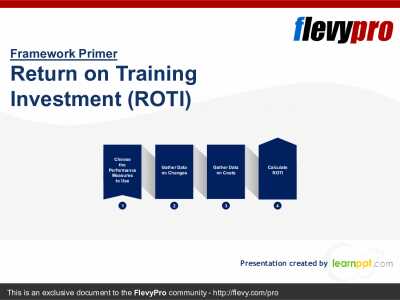
The concept of Return on Investment (ROI) originated in the Manufacturing sector, where it's simple to measure time and output. Next to adopt the concept was the Banking industry, where it is used consistently. ROI calculation is now a common feature in every type, industry, and function of
[read more]
97-slide PowerPoint presentation
The Training Within Industry (TWI) Job Relations (JR) program teaches supervisors how to evaluate and take proper actions to handle and to prevent people problems. This skill in leading helps the supervisor to improve his ability in working with people.
There are basic principles that,
[read more]
105-slide PowerPoint presentation
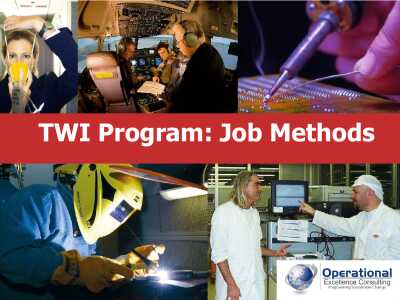
The TWI Job Methods (JM) program trains supervisors in how to improve the way jobs are performed in order to consistently produce greater quantities of quality products in less time using available manpower, machines and materials.
Participants are taught how to break down jobs into their
[read more]