Editor's Note: Take a look at our featured best practice, A Comprehensive Guide to Change Management (586-slide PowerPoint presentation). This "new and improved" A Comprehensive Guide to Change Management,, which replaces my previous "best seller" of the same name, contains everything (well nearly everything) you would ever want to know about Change Management. This slide-deck now contains over 580 slides which includes [read more]
* * * *
A transformation plan can specify new structures, processes, and milestones while leaving a consequential question unanswered: what must leaders do differently on an ordinary workday? Executives, middle managers, and team leads encounter different decisions during the same change. Developing their capabilities therefore starts with the work the transformation demands, rather than a standard course catalog. The following framework connects strategic intent to observable behavior, targeted support, and a review process that can evolve as the change unfolds.
Start with the Change, Not a Competency List
Broad competencies such as communication, adaptability, and resilience have a place in leadership development. On their own, however, they give consultants and HR leaders little guidance about where to focus during a particular transformation. Begin with the operational shift: which decisions must be made differently, which teams must coordinate in new ways, and where established habits are likely to conflict with the proposed model? From those questions, identify a small number of interactions or decision points where leadership behavior matters. This turns an abstract development priority into something leaders can practice and colleagues can observe.
Consider a hypothetical organization moving from separate departmental planning to shared priorities across functions. “Improve collaboration” is too broad to guide development. More useful behaviors might include resolving competing priorities in a joint planning meeting, making the reason for a trade-off explicit, and bringing an unresolved dependency to the right decision-maker before it delays delivery. The behaviors should describe actions within a leader’s control, not promise a business result. They also need to be specific enough that leaders can recognize when a familiar response is no longer serving the change.
Map Capability Needs to Roles and Change Stages
Once the critical behaviors are clear, map them against the roles expected to carry the change. Executives may need to make consistent trade-offs across functions and explain which priorities will take precedence. Middle managers often have to turn those choices into workable plans while surfacing conflicts that senior leaders cannot see from a distance. Team leads may need to discuss the immediate effects on workloads, invite questions, and help employees use a new process. Assigning all three groups the same development goals would obscure those differences, even when they share a common strategic objective.
Timing matters too. Early in a change, leaders may need to explain the direction without pretending every implementation detail is settled. As new routines take hold, the emphasis can shift toward removing obstacles, responding to feedback, and reinforcing decisions that support the intended way of working. These are planning distinctions, not fixed stages that every organization follows in the same order. A useful capability map records the role, the upcoming change situation, the behavior required, and the support the leader needs before that situation occurs. It can be revised when the work itself changes.
Build Development into the Flow of Work
Development is more likely to be useful when it prepares a leader for an actual decision or conversation. For example, a middle manager facing a cross-functional planning meeting could rehearse how to name a resource conflict, seek a decision, and explain the outcome to the team. Afterward, the manager can reflect on what happened and choose one adjustment for the next meeting. Peer discussions can expose alternative approaches, while targeted coaching can create space to examine difficult choices. CoachHub offers leadership coaching programs that organizations can consider when arranging structured support for leaders navigating uncertainty and change.
The design question is not simply how much development to provide, but whether it fits the work leaders are about to do. A short practice session before a milestone may be more relevant than a general workshop scheduled after the critical decisions have passed. Regular change meetings can include time to identify upcoming leadership challenges and share what has been learned from recent ones. HR leaders and transformation teams can also give managers protected time to participate, clarify which work goals the support addresses, and distinguish confidential coaching conversations from the information used to evaluate the wider program.
Support should remain proportionate to the role and the challenge. A leader handling a sensitive restructuring conversation may need a different form of preparation from one establishing a routine for joint planning. Connecting development to these distinct moments makes the capability map a working tool, rather than a document completed at launch and set aside.
Measure Progress without Overclaiming
Evaluation is most useful when it separates three kinds of evidence. Reach and participation show whether the intended leaders received support and had an opportunity to use it. Behavior signals indicate whether the targeted actions are appearing in relevant situations: for instance, whether planning discussions make trade-offs explicit or whether managers bring obstacles forward in time for a decision. Organizational indicators, such as the timeliness of decisions or adoption of a new process, show how the broader change is progressing. None of these measures should stand in for the others.
Before support begins, define what the team will observe and establish a practical baseline where possible. Use evidence suited to the behavior: meeting observations, structured feedback, or a review of decisions may be more informative than a satisfaction rating alone. Look at signals over a period that matches the work cycle; a behavior intended for quarterly planning cannot be judged before that planning takes place. Leaders should also consider other influences, including changes in resources, priorities, or process design. A rise in participation does not demonstrate behavior change, and an improvement in an organizational metric does not prove coaching caused it.
This distinction helps executives and HR leaders make decisions without asking a development program to explain every transformation outcome. If leaders attend support sessions but still struggle to resolve dependencies, the response may be to revisit the behavior being practiced, the authority attached to the role, or the process that sends issues upward. Measurement should help locate that friction, not merely produce a favorable score.
Treat the Framework as a Learning Loop
Organizational change rarely leaves leadership demands untouched from beginning to end. A decision that initially requires executive attention may become part of a manager’s routine; an unforeseen dependency may create a new challenge for team leads. Review the capability map alongside the transformation’s normal planning cadence. Ask which targeted behaviors are visible, where leaders continue to encounter difficulty, and whether support is reaching the roles facing the most consequential decisions. Feedback from leaders and their teams can help explain what the indicators alone cannot.
Use each review to make a specific adjustment. That could mean changing a practice exercise before the next planning cycle, helping managers prepare for a newly emerging conversation, or addressing a decision rule that prevents the desired behavior. Not every obstacle is a capability gap: leaders cannot consistently make a decision that the organization has not authorized them to make. Keeping process design and development in view together prevents the framework from becoming a training plan detached from transformation execution.
A practical starting point is to select one upcoming change situation and write down the leadership action it requires. Identify who must take that action, how they can prepare for it, and what observable evidence would show whether it happened. Testing that sequence against real work creates a firmer basis for the next development decision.
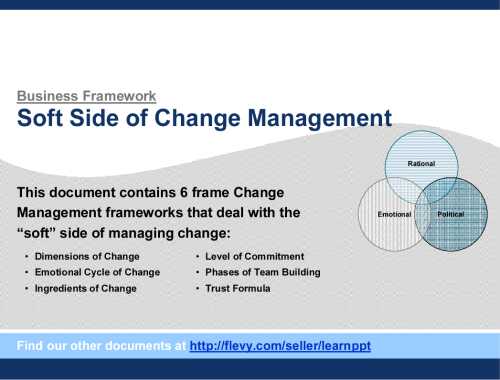
This document contains 6 frame Change Management frameworks that deal with the "soft" side of managing effective organizational change:
1. Dimensions of Change
2. Emotional Cycle of Change
3. Ingredients of Change
4. Level of Commitment
5. Phases of Team Building
6. Trust [read more]
Do You Want to Implement Business Best Practices?
You can download in-depth presentations on Change Management and 100s of management topics from the FlevyPro Library. FlevyPro is trusted and utilized by 1000s of management consultants and corporate executives.
For even more best practices available on Flevy, have a look at our top 100 lists:
These best practices are of the same as those leveraged by top-tier management consulting firms, like McKinsey, BCG, Bain, and Accenture. Improve the growth and efficiency of your organization by utilizing these best practice frameworks, templates, and tools. Most were developed by seasoned executives and consultants with over 20+ years of experience.
Readers of This Article Are Interested in These Resources
This is a collection of common Strategy and Management Consulting Frameworks. A Management Consulting Framework provides a structured approach to analyzing and solving a common business problem. It allows Management Consultants to address a client’s business issue in an organized, thorough, and [read more]
Change is the only constant in the work environment today. However, a McKinsey study revealed that 70% of change programs fail, most often due to resistance from employees. For change to be successful, it has to be effectively managed. To achieve this, it is essential that the human side of change [read more]
Mergers and Acquisitions (M&A) offer tremendous opportunities, and are utilized by enterprises with the intention to supplement organic growth efforts. Research on deals shows higher shareholder returns to firms that indulged in M&As than inactive companies. However, most executives get [read more]
Change is the only constant in the work environment today, and businesses and individuals must embrace change to stay relevant and competitive. However, a McKinsey study revealed that 70% of change programs fail, primarily due to employee resistance. To ensure successful change, it's imperative to [read more]
 A transformation plan can specify new structures, processes, and milestones while leaving a consequential question unanswered: what must leaders do differently on an ordinary workday? Executives, middle managers, and team leads encounter different decisions during the same change. Developing their capabilities therefore starts with the work the transformation demands, rather than a standard course catalog. The following framework connects strategic intent to observable behavior, targeted support, and a review process that can evolve as the change unfolds.