Editor's Note: Take a look at our featured best practice, Healthcare Business Capability Model (1-page PDF document). A business capability model for a Healthcare company. To be used as a core document for Enterprise Architects and EA work. Also very valuable to Business Architects and Business Architecture projects/programmes.
The Healthcare Business Capability Model provides a comprehensive framework for [read more]
* * * *
Front desks at small practices tend to break at the same points.
Phones ring out at 8 a.m., eligibility checks stack up before afternoon clinic and refill requests wait until someone has a spare minute.
Hello Rache is a well-known fix, but its hourly model isn’t the only way to staff reception, scheduling and call triage remotely.
This guide compares six alternatives on staffing model, listed price, front-desk coverage and compliance terms.
Every rate and feature comes from each provider’s own website as checked in September 2026.
In short, managed monthly plans suit practices that want vendor supervision.
Flat role tiers suit specialty hiring, while hourly and weekly models fit practices ready to train and supervise the assistant themselves.
Key Takeaways
Hello Rache lists a flat $9.50 an hour with weekly billing and no contracts.
Managed monthly plans cost more than the lowest hourly rates but bundle supervision, replacement and account support.
Portiva and DocVA both list triage on their own sites, DocVA as part of call handling and Portiva as a remote clinical support task.
My Mountain Mover’s pricing page states a signed BAA. Get BAA terms in writing from every other vendor.
Compare costs at the same monthly hours, not by headline rate.
Hello Rache at a Glance
Hello Rache places dedicated Healthcare Virtual Assistants with medical, dental, optometry and veterinary practices.
Its pricing page lists $9.50 an hour with weekly billing, no contracts, no setup fees and the option to cancel anytime.
Its roles include virtual scribe, virtual receptionist and administrative assistant, covering scheduling, calls, insurance and billing. The pricing page also lists time tracking with productivity reporting and says assistants work in any EMR or EHR system.
That makes it a simple hourly option. Practices may look elsewhere when they want vendor-side supervision, fixed monthly hours, role tiers or a trial before committing.
1. Wing Assistant
This option is best for practices that want admin owned by one dedicated person on a fixed monthly schedule.
A virtual medical personal assistant from Wing Assistant works exclusively on your account inside your existing EHR, building familiarity with your providers over time.
Why consider it:
Fixed hours: Part-time plans cover 80 hours a month and full-time plans cover 160.
Supervision: Team Captains and Supervisors oversee each assistant, alongside a dedicated Customer Success Manager.
Replacement: A poor-fit assistant is replaced within 24 hours at no extra cost.
Security: The page states ISO 27001 compliance, SOC 2 certification and HIPAA compliance, with patient data encrypted in transit and at rest.
Setup: Matching happens within 48 hours, and assistants work in Epic, Athenahealth, Kareo and other systems.
Pricing: Starts at $1,099/month part-time or $1,799/month full-time, with no contracts and the option to add or reduce hours.
2. My Mountain Mover
This option is best for practices hiring for a defined role, from front desk to billing or nurse-level support.
My Mountain Mover places full-time, Philippines-based assistants and prices them in three flat monthly tiers that cover salary, benefits and HR support.
Why consider it:
Role tiers: Core covers receptionists and admin assistants, Specialized covers billers and scribes and Expert covers US-registered nurses and bilingual VAs.
Signed BAA: The pricing page lists a signed BAA and access to an in-house HIPAA compliance officer.
Account support: Each client works with a dedicated Account Manager.
Onboarding: Guided onboarding support runs through the first 30 days.
EHR readiness: The home page says assistants are pre-trained in leading EHR systems and matched to your specialty.
Key services: Medical reception, medical admin, health education, medical and dental billing, scribing plus bilingual or custom roles.
Pricing: $1,895/month Core, $2,195 Specialized and $2,400 Expert. The pricing page doesn’t state monthly hours.
3. MEDVA
This option is best for practices that want an hourly model with clinically trained staff.
MEDVA was founded by Los Angeles physicians Dr. Steven Kupferman and Dr. Omid Shaye, and its sales page says its assistants are primarily registered nurses from the Philippines.
Why consider it:
Training: Each VA completes a two-week skills course that includes mandatory HIPAA certification.
Vetting: Every assistant passes a government background check.
Accountability: Time-tracking and monitoring software runs on each assistant’s device.
Consistency: You work with the same VA every day.
Flexibility: You can replace your VA whenever you need to.
Pricing: $10/hour on its sales page, with no payroll taxes or hidden fees.
4. Portiva
This option is best for practices that want to test phone and front-desk coverage before committing.
Portiva, founded in 2009 and based in Collegeville, Pennsylvania, staffs practices with HIPAA-trained assistants who connect to the office live.
Why consider it:
Trial: A free 7-day trial comes first, with no contract required.
Selection: You review resumes and intro videos before choosing your assistant.
Phones: Your office phone line can be linked directly to the assistant.
Triage support: Its FAQ lists patient triage and relaying patient concerns to providers among its remote clinical support tasks.
Continuity: The same dedicated assistant stays on your account.
Key services: Patient calls, scheduling, intake, refill requests, insurance verification, prior authorization, billing support, scribing and EHR updates.
Pricing: Billed hourly, starting around $10 to $15 an hour depending on the tasks.
5. VA.care
This option is best for practices that budget weekly and want a clear upgrade path to scribing.
VA.care, founded by Mark Suleman, sells three tiered packages at either 30 or 40 hours a week.
Why consider it:
VA Lite: Covers scheduling, gathering patient information, follow-up, reminders and file updates.
VA Essential: Adds virtual receptionist work and insurance verification plus follow-up on claims and appeals.
VA Scribe: Adds virtual scribing through Zoom or Microsoft Teams.
Overtime: The Scribe tier lists availability for overtime.
Integration: The Scribe tier includes white glove setup and connects to instant messaging and internal phone systems.
Key services: Scheduling, patient follow-up, reception, insurance verification, claims follow-up and virtual scribing, depending on tier.
Pricing: At 40 hours a week, $350 Lite, $390 Essential and $450 Scribe. At 30 hours a week, $280, $320 and $360.
6. DocVA
This option is best for practices that need phones answered and routed by their own rules.
DocVA, based in Fort Lauderdale, places one named assistant per seat. Its service page says every assistant has worked inside a U.S. clinic and many hold an active RN license.
Why consider it:
Call handling: Inbound answering includes triage, routing by the practice’s rules and peak-hour coverage.
Your choice: You interview a shortlist and approve the hire.
Access control: Assistants join your EHR under individually named credentials.
Tracking: Assistants run time-tracking and monitoring software.
No lock-in: There’s no minimum term, and an assistant who underperforms gets replaced.
Key services: Patient calls, scheduling with waitlist backfill, new patient intake, insurance verification, prior authorization, refills, chart prep, live scribing and billing support.
Pricing: $10.95/hour on its virtual medical assistant page.
Pricing Overview
Rates only compare fairly at the same hours.
The table converts each listed price to a full-time month. It uses 160 hours for hourly rates and roughly 173 hours (40-hour weeks times 52, divided by 12) for weekly packages.
Provider
Pricing model
Listed rate
Approx. full-time month
Best for
Wing Assistant
Fixed monthly plans
From $1,099 (80 hrs) or $1,799 (160 hrs)
$1,799
Managed coverage with vendor supervision
My Mountain Mover
Flat monthly tiers
$1,895 to $2,400
$1,895 to $2,400 (hours not stated)
Role-specific hires, including US-registered nurses
MEDVA
Hourly
$10/hr
About $1,600
RN-background assistants on an hourly rate
Portiva
Hourly
About $10 to $15/hr
About $1,600 to $2,400
Trialing phone and front-desk coverage
VA.care
Weekly packages
$280 to $450/week
About $1,517 to $1,950
Weekly budgeting with a scribe tier
DocVA
Hourly
$10.95/hr
About $1,752
Call handling with triage routing
The managed and tiered plans cost more than the cheapest hourly options, but they bundle supervision, account management or benefits that hourly models leave to your team.
Add your own staff’s training and oversight time to every hourly estimate.
What to Look for in a Medical Virtual Assistant Partner
Reception, intake and scheduling sit in the patient services layer of the healthcare value chain. A weak handoff there shows up later as billing delays and lost clinical time.
A signed BAA. Under HHS business associate guidance, covered entities need contracts with business associates that require them to safeguard protected health information. Ask whether the company or the individual assistant signs it.
Written triage rules. An assistant can answer, route and escalate calls, but clinical triage decisions belong to licensed clinicians following your protocols. Put escalation scripts in writing before go-live.
Named EHR access. Individual credentials and role-based access make activity traceable and easy to revoke.
Clear supervision. Confirm whether the vendor or your office manager reviews the assistant’s work day to day.
Replacement and coverage. Ask how fast a replacement arrives and who covers absences.
Like-for-like pricing. Compare included hours, tiers and billing cycle, not just the headline rate.
Exit terms. Check the cancellation notice, trial conditions and how access is removed when service ends.
Choosing the Right Fit
No single model wins for every practice. A managed monthly plan fits best when you want one person owning admin with a vendor team supervising.
Tiered and hourly services suit practices with a defined role and the bandwidth to manage it.
Start with one or two workflows, such as morning calls or eligibility checks.
Track accuracy as well as volume for 30 days, then expand the role once the numbers hold up.
FAQ
Which healthcare VA services handle reception, scheduling and triage?
Hello Rache, My Mountain Mover, MEDVA, Portiva, VA.care and DocVA all list phone or receptionist work on their own sites.
Portiva and DocVA go further and list triage, DocVA within call handling and Portiva among its remote clinical support tasks.
How much does Hello Rache cost per month?
Its pricing page lists $9.50 an hour, billed weekly. At 160 hours a month, that comes to about $1,520.
Do I need a BAA with a virtual assistant company?
If the vendor handles protected health information for your practice, HHS guidance calls for a written business associate contract requiring the vendor to safeguard it.
Confirm the agreement is signed before granting system access.
Can a virtual assistant triage patients?
An assistant can collect caller details, route calls and escalate by your written rules. Decisions about urgency and care stay with licensed clinicians.
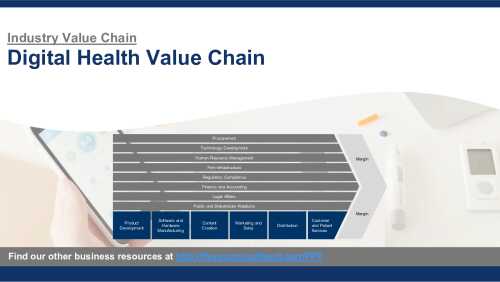
An Industry Value Chain is a visual representation of the series of steps an organization in a specific industry takes to deliver a product or service to the market. It captures the main business functions and processes that are involved in delivering the end product or service, illustrating how [read more]
Do You Want to Implement Business Best Practices?
You can download in-depth presentations on Healthcare and 100s of management topics from the FlevyPro Library. FlevyPro is trusted and utilized by 1000s of management consultants and corporate executives.
For even more best practices available on Flevy, have a look at our top 100 lists:
These best practices are of the same as those leveraged by top-tier management consulting firms, like McKinsey, BCG, Bain, and Accenture. Improve the growth and efficiency of your organization by utilizing these best practice frameworks, templates, and tools. Most were developed by seasoned executives and consultants with over 20+ years of experience.
Readers of This Article Are Interested in These Resources
This document presents analyses, frameworks, information, and templates that related to the Healthcare market and various sub-markets: Federal IT Healthcare, Healthcare Analytics, Cloud Healthcare, Healthcare Consulting. These slides can be utilized to develop a go-to-market strategy for a [read more]
Healthcare organizations today face increasing demands to improve patient care, reduce costs, and eliminate inefficiencies. Lean Healthcare applies proven Lean principles from the Toyota Production System (TPS) to the healthcare sector, enabling hospitals and clinics to streamline workflows, [read more]
Shrinking profits and market pressure to deliver greater value has necessitated the entire Healthcare landscape to transform. Some entities are more sophisticated than others, but the overall sector is building experience and new capabilities to improve economic performance and patient outcomes. [read more]
An Industry Value Chain is a visual representation of the series of steps an organization in a specific industry takes to deliver a product or service to the market. It captures the main business functions and processes that are involved in delivering the end product or service, illustrating how [read more]