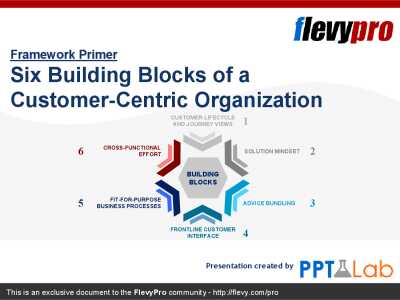
Editor's Note: Take a look at our featured best practice, Six Building Blocks of Digital Transformation (35-slide PowerPoint presentation). Digital Transformation touches practically every function in the entire organization. This thus requires an unprecedented amount of coordination among people, process, and technologies throughout the organization, leading to a difficult Transformation program.
The Six Building Blocks of [read more]
* * * *
In 2009, McKinsey’s Consumer Decision Journey replaced the marketing funnel with something closer to reality: buyers start with a small consideration set, add and drop brands during active evaluation, commit at a moment of purchase, and feed the post-purchase experience back into the next decision. The model assumed buyers gathered information from many touchpoints. Search results, company sites, review platforms, peers, and ads each got a vote.
AI answer engines now sit on top of all of them. When a buyer asks ChatGPT, Perplexity, Google’s AI answers, Claude, or Grok “which consulting firm should we hire for an SAP implementation,” the AI does the research and hands back a synthesized recommendation in one response. The customer journey that once spread across up to 10 touchpoints has collapsed into what we might call the customer journey singularity: a single answer that stands in for the consideration set, the evaluation, the price check, and the trust assessment all at once.
AI visibility is the measure of whether and how these engines surface, recommend, and represent your brand. It is now a board-level concern, and for most companies it is also a blind spot. AI answers are personalized and ephemeral, and none of it appears in your analytics. A buyer who asks ChatGPT about your category and gets steered to a competitor leaves no trace in your funnel.
Introducing the AI Visibility ANSWER Framework
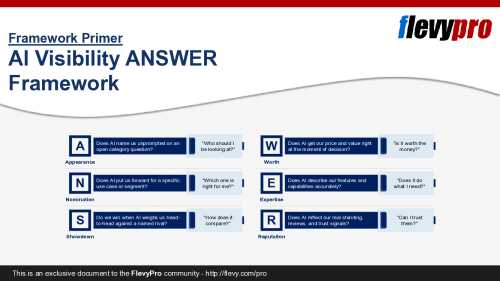
The AI Visibility ANSWER framework, developed by HiBot, breaks AI visibility into 6 measurable categories: Appearance, Nomination, Showdown, Worth, Expertise, and Reputation. The acronym is ordered on purpose. Read A through R and you trace a buyer’s path from first awareness to post-purchase trust. Appearance governs entry into the consideration set. Nomination, Showdown, and Expertise cover active evaluation. Worth sits at the moment of purchase. Reputation closes the loyalty loop.
The mapping to McKinsey’s journey is what makes the framework a diagnosis rather than a checklist: a low score in any category tells you exactly where a brand is leaking out of the buyer’s journey.
Deep Dive: Showdown
Showdown answers the buyer question “how does it stack up against the alternatives?” Buyers no longer build their own comparison matrices. They ask AI to choose: “Accenture vs Deloitte for digital transformation” or “how does your platform compare to a named competitor for warehouse automation?” Showdown measures whether a brand survives that head-to-head or gets dismissed before its strengths are weighed. Deals are won and lost here, because the AI’s verdict often becomes the shortlist.
Deep Dive: Worth
Worth answers “is it worth the money?” and sits at the most dangerous point in the journey: the moment of purchase. Buyers ask AI about cost, value for money, and ROI before they commit. An engine that states the wrong price or frames the brand as overpriced suppresses purchase intent at the exact moment it matters most. A brand can win every earlier phase and still lose here.
Case Study: Accenture
A July 2026 HiBot Pulse audit of Accenture shows why even elite brands need this diagnosis. Accenture scored 95/100, in the dominant band. Expertise and Reputation were both perfect at 100. AI engines describe the firm’s capabilities accurately and reflect its credibility in full. Accuracy across all answers: 100%.
Yet the citation rate was only 11%, and the pattern behind it is what the audit calls the runner-up effect. In Showdown (92), McKinsey takes the primary slot for pure strategy while engines route Accenture to the strategy-plus-implementation lane, and TCS gets held up as an equal counterpoint on cost and scale. In Worth (89, the weakest category), Perplexity and Google cite Accenture’s own ROI research favorably but stop short of recommending the firm, while ChatGPT treats it as a neutral example. Accenture is trusted and accurately described. It is just rarely named first.
The prescription follows: own specific comparison lanes so competitors stop splitting the primary slot, and seed verifiable ROI evidence so engines convert favorable framing into an actual recommendation.
You Cannot Manage What You Cannot See
If a 95/100 brand is leaking at the decision point, consider what an unaudited brand looks like inside the singularity. The first step is measurement, not optimization: a neutral, multi-engine baseline of what AI actually says about you, captured the way a real buyer would see it. That is what a HiBot audit delivers. Get your baseline at hibot.com before your buyers get theirs from ChatGPT.
You can download in-depth presentations on this and hundreds of similar business frameworks from the FlevyPro Library. FlevyPro is trusted and utilized by 1000s of management consultants and corporate executives.
For even more best practices available on Flevy, have a look at our top 100 lists:
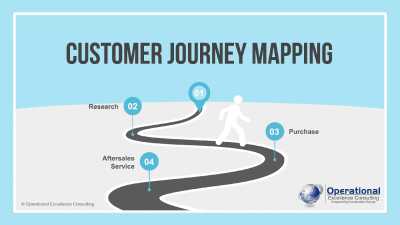
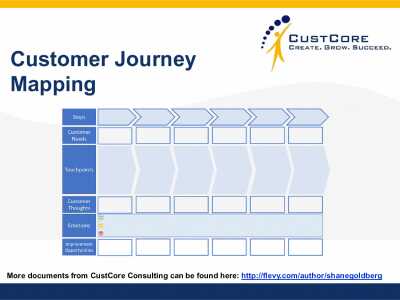
Customer Journey Mapping is the process of creating a graphical representation of the steps and stages a customer goes through to experience a product, service, an online experience, or any combination. It may focus on a particular part of the process or the end-to-end experience.
The journey [read more]
Readers of This Article Are Interested in These Resources
This Guide will take you through step-by-step detailed instructions to help you create a Customer Journey Map - a visual representation of the experience that customers have with your organisation, product or service.
The step-by-step guide includes a comprehensive outline and templates for use [read more]
More and more organizations are shifting a traditional Product-focused model to becoming a Customer-centric Organization. To do this without incurring debilitating costs from added process and organizational complexity, the organization must be build a true Customer-centric Organization by [read more]
Emerging technology trends are driving businesses to Digital Transformation across industries. At the core of most Digital Transformation projects is the evolution of the Customer Experience, from a traditional linear process (with few touch points) to a continuous, circular process (with [read more]
A fast-growing share of buyers now open an AI answer engine--ChatGPT, Perplexity, Google's AI answers, Claude, or Copilot--instead of a search engine, asking for an answer rather than a page of links. The engine names a few options, recommends one, and passes judgment on price and trust. [read more]
 In 2009, McKinsey’s