Editor's Note: Take a look at our featured best practice, Design Thinking (225-slide PowerPoint presentation). DESIGN THINKING: MASTER FACILITATOR TOOLKIT (CERTIFICATION & TRAIN-THE-TRAINER)
Bridge the gap between strategic theory and frontline innovation. This exhaustive certification-level resource is a strategic discipline for solving the right problems in the right way. Designed for professional [read more]
* * * *
 Today, the Direct-to-Consumer (D2C) enterprise landscape is characterized by scalable growth fueled by the combination of physical touchpoints and data-driven digital acquisition. As digital ad markets mature and consumer privacy updates limit traditional tracking, strategic business leaders need to rethink customer lifetime value (LTV) and customer acquisition cost (CAC).
Modern executives are employing a dual-track strategic model to establish sustainable market advantages. They are harnessing screenless hardware innovation to capture real-world consumer engagement while scaling digital media efficiency with data-driven competitive intelligence.
1. Hardware Innovation: Ambient AI as a High-Touch Commerce Model
The evolution of personal electronics has reached a critical juncture. Early wearable technology focused on visual interfaces limited to screens that often resulted in user fatigue and aesthetic friction. In contrast, modern ambient technology integrates artificial intelligence, optical sensors, and open-ear audio directly into consumer products of everyday life.
This move to ambient computing enables brands to create ongoing, frictionless relationships with consumers. Voice-enabled hardware integrates contextual help, translation, and media capture into everyday activities, rather than demanding attention from visual displays.
If you are a business strategist trying to analyze the trends in retail hardware, looking at the best AI glasses from Sunglasshut offers a case study of how traditional optical retailers are redefining brand engagement. Today’s smart eyewear blends timeless frame design with state-of-the-art micro-acoustics and conversational AI to showcase how low-profile hardware can become a pivotal touchpoint for everyday commerce, contextual search, and brand loyalty.
| Commercial Attribute |
Legacy Wearables |
Ambient Smart Glasses |
| User Interface |
Heads-up displays & touchscreen taps |
Voice & gesture conversational controls |
| Consumer Friction |
Visual distraction & optical fatigue |
Eyes-up situational awareness |
| Aesthetic Appeal |
Bulky, specialized hardware designs |
Classic, everyday retail frame styles |
| Engagement Model |
Occasional app touchpoints |
Continuous ambient background support |
2. Competitive Intelligence: Using Creative Intelligence to De-risk Paid Media
Hardware innovation changes the way consumers interact, but rapidly scaling an enterprise D2C brand requires aggressive efficiency in digital channels. As ad costs rise, brands can no longer afford to test campaigns by trial and error. Instead, high-growth marketing teams need to operationalize competitive intelligence to benchmark ad messaging, offer structures, and creative formats in real time.
Data-driven creative auditing allows growth teams to analyze the best-performing campaigns from competitors, find viral hooks, and assess landing page funnels before spending any capital.
Enterprise media buyers use advanced adspy analytics to track ad creative scaling across global networks, monitor competitor spend telemetry, and optimize conversion rate mechanics. This analytical rigor reduces testing burn rates and speeds the ability to scale campaigns efficiently.
| Pipeline Stage |
Analytical Action |
| 1. Competitor Telemetry |
Monitor trending ad formats |
| 2. Creative Deconstruction |
Dissect winning hooks & copy |
| 3. Hypothesis Validation |
Test adapted messaging concepts |
| 4. Rapid Scaling |
Deploy capital to proven angles |
3. Getting Digital Transformation and Strategy Execution to Work
Achieving a dual-track growth strategy means getting product development, digital marketing, and operational frameworks aligned across the organization. Strategy execution often fails when executive vision does not translate into clear, repeatable operational steps.
For organizations striving to grow digitally, structured growth strategy and strategy execution frameworks provide execution efficiencies that align cross-functional teams around measurable milestones. This structural discipline ensures hardware innovation and marketing optimization remain grounded in foundational business strategy.
Building an agile organization also requires leadership and operational teams to handle structural change effectively. For leaders thinking about long-term organizational design, a complete set of business transformation frameworks and tools can guide structural alignment during periods of rapid market growth.
4. Lessening Cognitive Load and Improving Digital Well-Being
Ambient computing’s strategic business case extends beyond functional utility into consumer wellness and cognitive health. The modern digital economy has created an environment of visual hyperarousal, where users are constantly exposed to streams of high-contrast screen lighting, blinking notifications, and rapid app switching. This environment is cognitively fatiguing, reducing attention span and increasing user friction.
Routine micro-interactions—such as setting reminders, getting turn-by-turn navigation, or executing voice queries—are moved off glowing screens and onto ambient smart frames, giving consumers back control over their attention.
Additionally, corporate wellness programs must understand the physiological effects of screen fatigue. Clinical eye health guidance from Healthline emphasizes the necessity of limiting extended focus on close objects on screens, practicing regular blink breaks, and controlling optical glare to help prevent digital eye strain and maintain long-term eye comfort.
Harvard Health Publishing also highlights that cutting down on exposure to artificial blue light in the hours before bed helps preserve natural melatonin production and healthy sleep architecture.
D2C Leadership: The Strategic Path Forward
The market leaders in the next decade will be the organizations that successfully marry physical product innovation with data-driven digital execution. Ambient hardware platforms allow brands to develop lower-friction, deeper customer relationships by keeping consumers present in their everyday environments. Concurrently, the use of stringent competitive intelligence tools ensures that paid acquisition models stay lean, agile, and profitable.
Enterprise leaders who combine ambient user touchpoints, rigorous market analytics, and structured strategic execution build a resilient foundation for long-term category dominance.
13-slide PowerPoint presentation
The first document in Straticx's new InnovationWorks series focuses on Ideation: A framework and process for developing new innovative ideas. The deck covers the tools and methodologies for:
1. Uncovering unmet needs
2. Defining the problem
3. Creating solutions
The tools and methodologies
[read more]
Do You Want to Implement Business Best Practices?
You can download in-depth presentations on Ideation and 100s of management topics from the FlevyPro Library. FlevyPro is trusted and utilized by 1000s of management consultants and corporate executives.
For even more best practices available on Flevy, have a look at our top 100 lists:
These best practices are of the same as those leveraged by top-tier management consulting firms, like McKinsey, BCG, Bain, and Accenture. Improve the growth and efficiency of your organization by utilizing these best practice frameworks, templates, and tools. Most were developed by seasoned executives and consultants with over 20+ years of experience.
Readers of This Article Are Interested in These Resources
28-slide PowerPoint presentation
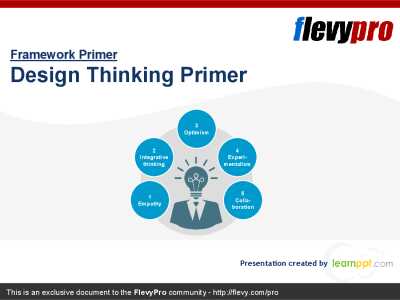
Thomas Edison represents what many of us think of as a golden age of American innovation. It is a time when new ideas transformed every aspect of our lives. Today, the need for transformation is greater than before.
A human-centered, creative, iterative, and practical approach is necessary to
[read more]
39-slide PowerPoint presentation
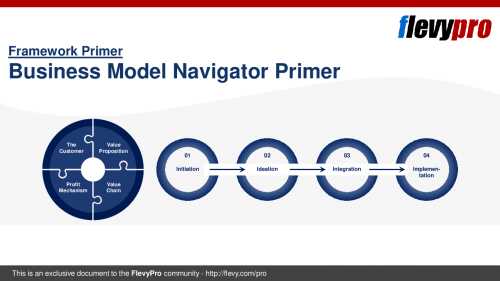
Organizations across industries face unprecedented challenges as markets evolve rapidly and innovation disrupts established norms. Even organizations with cutting-edge technological products struggle to sustain long-term success.
Notable examples include Kodak, Agfa, and other once-dominant
[read more]
31-slide PowerPoint presentation
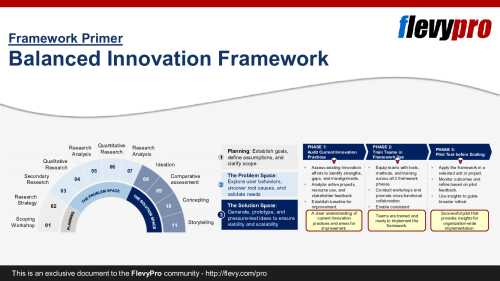
Innovation Portfolio Management (IPM) gives leaders the structure to assess, prioritize, and govern Innovation efforts across the organization. It helps manage risk, optimize ROI, and ensure alignment with strategic objectives.
This PPT presentation introduces the Balanced Innovation
[read more]
25-slide PowerPoint presentation
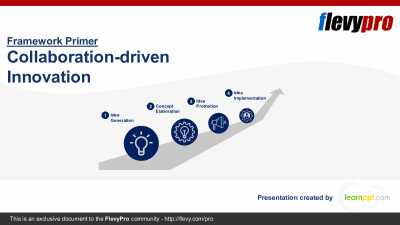
Idea Incubation to final Product Development is typically a lengthy, time-intensive process. The primary reason for this scenario is that even genuinely-innovative ideas, at the most-admired Innovation front-runners, often get delayed, robbed off their originality, or shelved in their stages of
[read more]