Editor's Note: Take a look at our featured best practice, Business Continuity Plan (BCP) Template (20-page Word document). A Business Continuity Plan (BCP) is a plan to continue operations if a place of business is affected by different levels of disaster which can be localized short term disasters, to days long building wide problems, to a permanent loss of a building. Such a plan typically explains how the [read more]
* * * *
Business continuity planning often concentrates on systems, facilities, suppliers, and financial controls. Documents receive less attention until an employee relocation, acquisition, audit, insurance claim, or unexpected disruption reveals that an essential record is missing, outdated, or inaccessible. For midsized organizations in particular, this can turn what should be a routine administrative task into a bottleneck involving HR, legal, compliance, and operations.
The solution is not to collect every possible document. Effective document readiness is a governance discipline: identifying which records are critical, assigning ownership, defining secure access, and making sure the right information can be retrieved when a business event requires it. The same principle applies to corporate records and to certain employee-held documents that may be necessary for mobility, benefits, or identity-dependent processes.
A birth certificate is a useful example. An organization generally should not retain copies of employees’ personal vital records without a legitimate business reason, but an employee may need access to one during an international transfer, benefits process, or other identity-related procedure. A mature readiness program distinguishes between documents the company must control and documents employees should be reminded to keep accessible themselves.
A Four-Layer Document Readiness Framework
A practical approach is to organize document readiness into four layers: identification, ownership, protection, and recoverability. Together, these controls help organizations reduce administrative friction without creating unnecessary repositories of sensitive information.
1. Identify Records by Business Impact
Not every document deserves the same level of control. Start by identifying records whose absence would materially delay operations, compliance, transactions, or employee deployment.
These may include incorporation documents, insurance policies, major contracts, licenses, banking authorities, intellectual property records, supplier agreements, employee certifications, and selected HR documentation. Personal records should be treated differently: instead of automatically storing them, organizations can identify situations in which employees may need to provide them.
This approach aligns with the broader records-management principle of managing information according to its operational value and lifecycle. ARMA’s overview of Records and Information Management emphasizes that effective programs cover policies, accountability, retention, protection, and the identification of vital records needed for business continuity.
2. Assign an Owner and a Retrieval Path
A critical record without a clear owner can be almost as problematic as a missing record.
Each record category should have a designated business owner responsible for accuracy, retention, and authorized access. Legal might own executed contracts, Finance may control banking authorities, HR may manage employment records, and Corporate Affairs may maintain entity documents.
The organization should also document the retrieval path. Managers need to know not only where a document normally resides but how it can be accessed if the primary system, office, or responsible employee is unavailable.
The organization should also document the retrieval path. Managers need to know not only where a document normally resides but how it can be accessed if the primary system, office, or responsible employee is unavailable. In some cases, this also means converting working files into more portable formats; for example, using Excel to PDF can make spreadsheets easier to preserve, share, and retrieve without depending on the original editing software.
Availability is only one objective. Records also need appropriate confidentiality and integrity controls.
An employee passport, corporate banking authorization, routine supplier agreement, and public company registration document do not create identical risks. Organizations should therefore classify records and apply controls proportionately.
For highly sensitive information, this can include restricted permissions, encryption, access logging, multifactor authentication, secure backups, and defined deletion schedules. Access should generally follow a least-privilege principle: employees receive the information necessary for their role rather than broad access to an entire repository.
This distinction is especially important when personal documentation enters a business process. Convenience should not become justification for indefinite retention.
4. Test Recoverability
A backup is useful only if it can be restored, and a document-management procedure is valuable only if people can execute it during disruption.
Organizations should periodically test whether priority documents remain accessible under realistic scenarios. Can Finance retrieve essential banking records if the main office is unavailable? Can HR continue an urgent relocation when a key team member is absent? Can Legal locate executed agreements during a systems outage?
The Business Continuity Institute’s Good Practice Guidelines frame business continuity as a management system that includes analysis, solution design, implementation, and validation. Document readiness should follow the same logic: identify requirements, implement controls, and then verify that those controls actually work.
Turn the Framework into an Operational Checklist
A concise records-readiness checklist can help managers translate the framework into routine governance:
Inventory: Identify records whose unavailability could interrupt a critical process or delay an important employee event.
Ownership: Assign one accountable function or role to every critical record category.
Classification: Separate corporate records, confidential employee records, and personal documents that employees themselves should maintain.
Access and backup: Define authorized users, primary storage, alternate access, and recovery procedures.
Review and testing: Check records periodically for expiration, outdated information, access problems, and recovery failures.
The checklist should also be triggered by major organizational events rather than reviewed only on a calendar. Acquisitions, restructuring, leadership changes, new jurisdictions, office moves, and changes to employee mobility programs can all alter what the organization needs to retain or retrieve.
Document Readiness Is a Resilience Capability
Strong records management is not primarily about filing. It is about removing avoidable dependencies from critical business processes.
Organizations do not need to centralize every document to become more resilient. They need to understand which records matter, who controls them, how sensitive they are, and how quickly authorized users can recover them when circumstances change.
For executives and operational leaders, that makes document readiness a practical component of business continuity, compliance, and workforce mobility. A modest investment in classification, ownership, secure access, and periodic testing can prevent missing paperwork from becoming an unnecessary operational constraint.
The disruption COVID-19 caused has made businesses more aware of the importance of business continuity planning (BCP) for effective disruption-related preparation, response and recovery.
Although the term "business continuity" is often used as a synonym for IT Disaster recovery (DR), [read more]
Do You Want to Implement Business Best Practices?
You can download in-depth presentations on BCP and 100s of management topics from the FlevyPro Library. FlevyPro is trusted and utilized by 1000s of management consultants and corporate executives.
For even more best practices available on Flevy, have a look at our top 100 lists:
These best practices are of the same as those leveraged by top-tier management consulting firms, like McKinsey, BCG, Bain, and Accenture. Improve the growth and efficiency of your organization by utilizing these best practice frameworks, templates, and tools. Most were developed by seasoned executives and consultants with over 20+ years of experience.
Readers of This Article Are Interested in These Resources
A Business Continuity Risk Assessment (BCRA) is part of Business Continuity Management. A BCRA must be carried out to assess the organisation's vulnerability to threats and establish the organisation's overall risk profile. It demonstrates a qualitative methodology of a Threats & Vulnerability [read more]
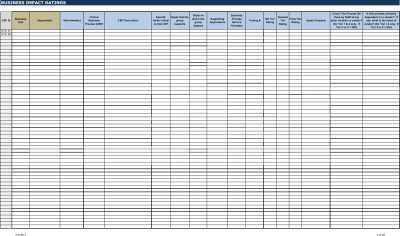
This Excel document provides a set of templates to capture data and analysis when conducting a Business Continuity Planning (BCP) and Disaster Recovery (DR) project for any size organization. These templates were originally developed for a large, international enterprise with locations in [read more]
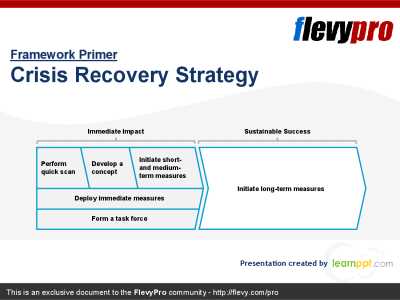
Many organizations are unable to successfully recover from a crisis and end up bankrupt. Organizations typically react to crises by adopting only short-term, operational measures.
To maintain a sustained Competitive Advantage and recover from the crisis stronger, we must tie short-term [read more]
Managing all the aspects of the business to ensure business continuity is referred to as Business Continuity Management. It means being prepared to deal with all forms of disruption of 'Business As Usual.' This could save your organization from potential damage. Damage in lost revenues, unnecessary [read more]
 Business continuity planning often concentrates on systems, facilities, suppliers, and financial controls. Documents receive less attention until an employee relocation, acquisition, audit, insurance claim, or unexpected disruption reveals that an essential record is missing, outdated, or inaccessible. For midsized organizations in particular, this can turn what should be a routine administrative task into a bottleneck involving HR, legal, compliance, and operations.