


 Click main image to view in full screen.
Business Continuity Risk Assessment (BCRA) Templates – Word DOC
Word (DOC) + Zip archive file (ZIP) 6 Pages


BCP WORD DESCRIPTION
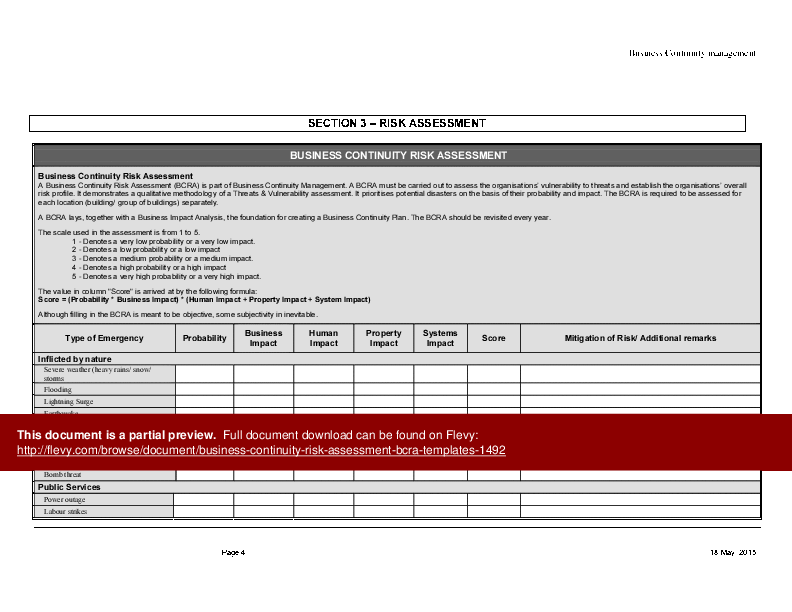
A Business Continuity Risk Assessment (BCRA) is part of Business Continuity Management. A BCRA must be carried out to assess the organisation's vulnerability to threats and establish the organisation's overall risk profile. It demonstrates a qualitative methodology of a Threats & Vulnerability assessment. It prioritises potential disasters on the basis of their probability and impact. The BCRA is required to be assessed for each location (building/group of buildings) separately.
A BCRA lays, together with a Business Impact Analysis, the foundation for creating a Business Continuity Plan. The BCRA should be revisited every year.
Purchase of this product includes 4 documents for conducting the BCRA:
• 6-page Word document (previewed above)
• BIA for Corporates, 4-page Word document (included in the secondary ZIP file)
• Business Continuity Risk Analysis, 2-page Word document (included in the secondary ZIP file)
• Excel-based Vulnerability Chart (included in the secondary ZIP file)
The BCRA template includes a comprehensive scoring system to evaluate the probability and impact of various threats. The scale ranges from 1 to 5, allowing for a nuanced assessment of potential risks. This quantitative approach ensures that decision-makers can prioritize resources effectively, focusing on high-probability, high-impact scenarios. The template also facilitates the identification of mitigation strategies, providing a structured format for documenting additional remarks and action plans.
This tool is indispensable for organizations aiming to bolster their resilience against disruptions. The detailed breakdown of business, human, property, and systems impact categories ensures a holistic view of potential vulnerabilities. By integrating this BCRA template into your risk management framework, you can enhance your preparedness and response strategies, safeguarding your operations against unforeseen events.
Got a question about the product? Email us at support@flevy.com or ask the author directly by using the "Ask the Author a Question" form. If you cannot view the preview above this document description, go here to view the large preview instead.
TOPIC FAQ
What is a Business Continuity Risk Assessment and why is it performed?
A Business Continuity Risk Assessment (BCRA) assesses an organisation’s vulnerability to threats to establish an overall risk profile and prioritise potential disasters by probability and impact. It’s used to inform Business Continuity Plans and must be carried out separately for each location and revisited every year.Which impact categories should I evaluate in a BCRA?
A BCRA should evaluate multiple impact categories to capture different loss types: business impact, human impact, property impact, and systems impact. These categories provide a holistic view of vulnerabilities and are explicitly included in the Business Continuity Risk Assessment (BCRA) Templates.How does scoring work in a typical BCRA?
The BCRA uses a quantitative scoring system to evaluate probability and impact on a scale from 1 to 5. This allows decision-makers to rank scenarios and focus resources on the highest-probability, highest-impact threats using the 1–5 probability/impact matrix.How does a BCRA relate to a Business Impact Analysis when creating a BCP?
A BCRA, together with a Business Impact Analysis, forms the foundation for a Business Continuity Plan by linking threat/vulnerability assessment to consequence analysis. Flevy’s Business Continuity Risk Assessment (BCRA) Templates include a 4-page BIA for Corporates to support that linkage.What practical elements should I look for when choosing a BCRA template?
Choose a template that supports location-level assessments, provides a clear probability/impact scoring scale, covers business/human/property/systems impacts, and includes workpapers such as a BIA and a Vulnerability Chart. The Business Continuity Risk Assessment (BCRA) Templates include a 1–5 scoring system, BIA, and an Excel Vulnerability Chart.How often and at what scope should I update a BCRA?
A BCRA should be revisited annually and must be assessed for each location (building or group of buildings) separately. Regular annual reviews ensure the risk profile remains current for each location and supports the ongoing maintenance of the Business Continuity Plan.What documentation from a BCRA helps demonstrate compliance for regulated organisations?
A BCRA documents the organisation’s risk profile, probability/impact scores, and mitigation plans, which can support compliance evidence. The Business Continuity Risk Assessment (BCRA) Templates note alignment with SOX, ITIL, FFIEC, BS25999, and ISO 17799/27001 as part of the documentation package.If I have limited resources, how should I prioritise BCRA actions?
With constrained resources, prioritise scenarios scoring high on both probability and impact using the 1–5 scoring system, and focus mitigation on those items first. Use a vulnerability chart to visualise and track high-priority items; the templates include an Excel-based Vulnerability Chart for this purpose.Source: Best Practices in BCP, Business Impact Analysis Word: Business Continuity Risk Assessment (BCRA) Templates Word (DOC) Document, Boris Agranovich