Editor's Note: Take a look at our featured best practice, Artificial Intelligence Data Center Ecosystem (30-slide PowerPoint presentation). This surge in AI usage stems from its ability to process vast amounts of data and derive insights that can significantly improve efficiency, innovation, and competitiveness.
Critical data center infrastructure plays a foundational role in the deployment and scaling of AI applications. The [read more]
* * * *
 Flevy’s readers spend their days building frameworks, decks, and strategic playbooks that help organizations run better. Marketing agencies are frequent consumers of that same kind of strategic thinking, since they operate under similar pressures: tight deadlines, client expectations that keep rising, and teams that need to move faster than their tools sometimes allow. What often gets left out of the strategy conversation is the plumbing underneath it all, the servers, networks, and software systems that either support a fast-moving agency or quietly hold it back. Understanding where those systems break down is just as important as understanding market positioning or client retention.
This guide is written for people encountering the concept of IT infrastructure bottlenecks for the first time. No prior technical background is assumed. Instead, we start with the basics and build toward practical, actionable knowledge that any operations lead, account manager, or agency owner can use to spot trouble before it becomes a crisis.
A good starting point is a resource like the 10 it bottlenecks marketing agencies will face in 2026 breakdown, which lays out the specific pain points agencies are running into as creative workloads, data volumes, and client demands continue to grow. That resource is a useful companion to this beginner’s overview, since it goes deeper into agency-specific scenarios once you understand the fundamentals covered here.
What Are IT Infrastructure Bottlenecks? A Beginner’s Definition
An IT infrastructure bottleneck is any point in your technology stack where the flow of work slows down because a system, device, or process cannot keep up with demand. Think of it like a narrow section of highway during rush hour. The road itself might be fine everywhere else, but that one constrained stretch backs up traffic for everyone behind it. In an agency setting, this could be a server that cannot handle large video files, a Wi-Fi network that buckles when too many people join a client Zoom call at once, or a file-sharing system that takes minutes instead of seconds to sync creative assets across a team.
The important thing to understand is that bottlenecks are not always obvious. They frequently masquerade as “that’s just how things are” annoyances, like a laptop that takes forever to boot or a shared drive that occasionally freezes. Individually, these feel like minor inconveniences. Collectively, they represent a pattern worth investigating, because bottlenecks compound over time and tend to get worse as an agency adds more clients, more staff, and more data-heavy deliverables like video and design files.
The 5 Most Common IT Bottlenecks Marketing Agencies Face
Agencies tend to run into the same handful of infrastructure problems regardless of size or specialty. The first is bandwidth limitations, where internet connections cannot support simultaneous video calls, large uploads, and cloud-based design tools all at once. The second is outdated hardware, meaning laptops and workstations that were fine three years ago but now struggle with modern creative software and multitasking demands. The third is fragmented storage, where files live across too many disconnected drives and cloud accounts, making collaboration slow and version control a nightmare.
The fourth common bottleneck is insufficient server capacity or cloud resources, particularly as agencies lean more heavily into AI-assisted content creation and data analytics tools that require significant processing power. The fifth is poor network segmentation, where guest traffic, internal operations, and client-facing systems all compete for the same limited resources without any prioritization. Each of these bottlenecks can exist quietly for months before someone notices the agency has been operating at a fraction of its potential speed.
Why Bottlenecks Matter: Real Costs to Your Agency
It is tempting to treat slow systems as a minor annoyance rather than a business problem, but the numbers tell a different story. Research cited by Xvand, based on Robert Half data, estimates that a 25-person company loses roughly $80,000 annually to IT inefficiencies, driven by an average of 22 minutes lost per employee each day. For an agency billing hourly or managing tight production schedules, that lost time translates directly into missed deadlines, reduced margins, and frustrated clients who notice when deliverables slip.
The scale of this problem is growing, not shrinking. According to Globenewswire, infrastructure constraints have become the primary bottleneck for enterprise operations, with 40 percent of IT decision-makers now identifying a lack of specialized infrastructure as the primary constraint on AI initiatives, a more than fourfold increase from just 9 percent in 2024. Hatch Tribe research from 2026 similarly found that 58 percent of business bottlenecks stem from system inefficiency rather than actual workload volume, meaning agencies are often losing capacity to friction rather than genuine overwork.
| Metric |
Figure |
Source |
| IT leaders citing infrastructure as primary AI constraint |
40% (up from 9% in 2024) |
Digital Realty Global Data Insights Survey, 2026 |
| Enterprises using distributed data strategies |
88% |
Digital Realty Global Data Insights Survey, 2026 |
| Annual productivity loss per 25-person company |
$80,000 |
Robert Half research via Xvand |
| Bottlenecks caused by system inefficiency, not workload |
58% |
Hatch Tribe, 2026 |
| Corporate networks with correctable infrastructure issues |
75% |
Hummingbird Networks survey, 2025-2026 |
First Steps: How to Identify and Address Bottlenecks in Your Stack
The encouraging news is that most bottlenecks are fixable once identified. Hummingbird Networks surveyed corporate networks and found that 75 percent had infrastructure and optimization problems that were entirely correctable, meaning the issues were not exotic or expensive to solve, just unnoticed. The first step for any agency is simply paying attention to recurring complaints. If multiple people mention slow uploads, laggy video calls, or files that take too long to open, that pattern is data, not noise, and it deserves a closer look.
From there, a basic infrastructure audit can reveal where the real friction lives. This does not need to be a massive undertaking. It can start with tracking how long common tasks take, checking whether hardware meets current software requirements, and reviewing whether your network can handle current versus projected demand. Agencies preparing for growth, particularly those adopting AI tools or expanding video production, should treat this audit as a standing habit rather than a one-time fix, since the distributed data strategies now used by 88 percent of enterprises suggest that infrastructure needs will keep evolving rather than settling into a fixed state.
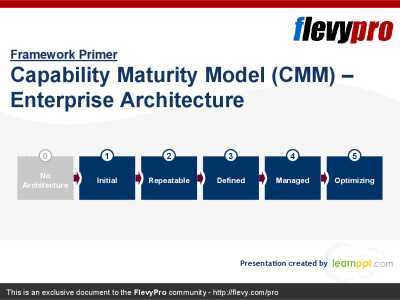
24-slide PowerPoint presentation
The Capability Maturity Model (CMM) is an organizational model that describes 5 evolutionary stages (or levels), in which the business processes in an organization are managed. The term "maturity" relates to the degree of formality and optimization of processes, from ad hoc practices, to formally
[read more]
Do You Want to Implement Business Best Practices?
You can download in-depth presentations on Enterprise Architecture and 100s of management topics from the FlevyPro Library. FlevyPro is trusted and utilized by 1000s of management consultants and corporate executives.
For even more best practices available on Flevy, have a look at our top 100 lists:
These best practices are of the same as those leveraged by top-tier management consulting firms, like McKinsey, BCG, Bain, and Accenture. Improve the growth and efficiency of your organization by utilizing these best practice frameworks, templates, and tools. Most were developed by seasoned executives and consultants with over 20+ years of experience.
Readers of This Article Are Interested in These Resources
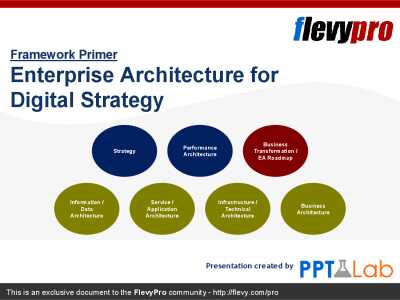
14-slide PowerPoint presentation
Enterprise Architecture (EA) is a well-defined framework for conducting enterprise analysis, design, planning, and implementation for the successful development and execution of strategy. Practitioners of EA, known as Enterprise Architects, are often called upon to draw conclusions from the
[read more]
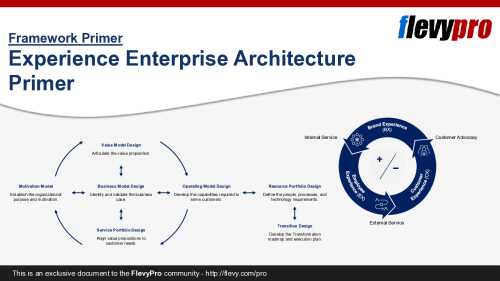
30-slide PowerPoint presentation
Today's digital-native customers have raised the stakes for every organization competing for their loyalty. They demand human-centered engagement, hyper-personalized offerings, and seamless experiences consistently aligned with their evolving preferences.
Forward-thinking organizations
[read more]
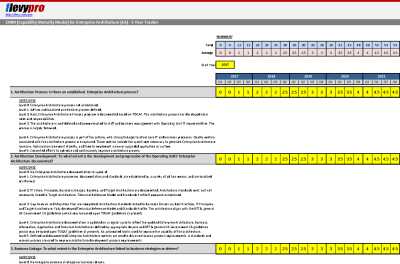
Excel workbook
This Excel spreadsheet evaluates and records targets of the CMM (Capability Maturity Model) level for Enterprise Architecture (EA) over a 5-year period.
The following criteria/questions around EA are evaluated:
1. Architecture Process: Is there an established Enterprise Architecture
[read more]
34-slide PowerPoint presentation
Application Portfolio Management (APM) is the disciplined inventory and assessment of every application, platform, capability, and service that supports organizational Strategy. APM establishes a single source of truth, assigns ownership, and ties each asset to cost, risk, and business
[read more]