Editor's Note: Take a look at our featured best practice, Digital Transformation Strategy (145-slide PowerPoint presentation). Digital Transformation is being embraced by organizations across most industries, as the role of technology shifts from being a business enabler to a business driver. This has only been accelerated by the COVID-19 global pandemic. Thus, to remain competitive and outcompete in today's fast paced, [read more]
* * * *
The contracting industry is undergoing significant changes thanks to the quick advancements in technology. From artificial intelligence (AI) to advanced construction management software, contractors are now equipped with tools that streamline operations, enhance project management, and improve client communication.
Here are six ways technology is revolutionizing the contracting industry in 2024.
1. AI-Powered Project Estimation
Accurate project estimation is crucial for contractors to ensure profitability and client satisfaction. AI-powered tools are now capable of analyzing vast amounts of data to provide precise estimates.
These tools consider factors such as material costs, labor hours, and historical project data to generate accurate estimates quickly.
By utilizing AI for project estimation, contractors can avoid underbidding or overbidding, leading to more successful project completions. AI also allows for dynamic adjustments, ensuring that estimates remain accurate even as project conditions change.
For example, if material costs fluctuate or unexpected delays occur, AI tools can swiftly recalibrate estimates, providing real-time updates and maintaining project viability.
2. Streamlined Invoicing and Payment Systems
Invoicing and payment processing are often time-consuming tasks for contractors. Innovative software solutions are simplifying these processes by automating invoicing, tracking payments, and sending reminders to clients. This not only saves time but also reduces the risk of errors and delays in payments.
For instance, Joist’s general contracting estimate and invoice software provides a comprehensive solution for contractors. It allows them to create estimates, send invoices, and manage payments all in one platform, enhancing efficiency and accuracy.
By integrating financial management into their daily operations, contractors can focus more on project execution and less on administrative tasks.
3. Enhanced Client Communication
Effective communication with clients is essential for the success of any contracting project. Technology is enabling better communication through various channels, including mobile apps, chatbots, and project management platforms.
These tools allow contractors to keep clients updated on project progress, address concerns promptly, and share important documents and images in real-time.
Mobile apps, in particular, offer clients the convenience of accessing project information from anywhere, fostering transparency and trust. This improved communication leads to higher client satisfaction and better project outcomes.
For example, a client can easily check the status of a project, view recent photos, and even approve changes directly through an app, streamlining the decision-making process.
4. Advanced Construction Management Software
Construction management software has evolved to become an indispensable tool for contractors. These platforms offer a range of features, including project scheduling, resource allocation, and document management.
By integrating all aspects of project management into a single platform, contractors can ensure that projects are completed on time and within budget.
Modern construction management software also includes collaboration tools, enabling teams to work together more effectively. This reduces the likelihood of miscommunication and ensures that everyone is on the same page throughout the project lifecycle.
Platforms like Procore or Buildertrend allow team members to update project statuses, track expenses, and communicate changes, all in real-time, which significantly enhances workflow efficiency.
5. Drones and Robotics
The use of drones and robotics in the construction industry is becoming increasingly common. Drones are used for site surveys, inspections, and progress tracking, providing contractors with real-time data and high-resolution images. This technology allows for more accurate and efficient site assessments, reducing the need for manual inspections.
Robotics, on the other hand, are being used for tasks such as bricklaying, concrete pouring, and demolition. These machines can work faster and with greater precision than human workers, increasing productivity and safety on construction sites.
For instance, robotic bricklayers like SAM (Semi-Automated Mason) can lay bricks more consistently and at a higher speed than traditional methods, reducing labor costs and improving construction timelines.
6. Virtual Reality and Augmented Reality
Virtual reality (VR) and augmented reality (AR) are transforming how contractors plan and execute projects. VR allows contractors to create immersive 3D models of projects, enabling clients to visualize the finished product before construction begins. This can lead to better design decisions and fewer changes during the construction phase.
AR, meanwhile, is being used on-site to overlay digital information onto the physical world. Contractors can use AR to see through walls, identify utilities, and ensure that installations are done correctly. This technology improves accuracy and reduces the likelihood of costly mistakes.
For example, using AR glasses, a contractor can view the exact placement of electrical wiring within a wall, ensuring that installations are performed without damaging existing infrastructure.
Conclusion
The integration of advanced technologies is revolutionizing the contracting industry, making it more efficient, accurate, and client-focused. From AI-powered project estimation and streamlined invoicing systems to drones, robotics, and VR/AR applications, these innovations are setting new standards for what is possible in the field. Contractors who embrace these technologies will be well-positioned to succeed in the increasingly competitive landscape of 2024.
By leveraging tools, contractors can enhance their workflows, improve client satisfaction, and ultimately deliver better project outcomes. The future of the contracting industry is optimistic, thanks to these transformative technologies.
This is again a "new improved" A Comprehensive Guide to Digital Transformation. What was one 173 slides has now increased to 206 because I have added a number of latest slides to the deck about Why People are the Critical Factor. The Value of Change Management. The deck is not intended to provide [read more]
Do You Want to Implement Business Best Practices?
You can download in-depth presentations on Digital Transformation and 100s of management topics from the FlevyPro Library. FlevyPro is trusted and utilized by 1000s of management consultants and corporate executives.
For even more best practices available on Flevy, have a look at our top 100 lists:
These best practices are of the same as those leveraged by top-tier management consulting firms, like McKinsey, BCG, Bain, and Accenture. Improve the growth and efficiency of your organization by utilizing these best practice frameworks, templates, and tools. Most were developed by seasoned executives and consultants with over 20+ years of experience.
Readers of This Article Are Interested in These Resources
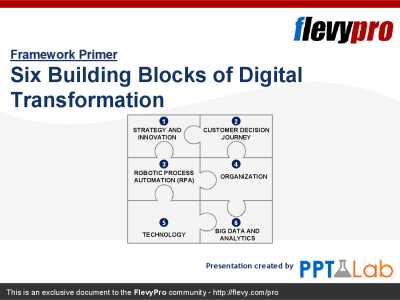
Digital Transformation touches practically every function in the entire organization. This thus requires an unprecedented amount of coordination among people, process, and technologies throughout the organization, leading to a difficult Transformation program.
The Six Building Blocks of [read more]
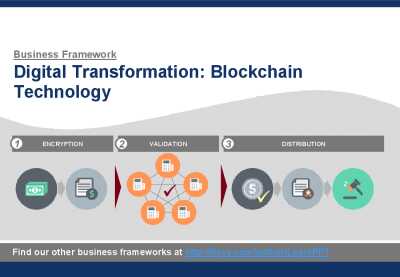
Blockchain Technology is an emerging database technology that has gained widespread appeal across many industries, mostly driven by the rise of cryptocurrencies--most notably Bitcoin. It provides numerous process benefits, including efficiency, security, transparency/openness, low cost, data [read more]
Most organizations recognize the significant potential in creating value through Digital Transformation. However, they may struggle with the question of exactly how much value they can create and where within the organization the value will come from. This presentation deals with the various [read more]
We are living in the Digital Age. For organizations to remain competitive, they must develop and execute robust Digital Transformation Strategies.
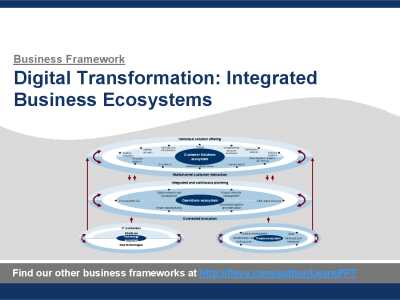
Organizations that have excelled in Digital Transformation distinguish themselves through their mastery of the 4 critical Business Ecosystems. [read more]
 The contracting industry is undergoing significant changes thanks to the quick advancements in technology. From artificial intelligence (AI) to advanced construction management software, contractors are now equipped with tools that streamline operations, enhance project management, and improve client communication.