Editor's Note: Take a look at our featured best practice, Complete Organization Design Toolkit (103-slide PowerPoint presentation). Recent McKinsey research surveyed a large set of global executives and suggests that many companies, these days, are in a nearly permanent state of organizational flux. A rise in efforts in Organizational Design is attributed to the accelerating pace of structural change generated by market [read more]
* * * *
A few decades ago, faculty members at the University of Michigan were researching the major indicators of effective organizational performance. What came from this research was an incredibly useful model for organizing and understanding a wide array of organizational (and individual) topics. These include theories on Organizational Effectiveness, Corporate Culture, Leadership Competencies, Stages of Life Cycle Development, Financial Strategy, among others.
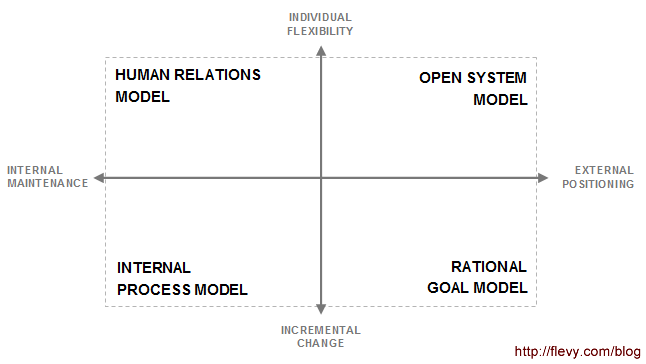
This model is the Competing Values Framework, developed by Robert Quinn and Jon Rohrbaugh. Based on statistical analyses of a comprehensive list of effectiveness indicators, Quinn and Rohrbaugh discovered 2 major dimensions underlying conceptions of effectiveness, focused on:
Organizational Focus. This dimension differentiates an emphasis on flexibility, discretion, and dynamism from an emphasis on stability, order, and control.
Organizational Preference for Structure. The second dimension differentiates an internal orientation—with a focus on integration, collaboration, and unity—from an external orientation—with a focus on differentiation, competition, and rivalry.
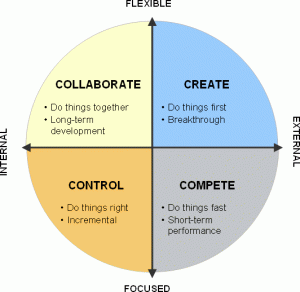
Together, the 2 dimensions form 4 quadrants. The diagram visualizes the framework and places names for each the quadrants:
Human Relations Model
Open System Model
Internal Process Model
Rational Goal Model
Each quadrant represents a unique and defining sets of organizational and individual values and implications. In fact, values and implications from diagonally opposing quadrants are complete opposites–hence the name, Competing Values Framework. Someone who strives in one quadrant may be completely ineffective and counter-productive if placed into an organization that is aligned with a different quadrant. Therefore, it critical to understand what quadrant your own organization falls into and the associated implications of being in this quadrant. Knowing this will help you identify the criteria for effectiveness that should be pursued, the leadership and managerial competencies that are most effective, and the underlying corporate culture.
Let’s look at an example.
Human Relations Model
The top-left quadrant, called the Human Relations Model, places a lot of emphasis on flexibility and internal focus. It stresses cohesion, morale, and human resources development as criteria for effectiveness. Tools and techniques, including teamwork, collaboration, talent management, empowerment, or inter-personal relationships, are highlighted here.
Leaders here tend to be Facilitators, Mentors, and Team Builders. The culture is one of Collaboration with the mantra, “do things together.” Value drivers include Commitment, Communication, and Development.
Rational Goal Model
On the opposing (bottom-right) quadrant, we have the Rational Goal Model. Rational Goal Model emphasizes control and an external focus. It regards planning, goal setting, productivity, and efficiency as being effective. Tools and techniques, including competitiveness, fast response, decisiveness, driving through barriers, or goal achievement, are highlighted here.
Leaders here to be Competitors and Producers. The culture is more around Competition, where folks live by the mentality, “do things fast.” Value drivers include Market Share, Goal Achievement, and Profitability.
Leadership Development
As alluded to, the Competing Values Framework can be applied to Leadership Development. The subtlety that this model addresses is that an effective leader in one organization may not be an effective leader in a different organization. Why? Well, it’s because the 2 organizations may not fall within the same quadrant.
Leadership development experiences and executive education programs often focus on competencies and capabilities that reside in each of the 4 different quadrants. Eight categories of leader behavior, or roles, emerge from this framework:
The specific leadership tools and techniques that receive emphasis with leadership groups are often determined by the organization’s own culture, aspirations for change, competencies of the management team, or the feedback that individuals receive from various assessments.
What are your thoughts on this model? Where does your organization fall? Please share your thoughts in the comments below. You can download an editable PowerPoint about the Competing Values Framework here on the Flevy documents marketplace.
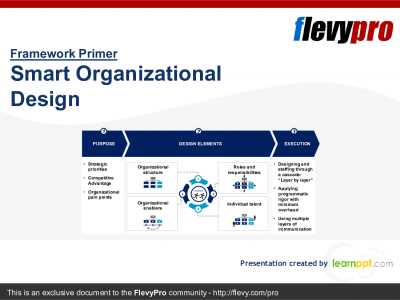
Organizational Design involves the creation of roles, processes, and structures to ensure that the organization's goals can be realized. Organizational Design span across various levels of the organization. This framework focuses on the following 3 initial steps of the full 10-step Organizational [read more]
Do You Want to Implement Business Best Practices?
You can download in-depth presentations on Organizational Design and 100s of management topics from the FlevyPro Library. FlevyPro is trusted and utilized by 1000s of management consultants and corporate executives.
For even more best practices available on Flevy, have a look at our top 100 lists:
These best practices are of the same as those leveraged by top-tier management consulting firms, like McKinsey, BCG, Bain, and Accenture. Improve the growth and efficiency of your organization by utilizing these best practice frameworks, templates, and tools. Most were developed by seasoned executives and consultants with over 20+ years of experience.
Readers of This Article Are Interested in These Resources
The McKinsey 7-S Strategy Model is a business framework used to evaluate organizational effectiveness and alignment. It identifies 7 internal, interrelated organizational elements: Shared Vision, Strategy, Structure, Systems, Style, Staff, and Skills. These elements need to be aligned for the [read more]
Organizational Design (OD) is a structured approach to aligning the structure, processes, and systems of an organization to achieve its strategic objectives and enhance performance. It encompasses various components, including defining the purpose of reorganization, determining supportive [read more]
Business environment has transformed drastically and has become immensely challenging due to competition, disruptive technologies, laws, and globalization. These challenges warrant better performance to address customer needs and to survive--and outpace--intense competition.
Consequently, [read more]
The objectives of this document are:
- Explain organisation design in relation to the other attributes of an organisation, such as its people and strategy
- Outline the key success factors in designing an organisation structure
- Explain the high level process and supporting [read more]
 A few decades ago, faculty members at the University of Michigan were researching the major indicators of effective organizational performance. What came from this research was an incredibly useful model for organizing and understanding a wide array of organizational (and individual) topics. These include theories on Organizational Effectiveness, Corporate Culture, Leadership Competencies, Stages of Life Cycle Development, Financial Strategy, among others.