A supplier in Vietnam suddenly faces new tariffs. A data localization law in Brazil changes how a customer database can be stored. A port strike in Germany delays a product launch by six weeks. None of these events originate in a boardroom, yet each one rewrites a company’s numbers. What is geopolitics, in practical terms? It is the study of how power, territory, and politics between nations shape the conditions businesses operate in, and it has quietly become one of the most consequential variables in strategic planning.
Here is geopolitics broken into pieces a strategy or operations leader can actually use: what it covers, why it belongs in global business management, and how to build a habit of tracking it. If you want a structured starting point, the geopolitics lessons available through short daily courses offer a way to build foundational literacy on trade blocs, sanctions regimes, and regional power dynamics without committing to a semester-long course.
What Is Geopolitics, Exactly?
Geopolitics examines how geography, resources, and national interest interact to produce political decisions, alliances, and conflicts. A country’s access to a seaport, a mountain range, or a rare-earth mineral deposit shapes its foreign policy as much as its ideology does. Singapore’s foreign policy, for instance, has been shaped for decades by its position on the Strait of Malacca, one of the busiest shipping corridors in the world. Building a working knowledge of these physical realities does not require a geography degree: a rotation of short geography lessons covering terrain, resource distribution, and border history is enough to make a headline about a contested shipping lane or a disputed border region make sense immediately, rather than sending you to search for background every time a new country enters the conversation.
For a business, the discipline matters because it explains the “why” behind events that otherwise look random: a new export control, a currency devaluation, a diplomatic rupture between two trading partners. Executives who understand the underlying pressures can anticipate shifts instead of reacting to headlines after the damage is done.
Why Geopolitics Belongs in Global Business Management
Global business management has traditionally focused on market entry, pricing, and supply chain efficiency. Geopolitical analysis adds a layer that explains why those levers sometimes stop working. The 2018-2019 U.S.-China tariff increases, for example, raised costs on thousands of product categories overnight, forcing companies like Apple and Ford to redesign sourcing strategies that had taken years to optimize.
Three mechanisms explain why this matters structurally, not just anecdotally:
Trade policy changes the relative cost of doing business in a region, which can erase a supply chain’s cost advantage within a single fiscal quarter.
Sanctions and export controls can legally block a transaction that was commercially sound the week before, as seen when the European Union and United States expanded sanctions on Russian financial institutions in 2022.
Regulatory divergence, such as the EU’s General Data Protection Regulation versus China’s Personal Information Protection Law, forces companies to run parallel compliance systems rather than one global standard.
Treating these as one-off surprises is expensive. Treating them as a recurring input to planning, the way currency risk or inflation already are, is how mature organizations avoid being blindsided twice by the same category of risk.
The Four Risk Categories Worth Tracking
Most geopolitical exposure for a multinational falls into one of four buckets. Mapping a company’s footprint against these categories is a faster exercise than building a full risk model from scratch, and it gives leadership a shared vocabulary.
Trade and tariff risk. Changes in import duties, quotas, or trade agreements directly affect landed cost and sourcing decisions. The renegotiation of NAFTA into the USMCA in 2020 changed rules of origin for automotive parts, requiring manufacturers to recalculate supplier eligibility across North America.
Regulatory and legal risk. Divergent data, labor, and environmental laws create compliance burdens that scale with the number of jurisdictions a company operates in. A firm selling software in both the EU and California now manages two different privacy regimes with overlapping but not identical requirements.
Physical and security risk. Conflict, piracy, and infrastructure disruption affect logistics and personnel safety. The 2021 blockage of the Suez Canal by the container ship Ever Given shut down one of the world’s busiest shipping lanes for about six days, and estimates of the trade volume affected varied widely depending on the source, underscoring how quickly a single chokepoint can disrupt global logistics even when the exact scale of the damage stays uncertain.
Currency and capital risk. Political instability often precedes currency volatility, as seen in Turkey’s lira depreciation through 2021 and 2022 following central bank policy changes tied to political pressure. Companies with revenue in affected currencies need hedging strategies that account for political, not just economic, triggers.
Building Geopolitical Awareness into Global Business Services
Global business services teams, the shared functions handling finance, procurement, and IT across a multinational’s regions, are often the first to feel geopolitical shocks because they sit closest to cross-border transactions. A procurement team processing payments to a supplier in a newly sanctioned region will hit a blocked transaction before a regional VP reads about the sanction in the news.
Building awareness into these functions does not require hiring a political scientist. It requires three practical changes: adding a geopolitical risk checkpoint to supplier onboarding, subscribing to a sanctions-screening service that updates in near real time, and running a quarterly review of the four risk categories above against the company’s current footprint. Organizations that already maintain a maturity model for digital transformation or operational risk can extend that same structure to geopolitics rather than building a separate framework from nothing.
Where to Find Reliable Context (and Where Not To)
A recurring question among strategy teams is where to get fast, digestible geopolitical context without wading through academic journals or partisan commentary. Searching reddit geopolitics threads is a common first stop, and the format has some value: practitioners and regional specialists occasionally flag emerging stories before mainstream coverage catches up. That value comes with real limits. Threads mix credentialed analysts with pure speculation, voting systems reward engaging claims over accurate ones, and there is no editorial accountability behind any of it. Treat these threads as, at best, a prompt to go looking elsewhere, not as an input to planning. Anything surfaced there needs independent confirmation from a named outlet like Reuters, the Financial Times, or a government trade office before it carries any weight in a business decision.
A Simple Framework to Start With
Leaders do not need a geopolitical forecasting unit to get value from this discipline. A workable starting framework has four steps: list every country where the company has suppliers, customers, or facilities; tag each one against the four risk categories; identify the three highest-exposure locations; and assign one person to monitor those three on a monthly basis using two or three named sources. This is small enough to run inside an existing risk committee and specific enough to produce action instead of a binder nobody reopens.
Next Steps for Your Organization
What is geopolitics, in the end, if not a recurring cost and opportunity variable that most planning cycles still treat as background noise? Companies that map their exposure against trade, regulatory, security, and currency risk catch problems while they are still cheap to solve. The next concrete step is small: pick the three countries where your revenue or supply chain is most concentrated, and assign someone to track them this quarter.
Geopolitical tensions, protectionist policies, and trade fragmentation are reshaping the global economy. Tariffs and retaliatory tariffs have not only disrupted supply chains but also eroded public trust in governments, institutions, and the multilateral trading system.
In a post-globalization [read more]
Do You Want to Implement Business Best Practices?
You can download in-depth presentations on Macroeconomics and 100s of management topics from the FlevyPro Library. FlevyPro is trusted and utilized by 1000s of management consultants and corporate executives.
For even more best practices available on Flevy, have a look at our top 100 lists:
These best practices are of the same as those leveraged by top-tier management consulting firms, like McKinsey, BCG, Bain, and Accenture. Improve the growth and efficiency of your organization by utilizing these best practice frameworks, templates, and tools. Most were developed by seasoned executives and consultants with over 20+ years of experience.
Readers of This Article Are Interested in These Resources
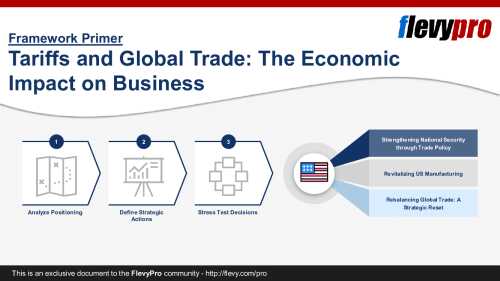
The recent wave of tariff measures and retaliatory trade actions is reshaping the global economic landscape.
These shifts have introduced deep uncertainty across multiple dimensions--cost structures, consumer demand, cross-border trade, and supply continuity. Government responses have diverged [read more]
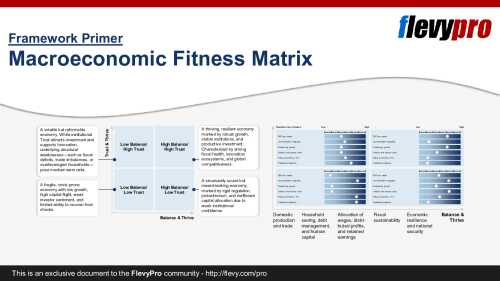
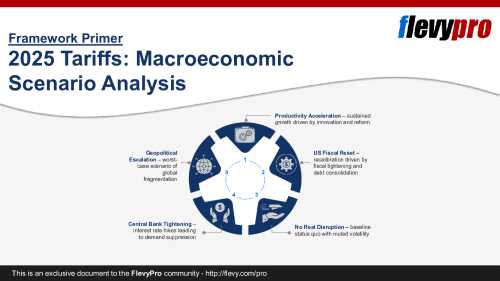
The global economy is entering a period of persistent instability.
In 2025, tariff wars, monetary tightening, and geopolitical tensions are converging to reshape the macroeconomic environment--posing serious challenges for executives trying to chart a long-term course.
Leaders cannot control [read more]
Curated by McKinsey-trained Executives
Mastering the Economic Landscape: The Ultimate Macroeconomics Business Workshop Toolkit
Are you ready to elevate your understanding of the economic world and navigate the complexities of macroeconomics with confidence? Introducing our comprehensive [read more]
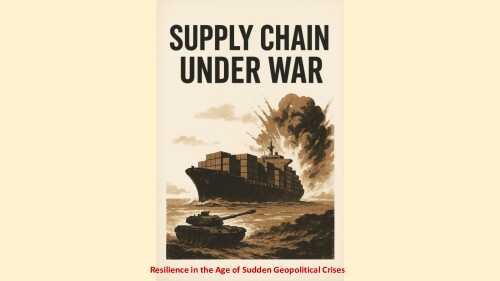
A practical, battle-tested framework for building resilient supply chains during geopolitical conflict.
Modern supply chains are collapsing under wars, sanctions, chokepoint attacks, and political instability.
This guide breaks down:
What really happens during war:
- Trade routes collapse [read more]
 A supplier in Vietnam suddenly faces new tariffs. A data localization law in Brazil changes how a customer database can be stored. A port strike in Germany delays a product launch by six weeks. None of these events originate in a boardroom, yet each one rewrites a company’s numbers. What is geopolitics, in practical terms? It is the study of how power, territory, and politics between nations shape the conditions businesses operate in, and it has quietly become one of the most consequential variables in strategic planning.