Editor's Note: Take a look at our featured best practice, Effective Communication with Virtual Teams (23-slide PowerPoint presentation). The number of people working remotely has been increasing progressively across the globe. An employee benefits report narrates that around 60% companies in the US offer telecommuting opportunities. According to Upwork, freelancers and contractors have increased by 81% from 2014 to 2017. [read more]
* * * *
You have a product to build, a few months of runway, and budget for two or three hires. Each of those hires will shape how your company works for years. Get one wrong and you lose salary, onboarding time, and weeks of progress you can’t get back.
The remote question makes this harder. Some founders hire remotely because it looks cheaper. Others insist on an office because that’s how startups have always been built. Both choices skip the questions that decide whether a hire succeeds.
Remote work is a stable option to plan around. Data on remote work statistics 2026 shows that average work-from-home days across 22 countries fell from 1.6 per week in 2022 to 1.27 in 2024 to 2025, with most of the decline ending after 2023. In the U.S., the digital nomad workforce reached 18.5 million in 2025.
So the real question is which of your first roles should be remote. The framework below gives you four questions to answer for each hire.
Why Your First Hires Carry Extra Weight
Your first employees set the habits everyone after them will follow. How they communicate, document work, and solve problems becomes the default for the team.
They also learn the business by watching you. In an office, that happens through overheard calls and quick questions. On a remote team, it only happens if you build it in on purpose.
Cost matters too. With a team of three, each hire is a large share of your payroll, so a poor fit at this stage is expensive.
The Four-Question Decision Framework
Answer these questions for each role separately. The answer for a bookkeeper may differ from the answer for your first salesperson.
1. Does the Role Need Real-Time Collaboration?
Some work runs on handoffs and deadlines. Other work depends on quick back-and-forth during business hours.
Async-friendly roles:
Bookkeeping and finance admin
Content writing and design
Research and data entry
Development work on clearly defined tasks
Overlap-dependent roles:
Sales reps calling prospects in your market
Live customer support
Product or operations roles working daily with the founder
Async roles can work from almost any location. Overlap-dependent roles need someone available during your working hours, which limits where you can hire.
2. Can You Manage without Being in the Same Room?
This question is about you. Remote hires depend on clear written direction because they can’t lean over and ask.
Check yourself honestly:
Are your key processes written down?
Can you give clear feedback in writing or in a short call?
Do you have a plan for a new hire’s first week?
Do you respond to questions within a few hours?
If you answered “no” to two or more, fix those gaps before your first remote hire. Otherwise, the new hire will spend their first month guessing.
3. Is the Hire Senior Enough to Work Independently?
Experience changes the equation. A senior hire who has worked remotely before knows how to manage their time, flag problems early, and keep you updated.
Junior hires usually need closer guidance. They learn faster by sitting next to someone who knows the work, and that kind of mentoring is harder to replicate over video.
For early remote roles, favor candidates with prior remote experience and a record of working with little supervision.
4. Are You Hiring Remotely at Home or Abroad?
Remote can mean a hire in another city or a hire in another country. These are two separate decisions.
A domestic remote hire falls under the same labor laws and payroll systems, with similar working hours. An international hire opens a larger talent pool and different salary levels. It also adds decisions you need to make before the offer goes out:
Engagement type: independent contractor or employee through an Employer of Record (EOR)
Payroll: currency, payment schedule, and fees
Local rules: employment and tax requirements in the hire’s country
Working hours: how much overlap the role needs with your time zone
Worker mobility adds another layer. A 2026 remote work report from Hire Overseas points out, a digital nomad visa allows someone to live and work remotely in a country, yet the employer still has to decide how to contract, pay, and classify that person. Treat immigration and employment as two separate checks.
Score Your Decision
Use this table for each open role and note which side each answer points to.
Question
Points to remote
Points to in-person or hybrid
Collaboration needs
Work runs on handoffs and deadlines
Work needs daily live back-and-forth
Founder readiness
Processes documented, onboarding planned
Little documentation, no onboarding plan
Seniority
Experienced, has worked remotely
Junior, needs hands-on mentoring
Location setup
Contract, payroll, and hours sorted
Engagement structure still unclear
If three or four answers point to remote, hire remotely for that role. If two or fewer do, start in person or hybrid and revisit the question once your processes are in place.
Test before You Commit
You can lower the risk of a remote hire before signing a long-term agreement.
Start with a paid trial. Give the candidate a real project lasting two to four weeks.
Set 30, 60, and 90-day targets. Define the output you expect at each point.
Review at day 90. Look at work quality, communication, and how much of your time the hire needed.
Apply what you learn. Use the results to set up your next hire.
A trial shows you how the person works inside your setup, which an interview can’t.
Conclusion
Remote first hires work well for some startups and fail for others. The outcome depends on four things: the role, the founder’s management habits, the hire’s experience, and the location setup.
Run the four questions for each role on its own. You may end up with a remote bookkeeper, an in-person salesperson, and a hybrid product lead, and that mix can be the right call.
Start with your next open role this week. Answer the four questions, score it, and plan a trial before you make the offer.
To quote, Richard Branson, a British business and philanthropist, "One day, offices will be a thing of the past."
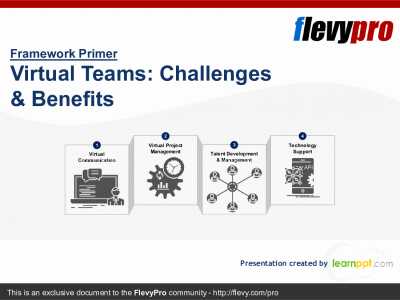
While organizations still need to travel to reach their physical offices, the rapid changes in the world is requiring businesses to form Virtual Teams. A Virtual Team refers to a [read more]
Do You Want to Implement Business Best Practices?
You can download in-depth presentations on Remote Work and 100s of management topics from the FlevyPro Library. FlevyPro is trusted and utilized by 1000s of management consultants and corporate executives.
For even more best practices available on Flevy, have a look at our top 100 lists:
These best practices are of the same as those leveraged by top-tier management consulting firms, like McKinsey, BCG, Bain, and Accenture. Improve the growth and efficiency of your organization by utilizing these best practice frameworks, templates, and tools. Most were developed by seasoned executives and consultants with over 20+ years of experience.
Readers of This Article Are Interested in These Resources
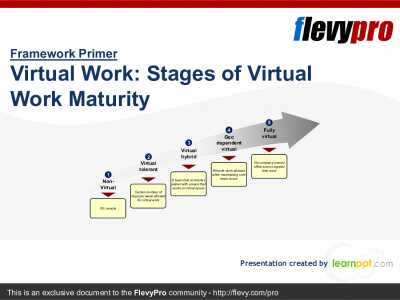
Virtual Work has become the trend of the future. In fact, 37% of the offices globally are working on hybrid-remote arrangements while 26% are 100% remote with people working in their own time. There is also about 25% of the companies that allow or tolerate virtual work with 12% that is 100% [read more]
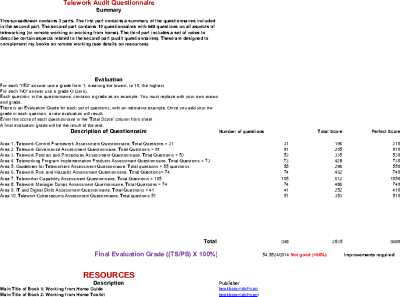
The purpose of this tool (spreadsheet) is to review, audit, assess and improve all teleworking aspects of companies, organizations and remote workers.
This spreadsheet contains 3 parts. The first part contains a summary of the questionnaires included in the second part. The second part [read more]
The global COVID-19 pandemic has forced organizations to rapidly adopt virtual work environments, making it the new norm. Digital Collaboration Platforms have been pivotal in the current scenario and have forever changed future work environment. Digital Collaboration Platforms is the new wave in [read more]
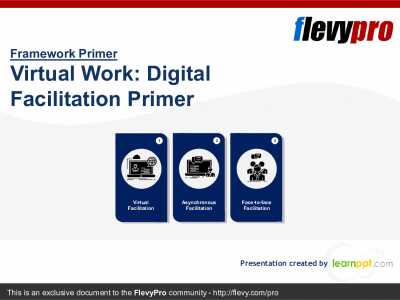
The global COVID-19 pandemic has forced organizations to rapidly adopt virtual work environments, making it the new norm. Digital Collaboration Platforms have been pivotal in the current scenario and have forever changed future work environment.
Digital Facilitation has its own set of [read more]
 You have a product to build, a few months of runway, and budget for two or three hires. Each of those hires will shape how your company works for years. Get one wrong and you lose salary, onboarding time, and weeks of progress you can’t get back.