Editor's Note: Take a look at our featured best practice, Strategic Planning: Process, Key Frameworks, and Tools (79-slide PowerPoint presentation). This document provides a holistic approach for undertaking strategic planning. While covering the traditional strategic planning approach, the document touches on adaptations that may be used in an unpredictable environment.
Contents:
1. Strategic Planning Overview
- Key questions and [read more]
The framework begins with defining the mission, outlining the organization’s purpose. Objectives translate this mission into specific, measurable targets. Strategies form the roadmap for achieving these objectives, while tactics are the concrete actions taken to implement the strategies. This holistic approach ensures that every organizational activity aligns with the mission, promoting efficiency and coherence.
MOST Analysis fosters a performance-oriented culture, linking everyday activities to strategic goals. By aligning operations with a clear mission and measurable objectives, it transforms theoretical goals into executable strategies, directly impacting the organization’s bottom line. This approach nurtures unity, enhances strategic implementation, and drives significant improvements in performance and morale.
Advantages of Using MOST Analysis
MOST Analysis stands out for its ability to create clear, actionable plans that align with an organization’s mission. This framework provides several benefits:
Establishes a business plan with clear mission, objectives, strategies, and tactics.
Aligns tactics and strategies with overarching goals, enhancing resource efficiency.
Mitigates conflicts arising from differing perspectives.
Facilitates performance assessment and strategic evaluation.
Breaks down communication barriers, fostering team cohesion.
Offers a robust guide for Decision making, reducing uncertainties.
Improves productivity by directing focus toward impactful objectives.
Enables tracking progress against benchmarks, allowing for performance adjustments.
MOST Analysis can be leveraged across a diverse array of applications:
Organizational Alignment: Identifies and addresses misalignment between mission, objectives, strategies, and tactics.
Strategic Planning: Utilized across various phases in different sectors.
Career Planning: Analyzes mission and objectives to select appropriate strategies and tactical plans.
Periodic Evaluation: Assists in mission and objective evaluations and course corrections.
Functional Application: Valuable in sales, Marketing, Human Capital Management, and process optimization.
Operational Optimization: Identifies inefficiencies and allows for targeted improvements.
Change Management: Manages change by setting clear objectives and strategies.
Marketing Strategy: Formulates strategies aligning with organizational objectives.
HR Alignment: Aligns HR strategies with business goals.
Product Development: Guides new product alignment with the mission.
Financial Planning: Aligns budget allocations with strategic priorities.
Risk Prioritization: Identifies and prioritizes risks based on their potential impact.
The framework is structured around 4 key components. Each component plays a vital role in guiding the organization toward its strategic goals.
Mission
Objectives
Strategy
Tactics
With its structured methodology, MOST Analysis not only addresses immediate challenges but also positions organizations for long-term success, ensuring they remain agile and responsive in a dynamic business environment.
Let’s delve deeper into the first two elements of MOST Analysis for now.
Mission
The mission is the cornerstone of MOST Analysis. It defines the organization’s core purpose and long-term vision, providing a consistent direction for all activities. A well-crafted mission statement, like Google’s “to organize the world’s information and make it universally accessible and useful,” serves as a strategic compass, guiding Decision making and aligning all efforts with the organization’s overarching goals. The mission remains stable over time, ensuring long-term focus and strategic alignment even as specific objectives and strategies evolve.
Objectives
Objectives translate the mission into tangible, time-bound targets. They provide a clear roadmap for what needs to be achieved, enabling effective resource allocation and performance tracking. Objectives are specific, measurable, achievable, relevant, and time-bound (SMART), allowing for precise tracking and review of progress.
Tesla’s objective to “accelerate the world’s transition to sustainable energy” exemplifies how specific goals drive strategic actions, from product development to marketing strategies, ensuring alignment with the broader mission.
You can download in-depth presentations on this and hundreds of similar business frameworks from the FlevyPro Library. FlevyPro is trusted and utilized by 1000s of management consultants and corporate executives.
For even more best practices available on Flevy, have a look at our top 100 lists:
This 77-slide PowerPoint presentation fully illustrates a comprehensive process for the formation of a Strategic Business Plan. It is intended to provide a compendium of substantive input based upon consulting market and management coaching experience and proven techniques generated from currently [read more]
Readers of This Article Are Interested in These Resources
This document outlines a 3-phase framework for conducting robust Strategic Analysis, based on a paper published by A. E. Boardman and A. R. Vining. The framework describes the major elements of a strategic analysis, and consists of a logically-sequenced, coherent skeleton of a comprehensive [read more]
This is a collection of major strategic analysis models into one practical toolkit (in excel format), including:
- Industry analysis
- Competitive analysis
- Porter's five forces model
- Strategic group map
- GE matrix
- Market analysis
- Environmental analysis
- SWOT analysis
- TOWS [read more]
Curated by former McKinsey Consultants
Are you looking to elevate your business strategy and take your company to the next level? Do you want to gain a competitive edge in your industry and drive growth? Look no further than our Strategy Consulting Toolkit.
Our toolkit is a comprehensive [read more]
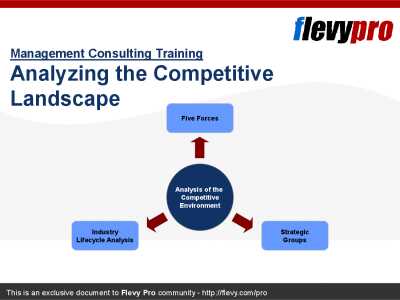
It goes without saying that understanding the competitive landscape is crucial to succeeding in the market.
This presentation discusses several frameworks to understand and analyze the competitive environment--and ultimately develop a sustainable competitive advantage.
This presentation will [read more]