Editor's Note: Take a look at our featured best practice, Consulting AI Prompt Package Toolkit (846-slide PowerPoint presentation). Curated by McKinsey-trained Executives
The Complete Consulting AI Prompt Package – 800+ Slides & 100+ Prompts for Next-Level Consulting Productivity
Are you a consultant, advisor, or independent practitioner looking to unlock the full power of AI in consulting work? The Complete [read more]
* * * *
Most people’s first attempt at AI-assisted writing goes the same way: type a topic into a chat window, copy the output, hit publish. The result reads fine for about two paragraphs before it starts repeating itself in slightly different words, and somehow still manages to say nothing specific. That’s not a limitation of the technology — it’s a predictable outcome of skipping every step that makes writing good in the first place.
An AI content generator is excellent at the mechanical parts of writing: structuring an argument, maintaining consistent grammar, producing a clean first draft fast. It is not, on its own, a substitute for having something worth saying. The quality gap between forgettable AI content and genuinely useful articles comes entirely from what happens before and after the generation step.
Feed It Knowledge before You Ask for Words
Skipping straight to “write me a post about [topic]” guarantees a generic result, because the model has nothing to draw on except whatever it already knows in general — which is exactly what every other article on the same topic also contains. The fix is almost embarrassingly simple: do fifteen minutes of actual research first.
Pull up two or three competing articles and note specifically what’s missing or wrong in them. Dig up one real number, example, or opinion from your own experience that nobody else is including. Feed that into your prompt as context rather than letting an AI blog writer guess at specifics it doesn’t have. This single habit is responsible for more of the quality gap than any prompting trick — the model can only be as specific as the information you give it.
Draft the Skeleton before the Sentences
Asking for a full, polished post in one generation skips the stage where structural problems are cheapest to catch. Request an outline first: section headers, the single point each one needs to make, and where a concrete example belongs. Look at it the way an editor would before any paragraph gets written in full.
This catches the issues that are nearly invisible once they’re buried in prose — a section that just restates the intro, a missing practical takeaway, an argument that doesn’t actually build toward a conclusion. Fixing a six-bullet outline takes two minutes. Fixing the same problem in 900 finished words takes considerably longer, and most people don’t bother, which is why so much AI content reads like it’s circling the topic instead of making a point.
Build the Draft Piece by Piece
Generating an entire article in a single pass tends to produce a flatter, more repetitive result than building it section by section. Left to run long, most models settle into predictable rhythms and filler transitions — phrases like “in conclusion” or “it’s worth noting” that add length without adding anything.
Working through one section at a time, reviewing before moving to the next, keeps the piece tighter and lets you catch repetition while it’s still a quick fix. It also means each new section can be generated with full awareness of what already exists, so the final draft reads as one continuous piece of reasoning rather than several loosely connected chunks stapled together.
Rewrite until It Sounds Like You
This is the step that actually determines whether the final piece reads as AI output or as writing. Default AI phrasing has recognizable habits — short punchy sentences in a row, a tendency to explain things the reader already knows, a fondness for listing exactly three examples of everything. None of it is incorrect. It’s just nobody’s actual voice.
Read the draft aloud and rewrite anything that sounds like a press release. Delete sentences that just restate the one before them in different words. Insert the specific detail that only you could know — an actual number from your own work, a genuine opinion you’d defend if challenged. That layer of editing is what separates a blog post from an AI content generator’s raw output with a byline slapped on top.
Verify Anything That Resembles a Fact
Language models occasionally produce statistics, dates, or claims that sound entirely plausible and simply aren’t accurate. That’s a tolerable risk in a private draft and a real liability in something published under your name. Before anything goes live, check every specific number and every “research shows” claim against an actual source. Anything you can’t verify gets cut or softened into a general statement rather than left as a precise, unverifiable claim.
Skipping this step is how confidently wrong content ends up published — and it’s the single most damaging failure mode in this entire process.
The Sequence That Actually Works
Put together, the full process looks like this:
Research manually first and gather one specific detail competitors don’t have
Generate and revise an outline before any full paragraph gets written
Draft section by section, reviewing as each one comes in
Rewrite for voice — cut generic phrasing, add what only you would know
Verify every number, date, or claim before publishing
That sequence is the actual difference between how to write a blog post with AI that performs and one that quietly disappears into the pile of indistinguishable content search engines have learned to deprioritize.
What This Actually Produces
Done this way, the final piece doesn’t read like a machine wrote it, and it doesn’t read like someone spent six hours typing every word by hand either. It reads like someone who actually knows the subject used a tool to clear away the mechanical overhead, then spent the time they saved on the parts that require real judgment — the angle, the specific detail, the opinion worth defending.
That’s the actual value an AI content generator offers a serious writer: not a replacement for thinking, but room to do more of it. Get the division of labor right, and what comes out stops looking like “content” and starts looking like something a reader would actually choose to finish.
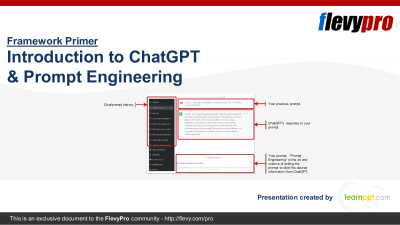
This is a primer to ChatGPT and includes foundational concepts to understanding the application, including GPT (Generative Pre-trained Transformer) and Prompt Engineering.
First, what is ChatGPT?
ChatGPT is a pre-trained language generation model developed by OpenAI. It uses deep learning [read more]
Do You Want to Implement Business Best Practices?
You can download in-depth presentations on Prompt Engineering and 100s of management topics from the FlevyPro Library. FlevyPro is trusted and utilized by 1000s of management consultants and corporate executives.
For even more best practices available on Flevy, have a look at our top 100 lists:
These best practices are of the same as those leveraged by top-tier management consulting firms, like McKinsey, BCG, Bain, and Accenture. Improve the growth and efficiency of your organization by utilizing these best practice frameworks, templates, and tools. Most were developed by seasoned executives and consultants with over 20+ years of experience.
Readers of This Article Are Interested in These Resources
Everyone has heard of ChatGPT. Immediately after launch, it gained both fame and infamy, and grew to become the fastest growing application of all time. But, have you used it? And, more importantly, do you understand how to maximize its usage to derive the greatest value for your work or [read more]
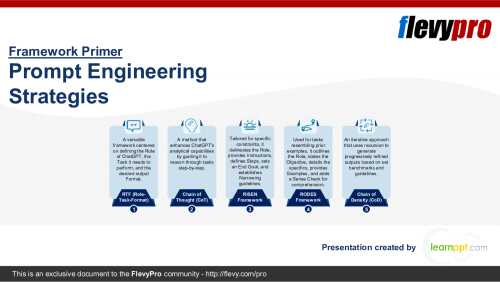
"Prompt Engineering" is the art and science of writing the prompt to elicit the desirable or useful results from the Artificial Intelligence (AI) tool you are using. In Prompt Engineering, the description of the task is embedded in the input, e.g., as a question instead of it being implicitly [read more]
Curated by McKinsey-trained Executives
Unlock the Future with Your Complete Prompt Engineering Business Toolkit
In the ever-advancing world of technology, Artificial Intelligence (AI) is your key to unlocking a bright future for your business. From understanding the foundations of AI to [read more]
AI Prompting Mastery Handbook – 46 Techniques, 5 Levels, 300+ Examples
Unlock the full power of AI with the AI Prompting Mastery Handbook - a step-by-step framework designed to help professionals, teams, and businesses master the art and science of prompting.
The results you get from any AI [read more]
 Most people’s first attempt at AI-assisted writing goes the same way: type a topic into a chat window, copy the output, hit publish. The result reads fine for about two paragraphs before it starts repeating itself in slightly different words, and somehow still manages to say nothing specific. That’s not a limitation of the technology — it’s a predictable outcome of skipping every step that makes writing good in the first place.