Editor's Note: Take a look at our featured best practice, Pricing Strategy (38-slide PowerPoint presentation). Pricing Strategy is a core pillar of Marketing and Product Strategy. It is 1 of the 4 Ps of Marketing (also known as the Marketing Mix - Product, Price, Placement, and Promotion). As such, knowing how to properly price your product is extremely important to the commercial success and viability of [read more]
* * * *
 eLearning courses are now becoming popular. People are not only using them but also creating them. Are you also new to the circle of developing your eLearning courses? Then, you must research how to price your course appropriately. What costs to consider and what to balance should be a topic of discussion with your team.
Pricing them too high would not convince learners to invest in the course, and a low price would not be beneficial enough to earn revenue. What is the way out?
We have you covered! Here is the article you need to understand the pricing model for eLearning courses.
How to Price Your eLearning course: Key Considerations
For contemporary associations, pricing eLearning programs is a significant challenge. There are many ways to approach this, from pricing individual courses to how the total price is organized.
Since membership growth through retention and recruiting is the long-term objective and education is the short-term strategy, it is especially crucial. To set pricing, you’ll need to go further into your courses’ costs and perceived value if you’re just getting started.
In any case, you need to follow the following few considerations to decide the price. Let us see what those are.
Volume and Seat Time
The length of the course and the total number of course components are two crucial factors that affect how much it costs to construct an eLearning project. Basic training can be delivered using short, straightforward, text-only courses, whereas advanced training demands a little more.
While the former is quite simple, the latter calls for integrating a number of complicated course components, including interactivities, videos, evaluations, surveys, etc., to help students retain their knowledge. Therefore, it is quicker and easier to create shorter, simpler courses than longer programs.
LMS Costs
While choosing an LMS like Adobe Connect, have you considered, for example, how Adobe Connect costs were decided? How will it affect your course’s cost?
Consider the cost of your LMS, how it charges, and the time spent interacting with the LMS and marketing your course. You should also consider the fee of LMS administrators and any other administrative costs included in your course’s development.
You want to maintain these costs because they will improve your course’s quality. For example, SMEs will ensure quality content, and marketers will take the course to the right audience. Thus you have to analyze how much you can spend on them and how you will be able to incorporate it into your charges.
Development Model
You have two options for constructing your eLearning project: in-house or by outsourcing the work to a qualified partner. Depending on the model you select, eLearning will have a different cost.
In-house development is frequently more expensive; you will need to include in operating expenses the cost of purchasing cutting-edge gear and the cost of retraining current employees for development.
Economies of scale, pooled resources, and tried-and-true procedures can all be used by outsourced partners to build efficiency and reduce costs.
Perceived Value
Last but not least, consider how much the association’s members are willing to spend on a course. The following courses may have a lower perceived value:
- Less thorough or more general.
- Extremely constrained or not applicable to many members in any other way.
- Not supported by domain knowledge.
- Simple replacement using free or less expensive options.
You can conduct a focus group, survey members, or even look at how other associations charge for courses with comparable difficulty and thoroughness to learn more about this. The trick is to consider what your members value and are interested in. How does that fit into your courses?
Conclusion
Pricing is a very important part of the development process. You want to give it a thorough thought, discuss it with your team, spend some time reflecting on it, and then come to a final decision. This article will help you come to a comprehensive cost.
47-slide PowerPoint presentation
There are 3 common approaches to pricing: Cost-based Pricing, Competitive Pricing, and Value-based Pricing.
Value-based Pricing offers numerous distinct advantages over the other 2 pricing methodologies. It is particularly suitable for situations where you are entering a new market, offering a
[read more]
Do You Want to Implement Business Best Practices?
You can download in-depth presentations on Pricing Strategy and 100s of management topics from the FlevyPro Library. FlevyPro is trusted and utilized by 1000s of management consultants and corporate executives.
For even more best practices available on Flevy, have a look at our top 100 lists:
These best practices are of the same as those leveraged by top-tier management consulting firms, like McKinsey, BCG, Bain, and Accenture. Improve the growth and efficiency of your organization by utilizing these best practice frameworks, templates, and tools. Most were developed by seasoned executives and consultants with over 20+ years of experience.
Readers of This Article Are Interested in These Resources
27-slide PowerPoint presentation
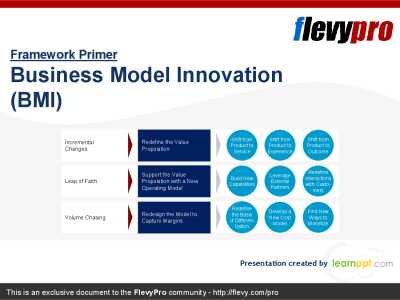
As core markets become saturated with new entrants and products, we find it more and more difficult to grow the core. We find traditional approaches that have successfully driven growth historically are also reaching points of diminishing returns.
Business Model Innovation (BMI) is a powerful,
[read more]
56-slide PowerPoint presentation
Pricing products and services is one of the most complex and overlooked elements of a strategy. This document provides a guide and framework to help build better understanding of different strategies and tactics available.
Areas covered include:
Why is pricing important?
Pricing Strategy
[read more]
133-slide PowerPoint presentation
This is a presentation used for conducting a pricing workshop for your organization or a client's. It covers, among others, the following:
- Pricing framework & Implementation
- OEM pricing
- Distributor pricing
- New product pricing
- Bundle pricing
The presentation has 130 slides.
See
[read more]
63-slide PowerPoint presentation
This toolkit is focused on the point at which we actually ask the customer for a price increase. None of the strategic value of a pricing recommendation matters unless we take action with the customer. There are several tools and approaches that could make the increase more successful.
This
[read more]