 Raising a funding round requires a company to open its internal records to prospective investors, often under significant time pressure. Financial statements, cap tables, contracts, intellectual property assignments, and other sensitive documents may need to be reviewed simultaneously by multiple parties. At that stage, email threads and shared folders quickly become difficult to manage, particularly when investors request the same documents in different formats or when multiple versions of a spreadsheet begin circulating.
A virtual data room for startups addresses this challenge by providing investors with controlled, trackable access to a centralized set of documents. Instead of repeatedly sending files or manually tracking who has received which version, founders can manage access from a single environment while maintaining greater control over sensitive information.
This becomes especially important during fundraising because organization and transparency are among the first qualities investors can assess. A well-structured data room demonstrates this before a formal meeting takes place, giving investors an early indication of how systematically the company manages its business and documentation.
What a Virtual Data Room Actually Does for a Startup
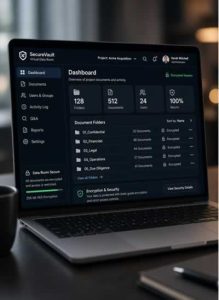
A virtual data room (VDR) is a secure, permission-based online repository designed for sharing sensitive documents with external parties, including investors, acquirers, and auditors. While it may resemble conventional cloud storage, a VDR typically provides three capabilities that are particularly important during fundraising:
- Granular permissions. Founders can determine which users can access specific folders and whether they can view or download documents.
- Activity tracking. Detailed logs record which documents users access and when, providing greater visibility into engagement.
- Integrated Q&A. Investor questions can be organized and directed to the appropriate team member, rather than being scattered across multiple email threads.
For an early-stage company, a data room will generally contain the documents investors need to evaluate the business and its legal and financial position. These may include the cap table and previous financing documents, intellectual property assignments, employment agreements, material customer contracts, financial statements, and the current term sheet draft.
Importantly, a startup does not necessarily need the complexity associated with large enterprise transactions. A typical early-stage data room may contain only a few hundred files rather than the tens of thousands involved in major M&A transactions. Nevertheless, the same principles of access control and document management still apply. A leaked term sheet, an outdated financial statement, or premature disclosure of cap table information can complicate negotiations, even at an early stage.
In practice, founders often discover the full extent of their documentation only when they begin preparing for their first external review. Organizing these materials in advance therefore does more than simplify file sharing; it creates a structured foundation for the diligence process that follows.
Why Fundraising Rounds Depend on Data Room Discipline
Fundraising involves multiple conversations taking place in parallel. Several investors may review the same materials simultaneously, while each progresses through its own internal evaluation process. A structured data room fundraising workflow helps maintain consistency throughout the process by ensuring investors have access to the same, up-to-date versions of key documents.
It also gives founders greater visibility into investor engagement. Rather than relying on email responses or informal follow-ups, founders can distinguish between investors who have actively reviewed the materials and those who have not yet engaged with the room.
Just as importantly, this structure helps protect the company’s negotiating position. When updated financials or other materials become available, the latest version can be made accessible through the centralized document set rather than distributed separately to different investors. This reduces the risk of inconsistent information circulating among prospective participants.
A well-managed data room for investors also creates a more consistent experience throughout the fundraising process. Investors can access the same core materials, while founders retain control over permissions and updates. As a result, the process becomes easier to manage as the number of interested parties increases.
The same principle applies to financing documentation. The National Venture Capital Association periodically updates its model legal documents, reflecting the broader value of standardized and well-organized financing paperwork in reducing unnecessary friction during negotiations.
For founders preparing for their first institutional round, it can therefore be useful to begin by comparing different data room options for startups. The platform selected at the seed stage can establish conventions for permissions, document organization, and naming that can carry over into subsequent financing rounds without requiring the company to rebuild its system from scratch.
Due Diligence Is Where a Data Room Earns Its Keep
The value of a data room becomes particularly clear during due diligence. At this stage, investors typically move beyond high-level fundraising materials and begin examining the documentation that supports the company’s financial, legal, commercial, and intellectual property claims.
That process often involves reviewing cap table history, prior financing terms, intellectual property ownership, material contracts, and other corporate records. Depending on the fundraising structure, it may also involve documentation associated with applicable securities-law exemptions and disclosures. The SEC’s guidance on capital-raising pathways for startups underscores the importance of understanding the documentation and compliance requirements associated with different approaches to raising capital.
A well-organized data room can make these requests substantially easier to manage. Organizing documents by workstream, such as legal, financial, intellectual property, and commercial, allows founders to quickly locate and provide relevant materials, rather than searching across disconnected folders and email attachments.
Moreover, the data room creates an additional layer of documentation through its activity records. A timestamped history of document access can show what individual investors reviewed and when. If questions about disclosures or document access arise after the transaction, that record can provide useful context.
For a company completing its first priced round, establishing this type of documentation and access infrastructure can also have benefits beyond the immediate transaction. The same organized records may later support subsequent fundraising, an acquisition process, an audit, or another form of external review.
Choosing the Right Data Room Vendor
Not every data room vendor is designed for the needs of an early-stage company. Enterprise systems built for large-scale M&A transactions may offer extensive functionality, but their pricing and complexity can exceed what a seed-stage startup actually requires.
Before selecting a provider, founders should consider several practical criteria:
- Permission granularity. Can access be restricted to specific folders or documents for individual investors without limiting access for everyone else?
- Activity tracking. Does the platform provide sufficiently detailed records of document views and user activity?
- Setup time. Can founders configure and maintain the room independently, or does routine administration require vendor assistance?
- Scalable pricing. Does the pricing model remain reasonable for a few hundred documents and a relatively small number of investors?
The best data room for startups is not necessarily the platform with the largest feature set. Instead, founders should consider how well a provider’s security controls, usability, pricing, and administrative features align with the company’s actual fundraising requirements.
A platform that can be configured within an afternoon while still providing appropriate permissions and audit capabilities may be more practical than an enterprise system designed for a transaction several orders of magnitude larger. Conversely, choosing a platform with insufficient access controls simply because it is inexpensive can create unnecessary risks later in the fundraising process.
Ultimately, a data room serves a practical purpose beyond document storage. It provides a structured environment for fundraising, gives investors reliable access to essential information, and helps founders maintain control as the number of stakeholders involved in the process grows.