Editor's Note: Take a look at our featured best practice, HR Strategy: Job Leveling (26-slide PowerPoint presentation). Job Leveling is a disciplined approach to gauge the value of work for individual positions across the organization. It entails ascertaining the nature of work done by each position, authority levels, and the effect of each job on business results.
Jobs that are configured inadequately bread [read more]
* * * *
The majority of staff augmentation projects are unsuccessful and go under the radar. The contractors ship, the deadline passes and a year later no one on the payroll knows how the billing service works.
The outside engineers are typically good. The problem begins with the placement of them in the org. The following is a working example of how to determine what to keep in-house, what to extend and how to hire external engineers without losing ownership.
Why Staff Augmentation Is an Org Design Decision, Not a Hiring Shortcut
Reactive augmentation is used to fill a hole. A senior engineer leaves, a deadline passes and three people from the vendor arrive on Monday. Structural augmentation is planned: leadership determines in advance which teams have the capacity to be flexible and moulds those teams to take up the flexibility.
Conway’s Law helps to answer the question of why. Systems reflect the structure of communication of the people who create them, and external engineers attach themselves to a team and create their own cluster. They end up with their own boundaries, their own handoffs, and more than their fair share of defects in their code.
Imagine that a platform team hires four contractors prior to a launch. They develop the billing service, launch ships and contracts are over. A pricing change is stalled for weeks after six months, due to lack of understanding of the code within. The actual question of design is which parts of the org require stability and which parts require elasticity?
Deciding What Stays Core and What Can Be Extended
A functional split ensures that the architecture, product-critical domain logic, security decisions and engineering leadership remain in-house. Well-bounded services, test automation, platform migration and specialized stack work are good choices for extension.
The call is made more pointed by two criteria: firstly, the duration of the knowledge’s relevance and secondly, the extent to which it differentiates the business. Differentiating and lasting knowledge remains internal. In a situation where the business is more thin on the ground and the work is more easily defined, a fintech may choose to maintain its ledger team entirely in-house while adding to its customer-facing mobile team.
It makes sense to “augment the boring work”, but it can often have the opposite effect. Legacy maintenance is one of the most unknown forms of knowledge in a company and if it is passed on to a rotating external bench, knowledge is not written down.
The ratio is important too. After about 30-40% of the external engineers have passed, quality and ownership begin to deteriorate. Consider that number a trend that you observed: some teams hit the wall sooner.
Integration Models That Actually Work Inside Teams
There are 3 models which are suitable for most situations. Embedded engineers are part of in-house teams and work in teams that have a long lifespan. A pod is an external group that is self-contained and has an internal tech lead, and works on bounded initiatives, such as a database migration. The capability-based model is where specialists (typically in quality assurance (QA) or DevOps) are spread throughout teams where that skill is in short supply throughout the organization.
In either case, the operation fundamentals determine the results. External engineers participate in the same rituals, review code to the same quality, utilize the same documentation and tools, and are involved in incident response. If they’re not involved in the design process, the teams that leave them out make them into a second tier of contributors who have to implement the decisions that they weren’t part of. And quality suffers at exactly those seams.
Next is the hidden tax. Real-time internal senior review and onboarding of external engineers is done in a real share of the week. Make sure to budget that time out, or it’s out of the roadmap time that no one wanted to waste.
Sourcing for Specific Capabilities: Stack Depth, QA Maturity, and Location
The org design should reveal the capability gap, which should be addressed through sourcing. The idea of asking a vendor for “any senior engineer” is a violation of the model, as the idea was to have specific skills in specific teams.
Java is a good test case: a vendor that lists it among 20 technologies will rarely have engineers who can debug garbage collection pauses or untangle a Spring Boot 2-to-3 migration. When comparing the top Java development companies, look past client logos and ask who on their bench has shipped that kind of work.
QA should be a decision in its own right. While the range of vendors is vast and the level of automation and domain knowledge is also quite different, testing capacity is typically the first function teams add to and the last they carefully consider.
Time zone overlap affects review turnaround and incident response more than hourly rate does. For US teams working in regulated domains or needing tight overlap on release days, regional QA partners are often worth the premium. Engineering leaders in the Southwest, for instance, can start by comparing the top software testing companies in New Mexico on automation maturity and domain experience before widening the search.
No matter what it is, the vetting remains solid: code samples in your stack, a paid trial task, and a definite answer on how the vendor deals with engineer rotation.
Keeping Knowledge, Quality, and Accountability Inside the Org
The risk in the long run is that knowledge will be lost when the contract expires. Architecture decision records document the “how” and the “why” of the system’s design, documentation is part of the definition of done, pairing internal and external engineers spreads context before anyone rolls off.
Even if most of the code for a service is written by external engineers, there should be an internal owner for each of the services. That owner is responsible for the design changes and incidents.
Measure the model, not the people. The following metrics can be used to determine if the structure holds: review cycle time, escaped defects by team, time to first meaningful pull request, and attrition within the external layer. If one team in the augmented team is having a lot of defects, it is more likely to be a seam issue than an engineer issue.
Know how to get out of the situation before it begins. For each, explain what it means to roll down and/or convert to full-time, and who will take on the work.
Conclusion
If leaders carefully plan the internal/external capacity interfaces as they do the service interfaces in their architecture, augmentation will hold up. A good first step is to identify each service and assign an internal owner and to work out the percentage of the external share for each team. The next incident that’s hard to diagnose is likely to be in the making where the ratio is the highest and ownership is the lowest.
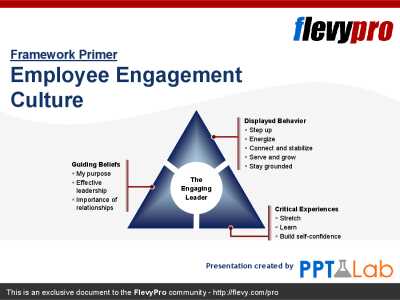
Improving Employee Engagement is a priority in most Talent and HR Strategies. This presentation provides a 5-step approach to building a culture of Employee Engagement. This processed was developed by Aon Hewitt based on the Aon Hewitt Top Companies for Leaders study.
Best practices from the [read more]
Do You Want to Implement Business Best Practices?
You can download in-depth presentations on Employee Management and 100s of management topics from the FlevyPro Library. FlevyPro is trusted and utilized by 1000s of management consultants and corporate executives.
For even more best practices available on Flevy, have a look at our top 100 lists:
These best practices are of the same as those leveraged by top-tier management consulting firms, like McKinsey, BCG, Bain, and Accenture. Improve the growth and efficiency of your organization by utilizing these best practice frameworks, templates, and tools. Most were developed by seasoned executives and consultants with over 20+ years of experience.
Readers of This Article Are Interested in These Resources
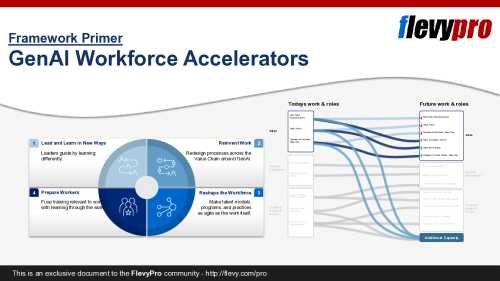
Generative AI (GenAI) is the most significant shift to work since the industrial revolution--and the Trifecta of Opportunities it unlocks (the economic, business, and people upsides) is the strategic objective. This presentation moves from the opportunity to the path: how leaders capture [read more]
In the face of the COVID-19 pandemic, Strategic Workforce Planning has emerged as the key to organizations effectively managing and adapting to unforeseen disruptions.
HR leaders excel in conducting Workforce Planning at the business unit level, but face challenges when it comes to incorporating [read more]
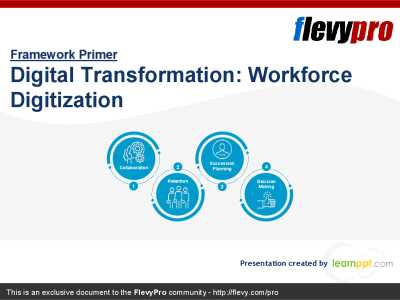
The approaching Age of Automation, together with the impending penetration of digital technology into the labor force, threatens to destabilize crucial aspects of how employees work by. It undermines the stability companies depend on to be agile.
Executives can re-solidify their companies even [read more]
This guide is a basic introduction to performance management, the process, setting objectives, providing feedback, the performance discussion between manager and employee. It is geared to small and mid-sized companies who want to provide a process that is clear and easy to use for managers.
This [read more]
 The majority of staff augmentation projects are unsuccessful and go under the radar. The contractors ship, the deadline passes and a year later no one on the payroll knows how the billing service works.