Editor's Note: Take a look at our featured best practice, Social Media Management (34-slide PowerPoint presentation). Social networks, blogs, web forums, and the like have influenced and disrupted almost every facet of life around the world. Smartphones and tablets have made it easy and cheap for users to create new content and share it with their contacts, as well as to review and comment on [read more]
* * * *
Video has become a standard part of digital communication, but many organizations still struggle to budget for it. Traditional production can be expensive and slow. AI video tools can reduce production time, but they do not remove the need for planning, review, distribution, and measurement.
For business teams, the useful question is not simply “How much does an AI video cost?” A better question is: “How should we allocate budget across production, testing, approval, and paid distribution so video becomes a repeatable operating capability?”
This article outlines a practical budget framework for AI video across organic and paid social.
Separate Production Cost from Media Spend
A common budgeting mistake is combining video production and paid distribution into one line item. These two costs behave differently.
Production cost includes the work required to create the asset:
Strategy and brief development
Script writing
Creative direction
AI generation or editing
Captions and localization
Review and approval
Exporting different versions
Media spend is the budget used to distribute or promote the asset on paid channels. A team may spend very little on production and a large amount on ads, or the opposite.
Separating these costs helps managers make better decisions. If a campaign underperforms, the problem may be the creative, the targeting, the offer, or the media plan. Combining everything into one number makes diagnosis harder.
Budget by Approved Video, Not Raw Generation
AI tools can generate many drafts quickly. However, not every generated video becomes useful. Some drafts may fail because the message is unclear, the visuals are not relevant, or the output does not fit the brand.
For planning, the key unit should be the approved video. This is the asset that passes review and is ready to publish.
A basic cost model can include:
Number of concepts created
Number of drafts generated
Number of videos approved
Number of channel-specific versions exported
Internal review time
Tool or credit cost
External publishing or placement cost
This gives a more realistic view of efficiency. A workflow that creates fewer drafts but more approved assets may be better than one that generates hundreds of unused files.
Use Organic Channels as a Testing Layer
Organic social can serve as a low-risk testing environment before larger paid spend. Teams can publish several variations and observe early signals such as watch time, saves, comments, click behavior, and audience fit.
This does not mean every organic result predicts paid performance. Paid campaigns have different targeting and delivery dynamics. Still, organic testing can reveal whether the message is understandable, whether the hook is strong, and whether the visual format is suitable.
A practical workflow might look like this:
Create several low-cost video variations.
Publish organically across suitable channels.
Identify which messages receive stronger engagement.
Refine the strongest version.
Allocate paid budget to the most promising creative.
AI video tools can support this by making it easier to create variations without starting from scratch. A video editor by Clideo can also help teams quickly refine and prepare different versions for social channels. For example, teams can use an AI ad video workflow to structure product benefits, hooks, captions, and calls to action for different social platforms.
Match Production Quality to the Business Objective
Not every video needs the same level of production. A board presentation, a brand launch video, a paid social test, and a quick product update all require different standards.
A practical budget framework can divide assets into three tiers:
Tier 1: Strategic Videos
These are high-visibility assets, such as launch videos, investor materials, product explainers, or sales enablement videos. They justify more planning, senior review, and higher production quality.
Tier 2: Campaign Videos
These support specific marketing initiatives. They need clear messaging and consistent branding, but they can be produced in repeatable templates.
Tier 3: Testing Videos
These are used to explore hooks, angles, formats, or audiences. They should be inexpensive and fast to produce. The goal is learning, not perfection.
This tiered approach prevents teams from overspending on every asset while still protecting important brand moments.
Include Review Time in the Budget
Many teams underestimate review time. Even with AI-generated drafts, people still need to check product claims, brand consistency, captions, and channel fit.
Review cost may include time from marketing, product, legal, compliance, or leadership. If the workflow lacks clear ownership, review can become the hidden cost that slows production.
A simple way to manage this is to define approval rules by risk level:
Low-risk social tests: marketing approval only
Product education videos: marketing and product approval
Claims-based paid ads: marketing, product, and legal approval
This keeps routine work moving while giving sensitive content the review it needs.
Plan for Versioning and Reuse
A video budget should not end with one export. Most teams need several versions of the same core asset:
Vertical short-form version
Landscape website version
Captioned silent-play version
Short paid ad version
Longer educational version
Localized version for another market
The ability to reuse scripts, prompts, captions, and source assets can improve the return on each production cycle. This is where AI workflows are especially useful. A team can turn one approved concept into several channel-specific versions while keeping the core message consistent.
Track Business Outcomes
Budgeting improves when teams connect video production to outcomes. Depending on the use case, useful metrics may include:
Cost per approved video
Cost per landing page visit
Cost per qualified lead
Time saved compared with traditional production
Organic engagement rate
Paid creative testing results
Sales or onboarding impact
The right metric depends on the objective. A product education video should not be judged only by likes. A paid ad should not be judged only by production cost. Each asset should have a clear business role.
Conclusion
AI video can reduce production friction, but it still needs disciplined budget planning. Business teams should separate production cost from media spend, budget by approved asset, use organic channels for early testing, match quality to the business objective, include review time, and plan for versioning.
With this structure, AI video becomes more than a low-cost content experiment. It becomes a repeatable operating capability that supports marketing, sales, product education, and internal communication.
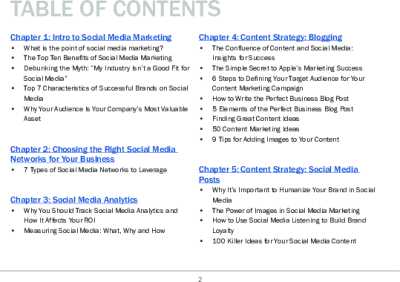
This Guide to Social Media Marketing is designed to help you understand what it takes to create an effective social media campaign. Whether you're starting from scratch or looking to improve your existing campaign, this guide will provide you with the knowledge and tools you need to attract [read more]
Do You Want to Implement Business Best Practices?
You can download in-depth presentations on Social Media Strategy and 100s of management topics from the FlevyPro Library. FlevyPro is trusted and utilized by 1000s of management consultants and corporate executives.
For even more best practices available on Flevy, have a look at our top 100 lists:
These best practices are of the same as those leveraged by top-tier management consulting firms, like McKinsey, BCG, Bain, and Accenture. Improve the growth and efficiency of your organization by utilizing these best practice frameworks, templates, and tools. Most were developed by seasoned executives and consultants with over 20+ years of experience.
Readers of This Article Are Interested in These Resources
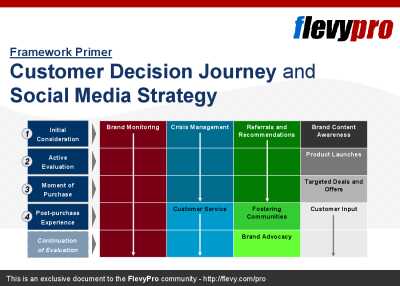
The Customer Decision Journey is a framework developed by McKinsey & Co. The management consulting firm developed this framework based on research of the purchase decisions of almost 20,000 consumers across 5 industries and 3 continents.
The Customer Decision Journey captures the changing [read more]
Course Summary: In this training course, we will walk through all of the key stages involved in putting together an effective social media campaign.
Clearly the best way to demonstrate these principles is to show them in action by using a proven, real world example. Throughout this course we [read more]
This guide has been specifically designed as an all-in-one resource to help start-ups and small businesses looking for a cost-effective way to raise their profile, promote goods and services and grow their business, using the power of social media.
The really good news is that being effective [read more]
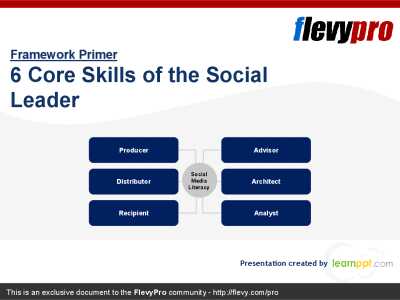
Organizational Social Media literacy is fast becoming a source of Competitive Advantage. As individuals increasingly embrace social technologies, many leaders fear the risks of unbridled information. They see difficulties meshing the open dynamics of Social Media with existing communication [read more]
 Video has become a standard part of digital communication, but many organizations still struggle to budget for it. Traditional production can be expensive and slow. AI video tools can reduce production time, but they do not remove the need for planning, review, distribution, and measurement.