Editor's Note: Take a look at our featured best practice, Digital Transformation Strategy (145-slide PowerPoint presentation). Digital Transformation is being embraced by organizations across most industries, as the role of technology shifts from being a business enabler to a business driver. This has only been accelerated by the COVID-19 global pandemic. Thus, to remain competitive and outcompete in today's fast paced, [read more]
* * * *
Traditional cost programs still dominate most planning calendars. Leadership freezes hiring, trims travel and applies a uniform percentage cut across functions. The P&L improves for a quarter or two. Complexity then reasserts itself. Hidden work returns, managers rebuild headcount under new labels, and the baseline that was supposed to have been reset looks familiar again. Shareholders notice the pattern. They are no longer satisfied with a one-cycle reduction that quietly reverses.
Those programs fail for structural reasons. They treat symptoms. A budget cut lowers spending without removing the redundant process, the overlapping committee, or the product variant that created the cost. They ignore strategy. Last year’s allocation is treated as legitimate, so high-value work is starved on the same percentage as low-value work. They cut uniformly, which feels fair and is operationally blunt. They neglect reinvestment, stopping at expense reduction instead of freeing capacity for digital platforms, Artificial Intelligence (AI), or growth. Over time, new products, governance layers, and regulatory tasks accumulate. Incremental budgeting never reaches that sediment. The result is a reactive cycle triggered by financial pressure and followed by tactical action, not by a redesign of how the enterprise creates value.
That is why the leadership conversation has shifted from Cost Optimization to Cost Transformation. Cost Optimization improves efficiency inside the current model. It renegotiates contracts, streamlines a process, and holds service levels steady. Cost Transformation asks a harder question: which activities should exist at all, and what is the best way to perform the ones that should? It redesigns the operating model, governance, structure, and cost base so that resources move toward work that advances strategy. Four pressures make that shift unavoidable. Economic uncertainty requires resilience and flexibility. AI and digital programs need capital that is currently locked in low-value activity. Complexity is slowing decisions and eroding productivity. Competition and changing customer expectations reward firms that can reallocate continuously rather than episodically.
Zero-Based Transformation (ZBT) Primer framework is the enterprise response to that requirement. In this model, nothing gets inherited from last year’s budget. Every cost, activity, and investment is justified by its contribution to strategic priorities and business outcomes. ZBT looks across strategy, the operating model, governance, structure, processes, technology, and ways of working. It is not a hunt for cuts, rather a method for identifying what creates value, how that work should be delivered, and what should be streamlined, redesigned, or stopped. Institutions applying the approach have unlocked 12 to 30% savings in directly controlled overhead while improving speed and clarity in daily execution. Those figures matter, but they are a consequence. The purpose is smarter spending: aligned with strategy, simple enough to execute, and durable enough that savings do not leak back.
The ZBT journey starts by defining enterprise value across functions. Leadership then convenes challenger workshops with one agenda: every line item in the expenditure and investment portfolio is examined. That scrutiny runs through 3 challenge lenses:
Strategy
Best Practices and Benchmark Gaps
Operating Effectiveness and Simplification
The first two lenses, however, decide what the enterprise should keep funding and how far current performance sits from a defensible standard. Those two conversations change the quality of every later design choice. The third lens asks how work actually flows, where fragmentation and blurred accountability have accumulated, and which committees, reports, and decision rights should be removed. Let’s discuss the first 2 lenses in detail, for now.
Lens 1: Strategy
ZBT is not a finance exercise dressed up as Business Transformation. The first lens tests every role, service, and expenditure against a single standard: does this advance the chosen strategic direction and the operating model that direction requires? Budgets do not force that choice on their own. They invite proportional trimming. The strategy lens forces explicit tradeoffs, because not every activity is equally valuable and some work actively contradicts the stated direction.
The practical effect is calibration. Team size, delivery speed, and service quality are set to what the organization actually intends to achieve, not to what it inherited. Capacity that supported a de-emphasized business is released. Capacity that supports the growth thesis is protected and, where the case is strong, increased. Leaders have to say which initiatives survive, which are redesigned, and which stop. That is uncomfortable. It is also the only way resource allocation becomes a strategy conversation instead of a negotiation among last year’s owners.
Without this lens, ZBT collapses into another round of tactical cutting. With it, the rest of the program has a north star. Activities are no longer defended as “necessary because they exist.” They are defended as necessary because they move the needle.
Lens 2: Best Practices and Benchmark Gaps
Through the second lens the organization measures itself against internal standards (prior performance and its own targets) and against external references (peers and demonstrated best practice). Transformation decisions then rest on evidence rather than on an arbitrary percentage.
The questions are pointed. Are costs to serve above the peer median? Do product changes take longer than they do at competitors? Affirmative answers are not moral failures. They show where process, technology, or service design lags, and they show where a catch-up investment would return more than another increment of local efficiency. Comparisons should run on concrete metrics: cost to serve, time to market, error rates, span of control, cycle time. Vague claims that “we are different” do not close a documented gap.
This lens also changes the politics of challenge. A function can no longer mark its own homework. External and internal reference points give the leadership team a shared fact base. That fact base is what allows the group to streamline a process, adopt a proven practice, or reallocate toward the area where the gap is largest, and the strategic payoff is highest.
Case Study
Consider a bank whose board has chosen to grow wealth management and to de-emphasize capital markets. Under incremental budgeting, both businesses would absorb a similar overhead cut, digital wealth platforms would compete for scraps with legacy trading infrastructure, and duplicative reporting would survive because each line “needs” it. Under the strategy lens, resources move toward scalable wealth platforms, and the support functions those platforms require. Legacy trading systems and parallel reporting that exist only to sustain the de-emphasized book are scaled back or stopped. Under the benchmark lens, the bank then tests whether its wealth onboarding cost, advisor support ratio, and time to launch a new digital feature sit inside a competitive range. Gaps that remain become redesign targets, not arguments for restoring the old budget. The outcome is not a smaller version of the previous bank. It is a cost base that matches the strategy the board already claimed to own.
FAQs
How is a challenge lens different from a normal budget review?
A normal review starts with last year’s number and negotiates variance. A challenge lens starts with strategy or evidence and asks whether the line item should exist, at what service level, and against what external standard.
Do the lenses apply only to overhead?
Overhead is often the cleanest place to begin because ownership is clearer. The same logic applies to any activity that consumes scarce capacity, including product variants, internal reporting, and enterprise services that sit between businesses.
What if a function is above the peer median for a regulated reason?
Then the gap is explained, not ignored. Regulation can justify a different cost to serve. It does not justify undocumented duplication or service levels that exceed the requirement.
Who should sit in the challenger workshop?
Cross-functional leaders, not a single function reviewing itself. The point is to expose departmental blind spots and to force a whole-enterprise view of value.
Can the firm use only the strategy lens and skip benchmarks?
It can, and it will underperform. Strategy without comparison leaves inefficient work intact if that work sounds aligned. Benchmarks keep the strategy honest.
Concluding Thoughts
Traditional programs fail because they assume the inherited portfolio is roughly right and only needs to be smaller. Cost Transformation rejects that assumption. ZBT gives leadership a practical way to act on the rejection: define value, then run every line through strategy and through evidence before simplification even begins. The cycle reinforces itself. A clearer strategy makes benchmark gaps meaningful. Closing those gaps frees capacity. Freed capacity is reinvested in the priorities the strategy named. Those priorities then become the standard for the next challenge, so last year’s allocation never again becomes next year’s entitlement. That is how cost management stops being a seasonal reaction and becomes a permanent discipline of value.
You can download in-depth presentations on this and hundreds of similar business frameworks from the FlevyPro Library. FlevyPro is trusted and utilized by 1000s of management consultants and corporate executives.
For even more best practices available on Flevy, have a look at our top 100 lists:
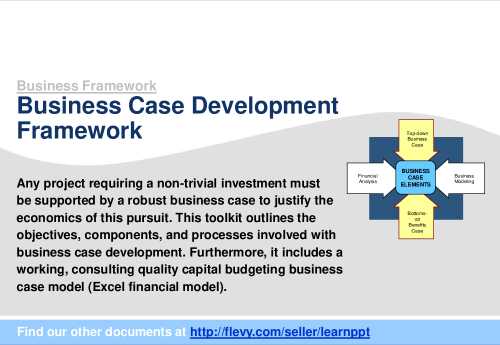
The Business Case is an instrumental tool in both justifying a project (requiring a capital budgeting decision), as well as measuring the project's success. The Business Case model typically takes the form of an Excel spreadsheet and quantifies the financial components of the project, [read more]
Readers of This Article Are Interested in These Resources
This is a very comprehensive document with over 400+ slides--covering 58 common management consulting frameworks and methodologies (listed below in alphabetical order). A detailed summary is provided for each business framework. The frameworks in this deck span across Corporate Strategy, [read more]
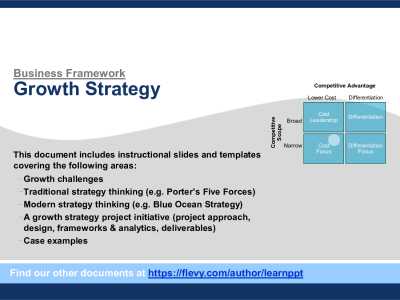
The reality is: all businesses face the challenge of achieving sustainable Growth. They need viable Growth Strategies.
So, what is Growth Strategy?
It is the organization's high-level Corporate Strategy Plan that outlines everything the organization needs to do to achieve its goals for [read more]
Recent McKinsey research surveyed a large set of global executives and suggests that many companies, these days, are in a nearly permanent state of organizational flux. A rise in efforts in Organizational Design is attributed to the accelerating pace of structural change generated by market [read more]
This comprehensive and user-friendly template is designed to help businesses efficiently manage their cash flow with accuracy and flexibility. Ideal for SMEs, the template provides tools to forecast, track, and analyze cash flow over a 13-week horizon.
Key Features:
Customizable Settings: [read more]
 Traditional cost programs still dominate most planning calendars.