Editor's Note: Take a look at our featured best practice, Business Continuity Plan (BCP) Template (20-page Word document). A Business Continuity Plan (BCP) is a plan to continue operations if a place of business is affected by different levels of disaster which can be localized short term disasters, to days long building wide problems, to a permanent loss of a building. Such a plan typically explains how the [read more]
* * * *
Flevy readers are accustomed to thinking in frameworks: risk registers, control matrices, business continuity plans, and the kind of structured thinking that turns an abstract threat into a manageable line item. Senior technology adoption rarely shows up in those documents, yet it belongs there. As the customer base, workforce, and caregiving networks of most organizations continue to age, the gap between how technology is designed and how older adults actually use it has become a measurable source of operational risk, not just a customer experience footnote.
This is not a niche demographic concern. Adults over 50 now represent a growing share of consumers, employees, and decision makers inside the organizations that Flevy’s audience advises and manages. When that population struggles to authenticate identity, complete digital transactions, or recognize fraudulent contact attempts, the downstream effects land squarely on the business: failed service delivery, data exposure, reputational damage, and in some cases, direct financial liability. Treating this as a UX afterthought rather than a continuity risk is itself a governance gap worth flagging in any enterprise risk assessment.
Organizations that serve or employ older populations, including healthcare providers, financial institutions, and home care networks, are increasingly building this risk into their planning documents. California Mobility’s compilation of 21 senior technology statistics is a useful starting point for teams that need current, sourced figures to anchor a risk assessment or a board briefing rather than relying on outdated assumptions about senior tech habits.
The Business Continuity Risk: Why Senior Tech Adoption Is No Longer Optional
Business continuity planning traditionally focuses on system outages, supply chain disruption, and cyber incidents. Senior technology adoption belongs in that same conversation because it directly affects an organization’s ability to maintain service continuity for a large and growing customer segment. Smartphone ownership among adults 50 and older reached 90 percent in 2025, up sharply from 55 percent in 2016, which means older customers are no longer opting out of digital channels, they are participating in them at scale, often without the support infrastructure to match. When an organization’s digital front door assumes a level of comfort or fluency that a meaningful share of its users do not have, the result is not just poor experience, it is service failure that can trigger complaints, regulatory scrutiny, or costly manual workarounds.
Generative AI tools compound this dynamic. Adoption of generative AI among older adults nearly doubled from 18 percent in 2024 to 30 percent in 2025, which means organizations deploying AI-driven chatbots, claims processing, or account verification tools are now interacting with a population that is adopting these tools faster than the guardrails around them are maturing. A continuity plan that does not account for this shift is planning against yesterday’s user base.
Compliance Gaps: Privacy, Data Security, and Regulatory Exposure
Privacy is the single largest friction point in senior technology adoption, and that friction has direct compliance implications. One-third of older adults cite data privacy concerns as the biggest barrier to adopting new technology, which signals that consent processes, data collection disclosures, and opt-in mechanisms are not landing as intended with this group. According to this article, trust, privacy, and data security concerns are cited by roughly half of older adults who remain hesitant to adopt new technologies, particularly AI-based tools. For organizations operating under privacy regulations that require demonstrable, informed consent, a population that distrusts or misunderstands the consent process represents a documentation and enforcement gap, not just a marketing challenge.
This gap widens further when technology is not designed with older users in mind. Three in five older adults, 60 percent, agree that technology generally lacks age-friendly design, which suggests that interface and disclosure choices many organizations treat as settled UX decisions are, for a large share of users, active barriers to informed participation. Compliance teams that audit consent flows without testing them against low-vision, low-literacy, or unfamiliar-interface conditions are likely missing a real exposure point.
Common Risk Drivers: Fraud, Digital Exclusion, and Organizational Liability
Fraud is the most quantifiable expression of this risk. Elder fraud losses reported to the FBI reached 4.885 billion dollars in 2024, from 147,127 complaints filed by people aged 60 and older. That figure represents real financial harm concentrated in a demographic that many organizations serve directly through banking, insurance, healthcare, and home services. When fraud occurs through a channel an organization built or maintains, questions about adequate warnings, verification design, and staff training follow quickly, and those questions can carry legal weight well beyond reputational damage.
Digital exclusion creates a parallel liability path. Older customers who cannot complete a required digital process may be forced into workarounds, delayed service, or reliance on third parties who introduce their own risk, including well-meaning family members who inadvertently create data handling problems. Each of these scenarios represents an accountability gap that a risk register should capture explicitly rather than absorb as routine customer friction.
Metric
Figure
Source
Older adults citing data privacy as top adoption barrier
33%
AARP, 2024
Elder fraud losses reported to FBI (2024)
$4.885 billion / 147,127 complaints
FBI IC3, 2024
Smartphone ownership among adults 50+
90% (up from 55% in 2016)
AARP, 2025
Generative AI adoption among older adults
30%, up from 18% in 2024
AARP, 2026
Older adults who feel tech lacks age-friendly design
60%
AARP, 2026
Proportionate Controls: Designing Age-Inclusive Technology and Support Systems
The response to this risk does not require reinventing an organization’s technology stack, it requires proportionate, documented controls layered onto what already exists. That starts with plain-language consent and disclosure processes tested against real older users rather than internal assumptions, paired with fraud-monitoring thresholds calibrated to the patterns most common in elder financial exploitation. Staff training on recognizing signs of digital confusion or coercion, alongside a clear escalation path when something looks off, closes a gap that many organizations currently leave to chance.
Equally important is building human-assisted alternatives into digital-first processes so that inability to navigate an app or portal does not become a service denial or a compliance failure. Organizations that document these controls, test them periodically, and revisit them as adoption patterns shift will find that senior technology inclusion is not a separate initiative from continuity and compliance planning, it is simply an update to frameworks these teams already maintain.
This Excel document provides a set of templates to capture data and analysis when conducting a Business Continuity Planning (BCP) and Disaster Recovery (DR) project for any size organization. These templates were originally developed for a large, international enterprise with locations in [read more]
Do You Want to Implement Business Best Practices?
You can download in-depth presentations on BCP and 100s of management topics from the FlevyPro Library. FlevyPro is trusted and utilized by 1000s of management consultants and corporate executives.
For even more best practices available on Flevy, have a look at our top 100 lists:
These best practices are of the same as those leveraged by top-tier management consulting firms, like McKinsey, BCG, Bain, and Accenture. Improve the growth and efficiency of your organization by utilizing these best practice frameworks, templates, and tools. Most were developed by seasoned executives and consultants with over 20+ years of experience.
Readers of This Article Are Interested in These Resources
The disruption COVID-19 caused has made businesses more aware of the importance of business continuity planning (BCP) for effective disruption-related preparation, response and recovery.
Although the term "business continuity" is often used as a synonym for IT Disaster recovery (DR), [read more]
A Business Continuity Risk Assessment (BCRA) is part of Business Continuity Management. A BCRA must be carried out to assess the organisation's vulnerability to threats and establish the organisation's overall risk profile. It demonstrates a qualitative methodology of a Threats & Vulnerability [read more]
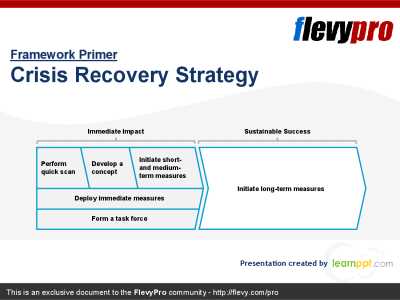
Many organizations are unable to successfully recover from a crisis and end up bankrupt. Organizations typically react to crises by adopting only short-term, operational measures.
To maintain a sustained Competitive Advantage and recover from the crisis stronger, we must tie short-term [read more]
Managing all the aspects of the business to ensure business continuity is referred to as Business Continuity Management. It means being prepared to deal with all forms of disruption of 'Business As Usual.' This could save your organization from potential damage. Damage in lost revenues, unnecessary [read more]
 Flevy readers are accustomed to thinking in frameworks: risk registers, control matrices, business continuity plans, and the kind of structured thinking that turns an abstract threat into a manageable line item. Senior technology adoption rarely shows up in those documents, yet it belongs there. As the customer base, workforce, and caregiving networks of most organizations continue to age, the gap between how technology is designed and how older adults actually use it has become a measurable source of operational risk, not just a customer experience footnote.