Editor's Note: Take a look at our featured best practice, Lean Manufacturing (167-slide PowerPoint presentation). [NOTE: Our Lean Manufacturing presentation has been trusted by an array of prestigious organizations, including industry leaders such as Apple, DHL, Cummins, Stryker, Avery Dennison, Volvo Cars, Baker Tilly, Viasat, Rubix, Techaerospace, Pacific Helmets, BBA, to name just a few.]
This [read more]
* * * *
Glass quality is not a single variable. It includes optical transmission, dimensional accuracy, surface integrity, mechanical strength, and the consistency with which those properties hold across a production run. Improving quality in any serious sense requires understanding which property is limiting performance in a given application, what in the process is responsible for that limitation, and what changes to materials, equipment, or process parameters would address it. Most quality failures in glass manufacturing trace to one of a small number of root causes, and recognizing them early changes the cost equation quite a bit.
The relationship between equipment capability and achievable quality is direct and consequential. Where the process requires submicron dimensional control, or optical performance that must hold within tight tolerances across thousands of units, the precision of the glass processing equipment sets a ceiling on what is achievable. Improving process outcomes beyond that ceiling requires improving the equipment, not further refining the technique applied to inadequate tools.
Heat Application Is Where Most Quality Problems Begin
In processing optical fiber and specialty glasses, the type and method of heat application during fusion, tapering, and joining is one of the most important determinants of the quality of produced items. The non-uniformity of heating gives rise to different amounts of mechanical stress on the fibers, which results in a change in the geometry of the fibers and degradation of functionality. Excessive heating sometimes alters the properties of the materials. On the contrary, if the heating is not enough, weak or lossy joints are formed. There is a very narrow band of acceptable heat levels, which varies depending on the type of fiber, coating materials, environmental conditions, and nature of the current operation.
That is something that plasma-based heating devices can tackle, providing more even heat distribution around the fiber than any electrode-based device. Furthermore, while electrodes degrade and thus produce a less stable quantity and quality of heat output, plasma systems do not require regular recalibration, which leads to improved economic indicators for mass producers.
Process Variability Is the Enemy of Consistent Quality
Variability is the mechanism through which a process that performs well in development fails to reproduce that performance in production. Sources of variability in glass processing include operator technique, environmental conditions, equipment calibration drift, and incoming material variation. A manufacturer who understands their specific variability sources is positioned to address them systematically. One who attributes variable output to general process difficulty has no specific target to improve against and will continue to see inconsistent results.
Real-time process monitoring changes this by converting a process that was previously opaque into one that generates measurable, actionable data. When a fusion splice is monitored for transmitted optical power during the process, the outcome of each operation is known at completion rather than discovered in downstream testing. That immediacy allows corrective action at the source, rather than after defective product has moved further along the production chain and accumulated additional value.
Specialty Materials Require Dedicated Process Development
Not all glass behaves the same way under processing conditions, and process parameters developed for standard silica fiber do not transfer without modification to rare-earth doped fibers, photonic crystal fibers, hollow core fibers, or large-diameter fibers. Each material has different thermal characteristics, different mechanical properties, and different tolerances for distortion introduced by processing operations. A manufacturer extending their process to a new fiber type without dedicated process development is accepting unknown yield and unknown performance, neither of which is acceptable in aerospace, medical, or defense applications.
The investment in process development for specialty materials is recovered through the reduction in scrap, improvement in first-pass yield, and the ability to meet performance specifications these applications require. For photonic crystal fiber and hollow core fiber in particular, where standard processing methods collapse the internal microstructure, the gap between adequate and inadequate process capability is the gap between a manufacturable product and one that cannot be produced at all.
Conclusion
Improving glass quality requires identifying the specific mechanisms responsible for current limitations and addressing them with precision. Heat uniformity, process variability, and material-specific process development are the three areas where most manufacturers have the greatest opportunity for improvement. The equipment capable of supporting that improvement exists. Applying it systematically, with a clear understanding of what each change is expected to accomplish and how outcomes will be measured, converts general quality intent into consistent production results.
A manufacturing company produces goods by transforming raw materials into finished products using labor, machinery, and technology. These companies operate across various industries--such as electronics, automotive, textiles, or food--and often include stages like design, production, assembly, and [read more]
Do You Want to Implement Business Best Practices?
You can download in-depth presentations on Manufacturing and 100s of management topics from the FlevyPro Library. FlevyPro is trusted and utilized by 1000s of management consultants and corporate executives.
For even more best practices available on Flevy, have a look at our top 100 lists:
These best practices are of the same as those leveraged by top-tier management consulting firms, like McKinsey, BCG, Bain, and Accenture. Improve the growth and efficiency of your organization by utilizing these best practice frameworks, templates, and tools. Most were developed by seasoned executives and consultants with over 20+ years of experience.
Readers of This Article Are Interested in These Resources
Internal manufacturing of a product versus procurement from external supplier sources is a difficult decision requiring careful and thorough assessment of multiple elements. The assessment includes organization's core competencies, business strategy, manufacturing strategy, internal capacity, [read more]
Good Manufacturing Practices (GMP) are a set of guidelines and regulations that ensure the production and manufacturing of safe and high-quality products, including food, drugs, and medical devices. These practices are designed to minimize the risks involved in any pharmaceutical production that [read more]
These KPIs provide manufacturers with valuable insights to help achieve their organizational objectives.
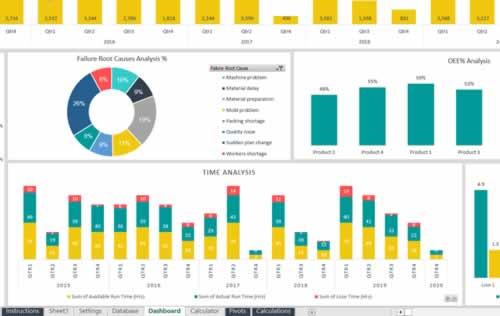
Settings: This sheet serves as the hub for configuring database operations related to "Product Details," "Operating Lines," "Operating Shifts," and "Root Causes of Failures."
Database: [read more]
The Manufacturing Startup Feasibility Model Excel Template is made for business owners who are engaged in the manufacturing business and want to know their future projections. There is a huge potential for manufacturers to grow in the future and earn reasonable profits. Hence one must plan [read more]
 Glass quality is not a single variable. It includes optical transmission, dimensional accuracy, surface integrity, mechanical strength, and the consistency with which those properties hold across a production run. Improving quality in any serious sense requires understanding which property is limiting performance in a given application, what in the process is responsible for that limitation, and what changes to materials, equipment, or process parameters would address it. Most quality failures in glass manufacturing trace to one of a small number of root causes, and recognizing them early changes the cost equation quite a bit.