 Compliance training protects employees, customers, revenue, and daily operations. It gives staff clear guidance on privacy, safety, conduct, reporting, and recordkeeping before pressure rises. Many organizations still treat it as an annual checkbox, which leaves avoidable risk in everyday decisions. A stronger program makes correct action easier at the point of work, where mistakes carry legal, financial, and human consequences.
Risk Starts Early
Risk rarely begins with one dramatic failure. It often starts with missed updates, vague ownership, or weak records. Teams assessing the best compliance training software usually need accurate course tracking, certificate storage, policy version control, and audit reports that help regulated departments show completion without chasing spreadsheets during reviews.
Costs Add Up
Penalties are only the visible part of a compliance failure. Legal review, contract delays, lost accounts, and higher insurance premiums often follow. Internal strain can be just as costly. Managers pause normal work to investigate incidents, correct files, or retrain teams under pressure. Practical instruction lowers that exposure by helping employees recognize warning signs before small errors spread.
Trust Needs Proof
Trust depends on evidence. Customers, partners, auditors, and board members may ask who completed training, which policy applied, and when records changed. A business that can answer quickly appears disciplined and prepared. Clear documentation also protects employees, since decisions can be reviewed against known guidance. Proof turns good intent into a defensible operating practice.
Employees Need Clarity
Policies can be accurate and still fail at the desk, counter, clinic, warehouse, or sales call. People need examples that match their tasks. Finance staff, field teams, managers, and new hires face different risks. Role-based lessons reduce hesitation and help employees choose the right next step. Clear reporting paths also make concerns easier to raise before harm grows.
Culture Sets Standards
Culture is shaped by what leaders tolerate. Employees notice skipped courses, ignored findings, and rushed approvals. A serious program applies one standard across seniority, location, and function. Managers should discuss expectations during team meetings, performance reviews, and incident follow-ups. Fair enforcement matters because staff are more likely to report concerns when rules feel consistent, visible, and real.
Data Guides Action
Training records can show where exposure is increasing. Missed deadlines, repeated quiz errors, and overdue certificates point to process weakness. Leaders can use those patterns to revise lessons, coach supervisors, or adjust staffing. Data also improves budget decisions. Investment should focus on areas with higher regulatory pressure, sensitive information, physical hazards, or frequent operational errors.
Better Reports
Useful reports should be current, readable, and ready for review. Completion rates, overdue learners, assessment results, and high-risk groups need to be visible at a glance. Managers can act earlier when dashboards show gaps before audit dates arrive. Exportable records also reduce stress when outside reviewers request evidence.
Remote Work Raises Stakes
Distributed teams may miss policy changes, local requirements, or informal coaching that office staff receive. Compliance training creates a shared baseline across home offices, branches, and field locations. Mobile access helps employees complete lessons without waiting for classroom time. Consistent delivery also limits regional gaps, especially when teams handle personal data, payments, equipment, or customer complaints.
Regulations Keep Moving
Rules affecting privacy, safety, hiring, finance, and industry conduct change often enough to strain manual updates. Organizations need a reliable method for reaching staff without long delays. Short modules work well because they explain one change at a time. Version history matters too. Employees should know which instruction replaced older guidance and when that revision took effect.
Faster Updates
Brief lessons help teams absorb a single rule, process change, or reporting step. That narrow format is easier to release and easier to complete. It also supports retention, since employees are not asked to sort through unrelated material during a time-sensitive update.
Onboarding Must Include It
New hires build habits quickly. Compliance training should begin before they handle customer information, payments, equipment, medical details, or confidential records. Early instruction sets expectations for privacy, conduct, safety, security, and reporting. Managers should confirm completion before assigning higher-risk duties. That first checkpoint protects the organization while giving employees a clear, steady start.
Accountability Requires Ownership
Human resources, legal, operations, information security, and department leaders may all contribute. Shared work still needs one accountable owner. That group should manage content, deadlines, evidence, and follow-up. Managers should support completion and coach local behavior. Executives need regular reviews because compliance performance belongs in the same conversation as quality, revenue, safety, and customer trust.
Conclusion
Compliance training deserves priority because it prevents harm before incidents become expensive. It supports safer choices, cleaner audits, a stronger culture, and greater customer confidence. Effective programs are practical, current, measurable, and tied to real duties. Leaders should treat training as part of disciplined operations, not paperwork. When employees know the right action and records confirm follow-through, the organization becomes easier to trust.
Do You Want to Implement Business Best Practices?
You can download in-depth presentations on Compliance and 100s of management topics from the FlevyPro Library. FlevyPro is trusted and utilized by 1000s of management consultants and corporate executives.
For even more best practices available on Flevy, have a look at our top 100 lists:
These best practices are of the same as those leveraged by top-tier management consulting firms, like McKinsey, BCG, Bain, and Accenture. Improve the growth and efficiency of your organization by utilizing these best practice frameworks, templates, and tools. Most were developed by seasoned executives and consultants with over 20+ years of experience.
Readers of This Article Are Interested in These Resources
Excel workbook
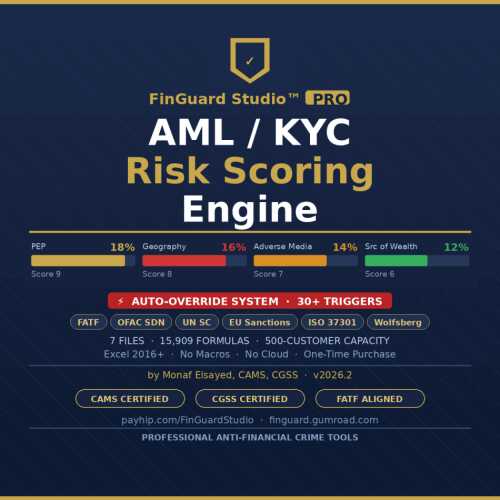
FinGuard Studio Pro is a professional-grade Excel-based AML/KYC customer risk scoring and onboarding logic engine built for compliance officers, MLROs, and AML analysts. Developed by a certified AML/KYC professional (CAMS, CGSS), every formula, weight, and trigger cites a regulatory source --
[read more]
160-page PDF document
The Only Complete Compliance and Risk Leadership System with Ready-to-Deploy Operational Tools
The Compliance leaders face unprecedented challenges: heightened organizations scrutiny, complex regulatory frameworks, resource constraints, and constant pressure to demonstrate accountability while
[read more]
10-page Word document
Curated by McKinsey-trained Executives
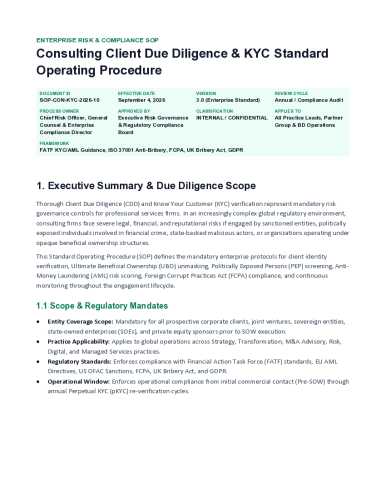
🚨 CONSULTING CLIENT DUE DILIGENCE & KYC STANDARD OPERATING PROCEDURE -- THE ENTERPRISE CLIENT RISK & COMPLIANCE STANDARD
⚡ STOP TREATING CLIENT DUE DILIGENCE LIKE A FORM-FILLING EXERCISE.
A consulting firm can win a major engagement, negotiate the
[read more]

74-slide PowerPoint presentation
ISO 37301:2021 is an international standard designed and formulated to help organizations implement a robust Compliance Management System (CMS).
The standard specifies requirements and provides guidelines for establishing, developing, implementing, evaluating, maintaining and improving an
[read more]