 Your investing app is good at one job. You pick a portfolio and money goes in from salary, bonuses or vested equity, and it ticks along without you thinking about it much. For a long stretch, that’s all you need.
Then something in your career or your life changes, and the app goes quiet on the question you actually have. That’s not a knock on the app. It manages a portfolio. It was never built to tell you whether to salary sacrifice into super, whether to throw the money at your mortgage, how to split a lump sum from an exit or vesting event, or what your plan should look like when one income drops to zero for a year. Those are the moments a real person, sitting across the table from you, starts to earn their keep.
None of what follows is personal advice, by the way. It’s a rough map of when the app has taken you as far as it can.
So When’s It Worth Paying Someone?
Not for everyday investing. If your situation is a salary plus bonuses, a mortgage or rent, some super and a bit invested on the side, you can run that yourself and the app is fine. The trigger is how many things are moving at once, and how expensive the wrong call would be. The size of your balance has little to do with it.
Here are the ones that usually tip execs over.
You’re Buying or Upgrading Property
This is where DIY starts to strain, because the money questions stop being about returns.
How much of your deposit should sit in growth assets versus cash when you’re buying in eighteen months? Does the First Home Super Saver Scheme actually help you, and how much can you pull back out? Should you keep renting and invest the difference, or is that just a story you’re telling yourself? An app won’t weigh those against your income, your equity position, and your timeline. A person will.
Your Household Cash Flow Is Changing
A child, a partner stepping back, or a relocation for a role changes your cash flow, your insurance needs, your appetite for risk and what you can afford to contribute, all at once.
Suddenly there’s a real reason to hold life and income protection cover, and a real cost to getting it wrong. One partner might step back from work, which reshapes what you can contribute and where. This is the point where people either overinsure through their super fund’s default cover or carry nothing at all, and both are worth a proper look.
A Lump sum Lands in Your Lap
Inheritance, a redundancy payout, whatever it is. A sudden chunk of money is where good intentions quietly go sideways.
The instinct is to do something with it fast. The better move is usually to sit on your hands while you work out the tax, whether it clears debt, how much belongs in super versus outside it, and what it does to the longer plan. This is one of the clearest cases for advice, and it’s exactly the kind of thing advisers see week in, week out.
Retirement Is Close Enough to See
Somewhere in your fifties the maths turns over. You stop asking how to grow the balance and start asking how to make it last thirty years without running out.
That’s messy. Transition-to-retirement, when exactly you knock off work, the way super and the Age Pension interact, drawing an income without bleeding the balance dry. Rules-heavy stuff, and the rules shift most Budgets. Get it wrong at 58 and you’ve got a lot less runway to fix it than you did at 38.
Your Income or Your Net Worth Climbs
At some point the tax and structuring questions get properly fiddly.
You start bumping the concessional contributions cap. You’re reading about carry-forward contributions at 11pm. You wonder whether a family trust is worth the accountant’s bill, and whether Division 293 now applies to you. Cash you invest in your own name cops your marginal rate, and once you’re in the top bracket that’s a serious amount to hand the ATO when there were tidier options going.
So How Do You Actually Pick Someone?
This is usually the point to get personal financial advice, ideally from an independent, fee-for-service adviser whose recommendations aren’t tied to selling you a particular fund or product. Firms structured this way charge for the advice itself rather than earning commissions on the products they put you in, which keeps the incentives on your side. Solace Financial, a Brisbane firm that holds its own Australian Financial Services Licence (number 509493), works this way: a fixed upfront fee for your plan, quoted before any work begins, then a percentage-based ongoing fee for reviews and management. Its advisers are the owners of the practice, so the people giving the advice are the same people accountable for how it turns out.
Whoever you talk to, ask what it costs before you agree to anything. Ask how they get paid, and who pays them. You want a straight number, not a shrug.
And don’t bin the app. Advice and doing-it-yourself aren’t enemies. Loads of executives run their own portfolio for years, then bring in an adviser when something big lands and go back to managing it themselves once the plan is sorted. The app got you into the habit. Working out when it’s out of its depth is just you getting better at the same thing.
Do You Want to Implement Business Best Practices?
You can download in-depth presentations on Financial Management and 100s of management topics from the FlevyPro Library. FlevyPro is trusted and utilized by 1000s of management consultants and corporate executives.
For even more best practices available on Flevy, have a look at our top 100 lists:
These best practices are of the same as those leveraged by top-tier management consulting firms, like McKinsey, BCG, Bain, and Accenture. Improve the growth and efficiency of your organization by utilizing these best practice frameworks, templates, and tools. Most were developed by seasoned executives and consultants with over 20+ years of experience.
Readers of This Article Are Interested in These Resources

Excel workbook
Curated by McKinsey-trained Executives
🚀 100+ Corporate Finance SOPs Excel Template -- The Ultimate Finance Operations System for CFOs, Controllers & Finance Teams
Transform your finance department into a high-performance, audit-ready, and automation-driven powerhouse with the 100+
[read more]

Excel workbook
Curated by McKinsey-trained Executives
Unlock the Ultimate CFO SOPs Package: 100+ Standard Operating Procedures for Financial Mastery
Are you a Chief Financial Officer striving for operational excellence, regulatory compliance, and strategic financial control? Our 100+ CFO SOPs Package is the
[read more]

Excel workbook
Curated by McKinsey-trained Executives
🚨 100+ FINOPS SOPs EXCEL LIBRARY 🚨
🔥 THE MOST COMPLETE CLOUD FINANCIAL MANAGEMENT OPERATING SYSTEM EVER BUILT 🔥
💣 WHY FINOPS FAILS IN REAL ORGANIZATIONS
Let's drop the corporate theater:
❌ Cloud costs spiral without
[read more]
22-slide PowerPoint presentation
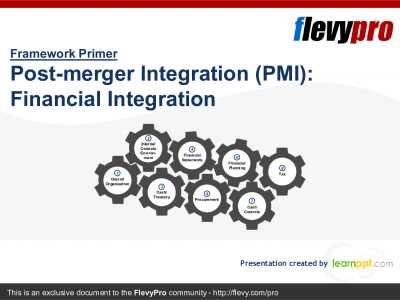
Post-merger Integration (PMI) is a highly complex process. It requires swift action as well as running the core business activities simultaneously. There is no one-size fits all approach to a successful PMI Process. However, careful planning focusing on the strategic objectives of the deal and the
[read more]