Editor's Note: Take a look at our featured best practice, HR Strategy: Job Leveling (26-slide PowerPoint presentation). Job Leveling is a disciplined approach to gauge the value of work for individual positions across the organization. It entails ascertaining the nature of work done by each position, authority levels, and the effect of each job on business results.
Jobs that are configured inadequately bread [read more]
* * * *
Leadership skills are the most important attribute for someone starting out in an entry-level career or seeking to advance the job ladder. Competent and able leadership is at the core of every successful business.
Employee engagement refers to the level of emotional commitment, enthusiasm, and dedication that employees show towards their work and their organization. Engaged employees are typically more motivated, productive, and satisfied with their jobs. They are willing to go the extra mile, contribute their best efforts, and actively participate in achieving organizational objectives.
By prioritizing employee engagement, leaders are able to attract and retain top talent, enhance productivity, and drive organizational growth. Employee Engagement warrants an in-depth interpretation of the workforce’s psychology and behaviors before anticipating the desired involvement from them.
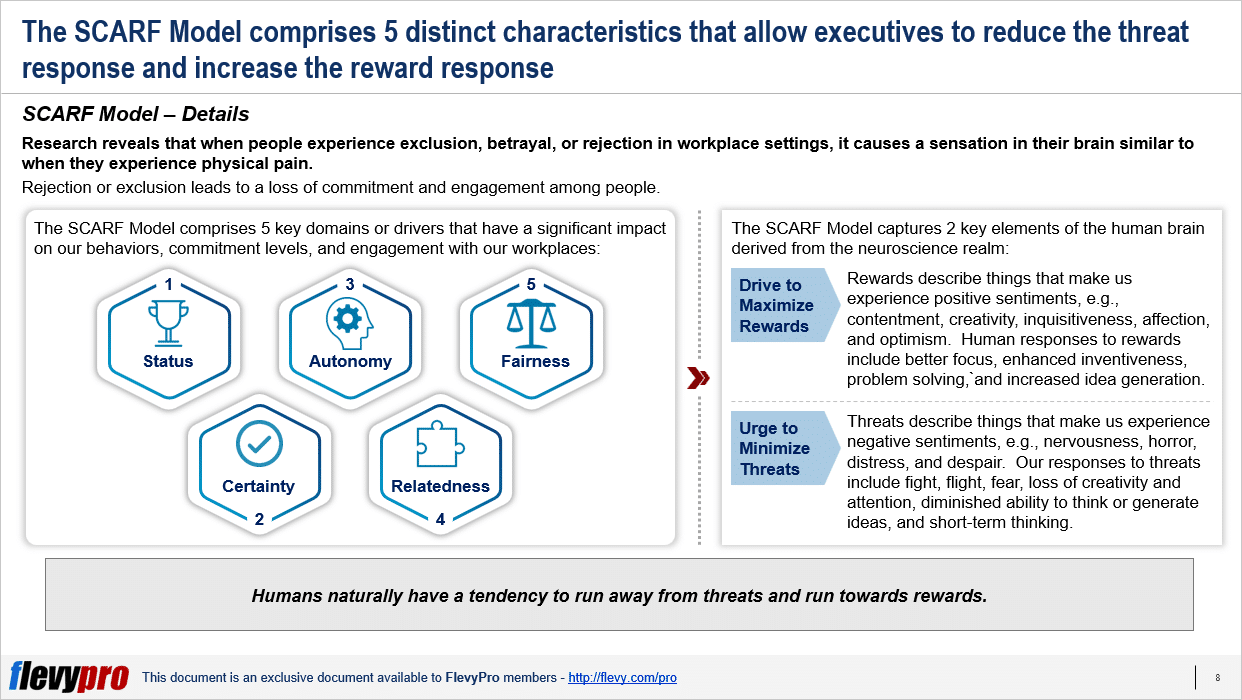
This is where the SCARF Model focuses. Developed by neuroscientist David Rock in 2008, the SCARF Model helps businesses apply empirical research to managing the workplace and teams and identify the environment required to make employees feel engaged.
The model comprises 5 key drivers that have a significant impact on our behaviors, commitment, and engagement levels:
Status
Certainty
Autonomy
Relatedness
Fairness
The SCARF Model captures 2 key elements of the human brain derived from the neuroscience realm: Rewards and Threats. Rewards describe things that make us experience positive sentiments, e.g., creativity, affection, or optimism. Human responses to rewards include better focus, problem solving, and increased idea generation.
Threats, on the other hand, make us experience negative sentiments, e.g., nervousness, fear, or distress. Our responses to threats include fight, flight, fear, or a diminished ability to think or generate ideas.
Let’s now discuss the drivers of the SCARF Model in detail.
Status
Our ranking compared to others defines our status in the organization. We have a natural inclination to value status. Our brain’s reward and threat pathways are greatly influenced by any changes in our status. According to research, people’s threat response activates and releases stress hormones when they consider a decline in their status. Conversely, when our status increases, our Dopamine levels go up, which in turn improves our mood.
Therefore, status has a direct impact on an employee’s general wellbeing. Implementing a carefully designed, participatory performance evaluation, recognizing employees, and praising them in front of others helps them feel less threatened and preserve their status.
Certainty
Being in the dark about what will happen next is devastating for people, as it uses up extra brain resources. Our brain is hardwired to begin to overwork itself when we are uncertain about something, since it tries to make sense of the unfamiliar. Uncertainty makes us feel intimidated, distracted, disengaged, and act unusually.
Leadership is all about helping people achieve their goals in the face of uncertainty and training them on how to stop feeling threatened in uncertain conditions. The breakdown of tasks into small, manageable parts assists employees in feeling certain about a job. Open communication with employees, clear expectations, agendas, guidelines, roles, and timelines foster confidence in people.
Autonomy
One of the main psychological drivers of human behavior is the desire for autonomy. Autonomy is the sensation of having complete freedom to decide how one behaves or performs. When individuals’ autonomy or control is threatened, they immediately become anxious and unmotivated. This hinders their ability to think and act rationally. A sense of increased autonomy, conversely, raises feelings of assurance and lowers stress.
To counter this, leaders and managers need to stop micromanaging people and give them more autonomy and authority. They should allow workers to manage their own schedules, trust their judgment, and experiment with new ideas.
You can download in-depth presentations on this and hundreds of similar business frameworks from the FlevyPro Library. FlevyPro is trusted and utilized by 1000s of management consultants and corporate executives.
For even more best practices available on Flevy, have a look at our top 100 lists:
Improving Employee Engagement is a priority in most Talent and HR Strategies. This presentation provides a 5-step approach to building a culture of Employee Engagement. This processed was developed by Aon Hewitt based on the Aon Hewitt Top Companies for Leaders study.
Best practices from the [read more]
Readers of This Article Are Interested in These Resources
This guide is a basic introduction to performance management, the process, setting objectives, providing feedback, the performance discussion between manager and employee. It is geared to small and mid-sized companies who want to provide a process that is clear and easy to use for managers.
This [read more]
The approaching Age of Automation, together with the impending penetration of digital technology into the labor force, threatens to destabilize crucial aspects of how employees work by. It undermines the stability companies depend on to be agile.
Executives can re-solidify their companies even [read more]
The Employee Training Tracker is a professionally designed Excel spreadsheet tailored to help organizations manage and monitor employee training programs with ease. This all-in-one tool not only keeps a record of individual and departmental training activities but also allows for efficient tracking [read more]
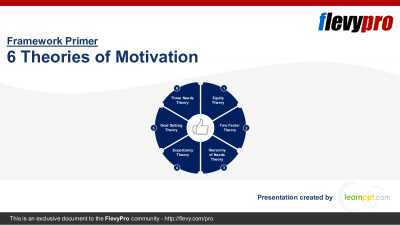
Interpreting the human psyche is a difficult undertaking. Determining what encourages and drives people to achieve their objectives isn't easy to figure out for Leaders and Human Capital experts. This is where research and insights gathered from the various Theories of Motivation comes to play. [read more]