Editor's Note: Take a look at our featured best practice, Organization Culture Assessment Questionnaire (8-page Word document). Each organization has its own culture -- the beliefs and norms of behavior that guide individual actions and decisions. These define what is expected from the members of the organization in order to "fit in."
To under your organization's corporate culture, we can leverage an organizational [read more]
* * * *
Cultural differences can be a barrier to communication. This could affect our organization’s ability to build connections and motivate people. While we may be excited with the opportunities that global connectedness has brought forth, yet we are cautious of making cross-cultural faux pas.
When faced with cultural differences, we need to understand the cultural dimensions of our company to be able to strategize our collaborative approach. When this happens, we get to break down the barriers that are holding us back from effectively communicating with each other and achieving organizational growth.
The 6 Dimensions of National Cultures
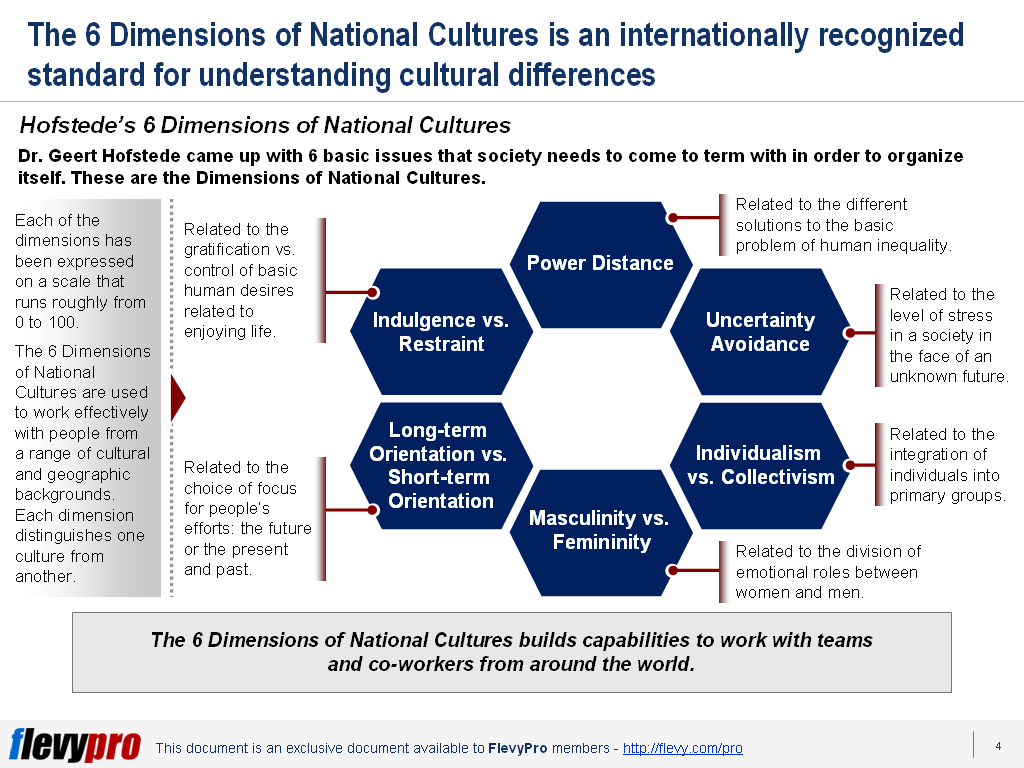
Dr. Geer Hofstede came up with 6 basic issues that society and even organizations need to come to terms with in order to organize itself. These are the 6 Dimensions of National Cultures.
The 6 Dimensions of National Cultures are used to work effectively with people from a range of cultural and geographic backgrounds. Each dimension distinguishes one culture from another. Having an understanding of these dimensions will also allow us to better under the intrinsic Corporate Cultures of organizations from other parts of the world.
Power Distance
Power Distance is the extent to which the less powerful members of organizations and institutions accept and expect that power is distributed unequally. Power Distance may be differentiated into Small Power Distance Index or Large Power Distance Index. When the hierarchy is clearly established and society accepts an unequal, hierarchical distribution of power, this is Small Power Distance Index. The reverse of this is the Large Power Distance Index.
Uncertainty Avoidance
Uncertainty Avoidance is the degree of society’s tolerance for ambiguity, in which people embrace or avert an event of something unexpected, unknown, or away from the status quo. Strong Uncertainty Avoidance exists when stiff codes of behavior, guidelines, and laws are preferred. If society is more accepting of differing thoughts or ideas and fewer regulations are imposed, a Weak Uncertainty Avoidance exists.
Individualism vs. Collectivism
Individualism vs. Collectivism is the degree to which people in a society are integrated into groups. There is Individualism when “I” is more emphasized than “We.” Collectivism is more on in-groups laced with undoubted loyalty and support for each other when conflict arises with another in-group.
Masculinity vs. Femininity
Masculinity is society’s preference for achievement, heroism, assertiveness, and material rewards for success. Femininity is a preference for cooperation, modesty, caring for the weak, and quality of life.
Long-term Orientation vs. Short-term Orientation
Long-term Orientation vs. Short-term Orientation associates the connection of the past with the current and future actions/challenges. There is Long-term Orientation when adaptation and circumstantial, pragmatic problem solving is viewed as a necessity. When traditions are honored and kept, this is Short-term Orientation.
Indulgence vs. Restraint
Indulgence vs. Restraint is essentially a measure of happiness; whether or not simple joys are fulfilled. A society is in a state of Indulgence when it allows relatively free gratification of basic and natural human desires related to enjoying life and having fun. They believe that they are in control of their own life and emotions. Restraint is when society controls the gratifications of needs and regulates it by means of strict social norms.
Understanding the 6 Dimensions of National Cultures and Its Approaches
Having a good understanding of the 6 Dimensions of National Cultures allows organizations to better manage changes not only from within but most importantly, changes in our external environment. Cultural differences exist between and among countries that we need to know, understand, and learn how to manage well. In the global world of business where we now need to cross boundaries and forge synergy, understanding the 6 Dimensions of National Cultures and Its Approaches has become a competitive strength.
In today's rapidly evolving business landscape, an Organizational Culture Assessment is an indispensable tool for visionary leaders. It offers a strategic lens to decode the complex tapestry of workplace dynamics, unveiling not only the vivid patterns of strengths but also the subtle undercurrents [read more]
Do You Want to Implement Business Best Practices?
You can download in-depth presentations on Corporate Culture and 100s of management topics from the FlevyPro Library. FlevyPro is trusted and utilized by 1000s of management consultants and corporate executives.
For even more best practices available on Flevy, have a look at our top 100 lists:
These best practices are of the same as those leveraged by top-tier management consulting firms, like McKinsey, BCG, Bain, and Accenture. Improve the growth and efficiency of your organization by utilizing these best practice frameworks, templates, and tools. Most were developed by seasoned executives and consultants with over 20+ years of experience.
Readers of This Article Are Interested in These Resources
Improving Employee Engagement is a priority in most Talent and HR Strategies. This presentation provides a 5-step approach to building a culture of Employee Engagement. This processed was developed by Aon Hewitt based on the Aon Hewitt Top Companies for Leaders study.
Best practices from the [read more]
Innovation is actually easy--when the corporate culture is supporting it. Unfortunately today many companies show "excellent" practise killing the innovative spirit. In this new in-depth article Dirk Loop explores the opportunities every employee--not just executives and innovation managers--has to [read more]
A company's cultural situation is challenging, multidimensional, and difficult to deal with. It constitutes a powerful set of emotional resources. To a degree, Culture can be compared to natural forces such as winds and tides. These elements are there in the background, sometimes unnoticed, [read more]
The use of Internet and other online tools have turned consumers to be more empowered and are now shopping differently. Customers are becoming more demanding and accustomed to getting what they want. With greater access to reviews and online rating, customers are better equipped to switch to new [read more]
 connections and motivate people. While we may be excited with the opportunities that global connectedness has brought forth, yet we are cautious of making cross-cultural faux pas.